

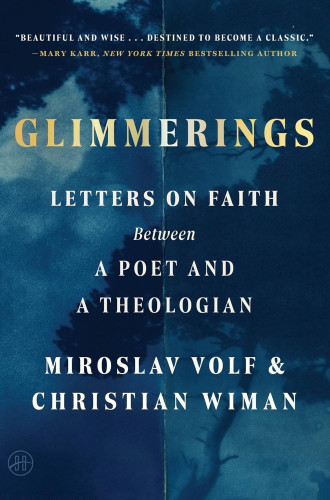
Glimmerings
Letters on Faith Between a Poet and a Theologian
Epistolary correspondence has a long history in Christianity: a goodly chunk of the New Testament itself but also the letters of Abelard and Heloise, the spiritual friendship of Francis de Sales and Jane de Chantal, Bonhoeffer writing from prison to Eberhard Bethge. Glimmerings collects emails that poet Christian Wiman and theologian Miroslav Volf, colleagues at Yale Divinity School, exchanged in 2023 and 2024. These are ruminations on Christian faith—on how faith presents itself to Wiman and Volf and what they can say to each other about it. Wiman appears “appetitive” and “restless” (his words) and possessed of the mystic’s strange relationship to agency (“Sometimes I find myself having fallen into atheism”). For his part, Volf writes early on that, in contrast to his friend, “I am less reaching for God than recognizing, at times, that God is holding me.”
I’ve read more of Wiman than I have of Volf, and I find myself alternately wowed by, irritated by, and made neurotically insecure by the spiritual self Wiman fashions on the page. Sometimes his writing arrives at a declaration so unguarded: “I expect you know exactly what it means to love God,” he tells Volf. “And I expect I do, too. And I expect it doesn’t mean the same thing to either of us, and that neither of us is ultimately able to put it into words. But we know it.” After distinguishing this love from his love for his wife and for poetry, Wiman comes, simply and straightforwardly, to the solitary self called to love God: “I bow my head and I do it.” I read this and I wonder whether, underneath all my distraction and duty, there is a love more certain than my ability to describe it. (Also, the same paragraph contains a sentence I’d be happy to have if I could have only one sentence about prayer: “That’s the entire reason I pray, because I love God and want to be with him.”)
Perhaps because Wiman can write with such directness, I become impatient when he retreats into aphoristic irresolution. He likes to assert something provocative, supply its opposite, and then suspend us in the tension. Consider: “God doesn’t exist until I turn my attention to him.” This is a startling (and false) metaphysical claim, which Wiman almost immediately pulls in: “Relation brings him into being, or, more accurately, enables his being to be perceived, experienced, shared.” From bracing, then, to something quite conventional. Which is to say, Wiman gets the voltage of the first claim without quite having to reckon its consequence. Or again: “God is dead. God is our salvation. God is a noun. God is a verb.” Every claim is immediately counterpoised, and the elegance of the antitheses supplies the profundity.
I do not need the poet to become a systematic theologian. But I flinch at the way contradiction can become a kind of insulation. Each avowal arrives with its own hedge. Or, as Wiman himself puts it, “Every statement about God is provisional.” He then adds, inevitably, “(including this one).” Thinking through antitheses has a long pedigree. But Pascal’s and Kierkegaard’s dialectics clarify the excessiveness of the claims they take to be essential. My fear is that Wiman’s dialectics sometimes exactly avoid grasping the nettle.
I suspect my ambivalence about Wiman’s prose persona has in part to do with his ambivalence about the church. While Volf is ecclesially moored (the Book of Common Prayer, he writes, “returns me to myself by taking me to Christ”), Wiman casts himself as longing for a church that is too poor to supply his wants. “I have such a hunger for church—no, for shared prayer and praise—but have given up on having it fed,” he writes. Church makes him crawl out of his skin; Episcopalianism strikes him as “chilly, and wealthy, and white”; in Episcopal worship he is “bored, anxious,” trying to reconcile its “cosmic lassitude” with the “fire in [his] heart,” and he usually leaves before the service ends.
I recognize nearly every part of this indictment, and still I find myself wanting Wiman to remain in the pew. Not because going to church would calm his struggles but because the church is meant for such struggles. Neither the Book of Common Prayer nor, say, Baptist preaching is merely beautiful; these—and coffee hour, and the Sunday school class for men, not to mention the Eucharist—are the forms God has given Christians for contending with God and one another.
But perhaps I am wrong to wish for Wiman’s churchgoing. Perhaps I want people to find beautiful the exact same things I find beautiful. Perhaps I resent people who seem able to take what they need from the deposit of the church without submitting to her inconveniences; perhaps I want to conscript Wiman into my ecclesiology more than I want to understand his faith. Still, I want him to remain in the pew.
The church is, among other things, the place where Christian language ceases to be the preserve of the person speaking it. One of the book’s most rewarding themes is language itself, Volf and Wiman’s version of a very old question: How does language speak faith? How do creatures of words—all of us, but perhaps especially these two—live their faith through the finitudes of language? This theme is announced at the start: Wiman’s first letter to his friend begins with the failure of what he describes as Christianity’s “big words”—faith, grace, sin, redemption. They demand “whole-souled attention,” but “they seethe and shift and slip free from meaning.” Volf replies, “For me, big and semantically unstable Christian words mostly became ‘good and broad land,’ hospitable spaces in which I could live without pressure.”
Volf has the task of suggesting that while of course old Christian language, even trite Christian language, fails, it may yet still be inhabited by the Word. “Do not saintly lives help words that fail as language succeed as communication?” He speaks about the Pentecostalism from which he came. As a teenager, he found speaking in tongues irrational and maddening. Now, though, he sees that “those who speak about God always speak in tongues, not quite understanding what we are saying.” So on the one hand he is saying much what Wiman is saying about the inadequacies of human speech. But Volf emphasizes more the necessity, and reliable possibility, of divine initiative: “God must come into religious language for it to actually speak, for it to become about God and to become God’s speech.”
In trying to reckon with my own ambivalence, I have perhaps implied that the irresolutions of Wiman, the poet, supply the book’s drama while Volf plays the confident theologian who is somehow always responding to, or maybe even tutoring, his friend. That isn’t quite right. Volf has his own disquiets. Often when he prays, the words “dissipate into airy nothingness.” He hopes a colleague “will succeed in showing that the slaughter bench of history and God’s goodness are somehow compatible.” He recognizes that he doesn’t “love and trust the bare goodness of God” in the way that would make him “free no matter what happened in my life.” He notes that he has never “leapt and danced out of love for God.” Wiman’s struggles are found, as he puts it early on, in the difficulty of making “a life out of” the moments when “my own faith seems to be answered—or, maybe more accurately, fulfilled, a moment of being so replete and consummate that the word ‘faith’ just falls away.” Volf’s wrestlings seem more to reside at the level of, to use an old-fashioned phrase, religious affections.
To their pursuit of language about language Wiman brings George Herbert’s “A True Hymne”: The heart offers its sincere but inadequate “O, could I love!” and God “supplie[s] the want” by answering, “Loved.” But Volf resists even this accommodation, since it leaves God arriving only at the end to perfect a human effort—one that grace must already have enabled at its beginning and sustained through its middle.
The letters themselves offer a different response to these two men’s exchanges about language, for a letter already presumes language’s limitations. To write a letter and send it is to recognize that someone else might take a look at your language and enlarge it, or challenge it, or hear in it something you did not hear. So a correspondence about faith, whether Abelard and Heloise’s or Wiman and Volf’s, is a means by which two people participate in making each other’s Christian selves. And in a correspondence, Christian language becomes—perhaps Volf and Wiman could both assent to this description—a shared failure that may yet be inhabited by the Word.
“I love how disagreeing with you feels like disagreeing with myself,” Volf writes, borrowing Augustine, “free of any envy and malice.” His friend has become internal to his own self’s thinking, and disagreement with his friend has become a form of self-scrutiny practiced with more charity than he might have brought to himself on his own. In these letters, faith is not something either man possesses and reports. It is something that gets remade through exchange.
Reading Glimmerings left me wanting a correspondent.