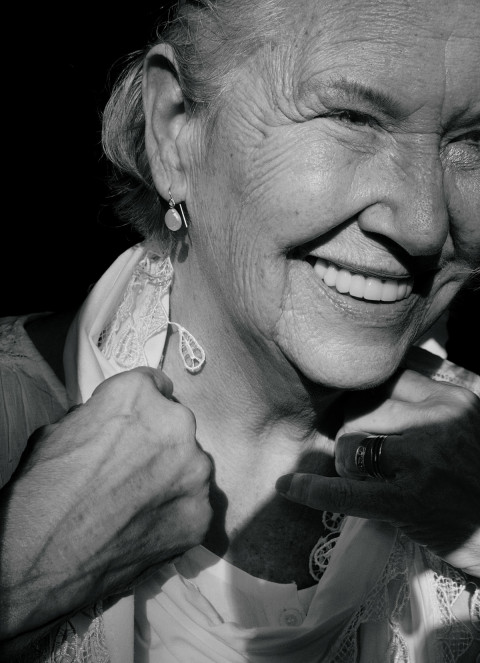
Annie Dillard died on September 15 at the all-too-young age of 81. We weren’t ready. Her poetry, her fiction, and especially her essays reinvented and extended American literature for a new era in a voice so refreshing, it doesn’t matter that some of her most influential work was published more than 50 years ago. The human predicament and the fundamental puzzle of the natural world remained her subjects, and she was always seeing with new eyes. She won the Pulitzer Prize for Pilgrim at Tinker Creek in 1975 and was awarded a National Humanities Medal in 2015. But none of this says what she meant to us. She was visionary, prophet, and mystic, and there are no national prizes in those arenas.
I read the first Dillard essay that seared me almost 35 years ago. I was living in Estonia, in the first true solitude of my life, and I picked up Pilgrim at Tinker Creek from the American Library in Tallinn. I read “Seeing,” and I never saw the same afterward. Visible to me for the first time was the old woman selling three wrinkly apples at a table next to the train station. Why did she have only three? Should I buy all three and let her go home on that bitter January day? (When I did, three more apples appeared on the table.) All kinds of everyday objects and people suddenly had new meaning. Life took on a dimension it hadn’t before.
That essay announced, in essence, my vocation: paying attention. I don’t think I am alone in having Dillard call me to attention, demand that I align my love properly in the world, and never give up that pursuit. In “Seeing,” she writes, “If you cultivate a healthy poverty and simplicity, so that finding a penny will literally make your day, then, since the world is in fact planted in pennies, you have with your poverty bought a lifetime of days.”
What has struck me again and again about Dillard’s work is her utter, defenseless exuberance on behalf of the world. Her work contains an unrestrained hallelujah at a time when a defensive—even cynical—tone is more acceptable and celebrated. She celebrates the weasel, a strange clown painting in a motel room, a church service gone amok, a man trying to teach a stone to talk, the awesome fear that overtakes a crowd at a viewing of the total eclipse. On and on.
On the edge of this celebration is a practical and embodied mysticism. Holy the Firm (1977) begins, “Every day is a god, each day is a god, and holiness holds forth in time. I worship each god, I praise each day splintered down, splintered down and wrapped in time like a husk, a husk of many colors spreading, at dawn fast over the mountains split.” She tries to see into the world, beyond its physical manifestations into a deeper strangeness, one where she encounters silence.
Or, to put it another way, it’s as if she is standing in a doorway between two worlds, trying to see both with equal clarity. In one world there are finches and turtles, sycamores and caddisflies. But in the other there is a silence, deep and mysterious, where there are no words. Her essay “A Field of Silence,” in Teaching A Stone to Talk (1982), draws us into a weird and enigmatic moment from her past, to a place where she is certain that she encountered angels. In that moment, “something had unhinged the world. The houses and roadsides and pastures were buckling under the silence.”
Throughout the essay, Dillard struggles to find the words to convey what she experienced. The closest words she can find are, “There are angels in those fields.” The word angels shocks her, even as she speaks it. It feels as if we are watching the great Annie Dillard fail in language in real time as we read. Maybe that gap itself—between experience and the ability of words to capture it—is the space where angels dwell.
A few years ago, when I was on staff at the CENTURY, we asked Dillard to contribute to the How My Mind Has Changed essay series, which the magazine introduced in 1939 and returns to every decade or so. She declined to participate—in an email that itself amounted to a mini-essay. There was little evidence that she intended it for publication. It felt as if she couldn’t resist reflecting on the question, however, so we asked if we could publish her response in full, and she agreed.
“I identify as a Christian,” she wrote:
Many Christians would disagree that I can use the term honestly.
I can’t and don’t give intellectual assent to many very established and agreed-upon Christian dogmas, if not most of them, if not all of them.
That Jesus of Nazareth is “the only begotten son of God, begotten not made, God of God, light of light, true God of true God” is something I always enjoy saying. But I wouldn’t bet the farm on it. I wouldn’t render it to Caesar. These are spiritual matters. Their language merely resembles ours. They need not make sense in worldly terms. . . .
I know only one thing for certain: there is holiness. Standing there, a person can sing myriad songs.
And she did. I will miss her voice.