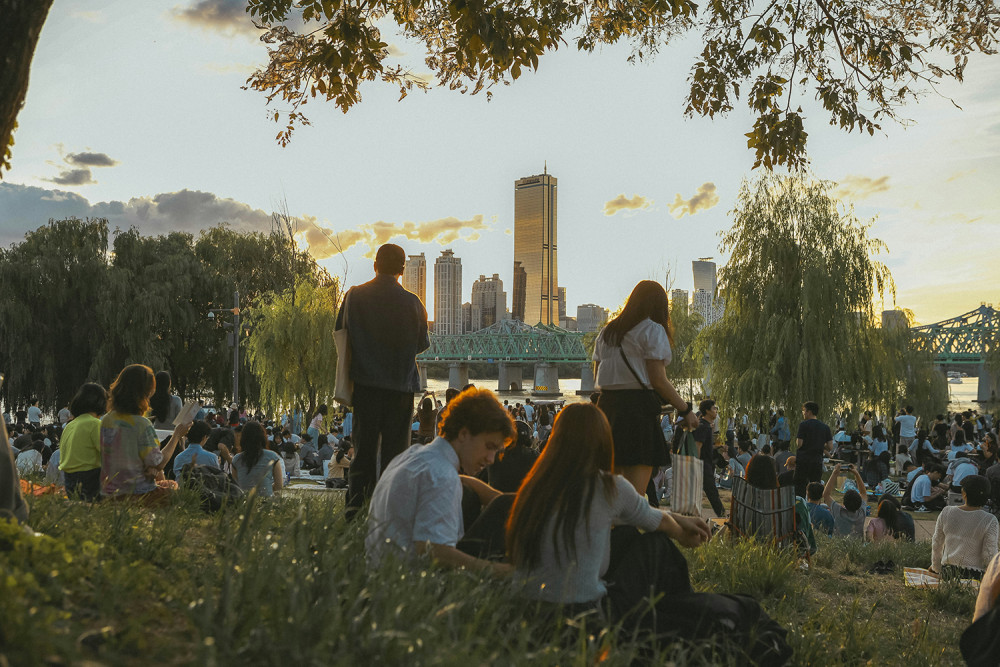
It is my last night in Seoul, and that may be why I am so keenly attuned to the goodbyes all around me, but everyone seems to be bidding farewell. A loud group of ahjummas and ahjussis yell at each other in the middle of the street, several of them visibly tipsy. “See you soon! Watch out!” It’s a protracted ritual, they don’t seem to want to part, and the fact that they are shouting in the middle of the street adds to the comic drama.
Halfway down the block, two women in front of me are holding hands as they walk. They embrace, and one rides away on a bike, waving as she weaves adroitly through the crowd. A crescendo of cicadas provides the soundtrack. It feels like I am in a movie.
Read our latest issue or browse back issues.
Around the corner, I walk past three men bowing. One of them, the obvious junior, holds the door of a taxi open for the two older gents, who give him an approving pat on the shoulder as they enter the backseat. The man on the sidewalk gives one more deep bow as the car drives away.
I am wrapping up my first trip to Korea in decades, and these heartfelt scenes unfolding before me feel like a parting gift. It’s possible my perspective is distorted by the allure of being in a new environment, but I have been struck time and again by the depth of relational intimacy everywhere I go: in parks, in coffee shops and restaurants, and on the streets. I myself have had one warm experience after another in what has been a pilgrimage of food, coffee, and walking the land of my ancestors.
I am technically a foreigner, and it is jarring to hear people from time to time refer to me as such. For the most part, however, I have felt welcome all around, a sense of belonging throughout.
I have thought often during this trip about what Cathy Park Hong calls the “purgatorial status” of Asian Americans, who are “not white enough nor black enough; distrusted by African Americans, ignored by whites.” This liminal positionality can make it hard for Asian Americans to feel they truly belong, even when America is the only home they have known. The contrast in Korea for me is palpable. What is this unfamiliar ease in my body? Is the repose I feel here the result of being out of purgatory?
Late one night in Jeonju, a small city south of Seoul, I am walking back to the hotel when, on a quiet, dark street, I notice a bookstore that is still open. Upon entering, I catch sight of the book Stoner, by John Williams. First published in 1965, the novel sold few copies and quickly went out of print. Although I have been raving to friends about this favorite recent read, it was not a book I expected to see here, much less prominently displayed with effusive blurbs by Korean literary critics. After that encounter, I see the book in every bookstore I visit—in Busan, Seoul, and even Incheon International Airport. Apparently, over the last decade Stoner has been rediscovered and has repeatedly enjoyed bestseller status. To see a beloved book that I believed to be entirely obscure so popular this far from home had my head spinning and my heart strangely full. As odd as it may sound, it kindled a deeper sense of belonging, a feeling that I was among my people.
There’s a Korean word for what I have been describing, a word many say is difficult to translate into English: 薑 (jeong), which depicts affection and attachment, the kind that develops over years of friendship or generations of belonging together. Jeong can also be felt between strangers who share . . . who share what exactly? I do not want to say a cultural or national bond, maybe because of my anxieties about insularism and nationalism, but also because it genuinely feels off the mark. It seems to me jeong takes root where there is recognition of our shared humanity. It can even grow between a native person and a foreigner.
This word and my sojourn through Korea increase my appreciation for the opening of Matthew’s Gospel, with its focus on community. A genealogy, which reads like a random list of names, may not seem like the most stirring introduction to a book for modern readers. But I can imagine the pathos it must have evoked in an audience steeped in Israel’s scriptures, hearing all those names in quick succession. The appearance of four outsiders’ names no doubt added to the sense of unfolding drama: Tamar, Rahab, Ruth, and Bathsheba. The story of a community spanning time and space asserts a transcendent bond and invites readers to consider their own sense of belonging through unexpected bonds.
In fact, valuing our common humanity despite lines of difference is a key theme throughout Matthew’s Gospel. It is, after all, a story that opens with the Magi, representing the nations, coming to pay homage to the Messiah, and ends with the disciples of Jesus going out to the nations. In between, we have a story that rehearses the story of Israel to show a trajectory that moves outward to all the world.
When all is said and done, jeong is not a uniquely Korean expression. Across cultures, languages ache and reach for the articulation of human belonging. Japanese has jō, Chinese has qing, Portuguese has saudade, Spanish has cariño, and Zulu has ubuntu. Even a cursory survey points to the universal human longing for community. Sometimes we have to go halfway across the world to apprehend what abounds anywhere we call home. In the most quotidian ways and in the most unexpected ways, we belong together.