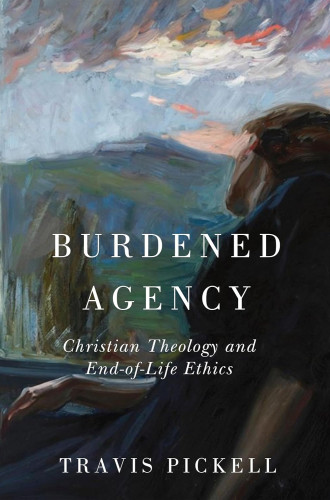
Burdened Agency
Christian Theology and End-of-Life Ethics
Amid much conversation about end-of-life care—its methods, costs, and ethics—there is little sustained attention to the question of why this subject generates so much political and moral controversy. The blame is sometimes placed on advances in medical technologies (such as ventilators and artificial nutrition and hydration) or in treatments (such as kidney dialysis and aggressive chemotherapy). But the reality is more complicated, argues Travis Pickell in Burdened Agency.
Pickell, who teaches theology and ethics at George Fox University, argues that advances in medical treatment and technology are not the sole cause of angst over the end of life. What makes the debates so fraught is the changing cultural conditions in which medical treatments and technologies are employed.
Read our latest issue or browse back issues.
Historically, individuals died when the natural course of their disease progressed enough to end their lives. Because technology now allows medicine to “bring the nature and timing of death and dying under efficient and instrumental control,” agency has shifted. Aggressive treatments can sustain respiration and life, even with minimal mobility or brain function. This means that individuals or their medical proxies often must proactively decide to stop treatment, making them responsible for the timing of their own deaths. While such freedom is not necessarily negative, says Pickell, it places an enormous moral burden on individuals—during a time when there is a weakening of communal institutions such as churches to help individuals navigate those decisions ethically and ritually.
Pickell devotes much of the book to exploring various theological understandings of death and outlining the “scripts for dying” created by each theology. He begins by exploring the spirituality of martyrdom in the Roman Catholic tradition, exemplified by Richard McCormick’s theology of dependence, as modeled by Christ in the incarnation, and Karl Rahner’s construction of the human as both finite in nature and free in the moral and spiritual realms. Both of these theologies, according to Pickell, point to a kenotic posture in approaching dying, a “submissive receptivity” to the natural end of life.
Next, Pickell turns to Karl Barth’s theology of human mortality as a “form of limitation graciously given to the human creature by God.” For Barth, “the posture toward this limitedness, which corresponds to the reality given to us in Jesus Christ, is not rebellion or resentment but rather affirmation, trust, and gratitude.” Because “the moral life of the human being exists largely in learning to be finite,” the Barthian script for dying flows from “the freedom to be patient and receptive and to find dignity and joy precisely in the giving over of the moment of death to the One who is Lord of death.” This discussion flows into a chapter on Stanley Hauerwas, whose pacifist “ethics of dispossession,” rooted in his kenotic Christology, leads to a script for dying focused on virtues such as patience and honesty, forged through communal formation.
Drawing on the work of Sarah Coakley, Ignatius of Loyola, Rowan Williams, William Cavanaugh, Ellen Concannon, and others, Pickell argues that Christians learn to understand their bodies in relation to God through prayer, baptism, and Eucharist. He acknowledges that these practices “can become subsumed within the modern social imaginary rather than the other way around.” It takes years of formation to learn to know and trust the scriptures that provide wisdom for times of illness. Sacramental practices should not be constrained to the moment of death, Pickell notes, since they provide “gradual lifelong transformation on the level of comportment or posture.” Prayer teaches openness and vulnerability to the Divine, baptism places the individual’s life in God’s hands, and the Eucharist forms an “alternative imagination” that can lead to models of flourishing more faithful than those offered by medicine.
As a hospice chaplain and congregational pastor, I have seen elderly individuals turn to well-worn Bibles as to a trusted friend. But at the end of the day, they still must make concrete treatment decisions based on science. A sacramentally formed imagination does not always clarify what a faithful treatment decision might be. I recall being called to the medical intensive care unit one night to speak to a devout Catholic woman, who wondered if faithfulness to God required her to accept a transfer to another major academic medical center for a complex lung transplant. She wanted to know if she could simply “give up” and still be faithful. There is always ambiguity and uncertainty in medicine. Pickell fails to acknowledge the extent to which medical advances create opportunities for agency at the end of life that even people deeply formed by faith find difficult to navigate.
Burdened Agency closes with several stories of dying. The first is drawn from Wendell Berry’s short story “Fidelity” and interpreted through the oft-quoted distinction Berry makes between “the world of efficiency” (medicine) and “the world of love” (community). The final story is about Pickell’s friends Scott and Meg, who learn five months into their pregnancy that the baby has the severe genetic condition—trisomy 13. Pickell tells this story movingly, illuminating the book’s main conviction: Our bodies are sustained, redeemed, and resurrected by God, and if we learn to live the Christian story amid illness and finitude, we can approach medicine’s tools with faithfulness and wisdom.