Somehow, I came to believe that a library would heal me. It was eight months into the war in Gaza. I was living in Bethlehem with my husband, who is a parish priest, and our three children. The death toll was rising every day. I couldn’t sleep. Some mornings, I felt so helpless that I struggled to get out of bed.
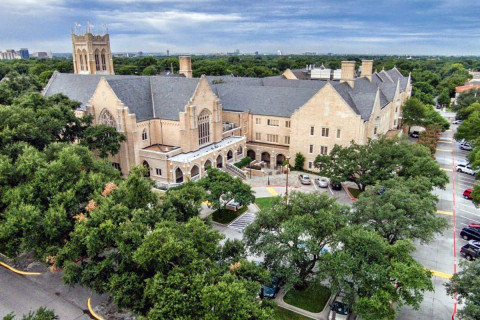
One day, I saw a picture of a distant library, with high shelves, arches, wooden desks—and rooms where you could spend the night. I applied to stay for a week to do research and was accepted, though I wouldn’t be able to go for another year.

Read our latest issue or browse back issues.
In Victorian novels, sometimes a sick patient is prescribed time by the sea. I thought that any reasonable doctor, faced with a patient in despair, might prescribe a week at the library. The knowledge of that library on the horizon carried me through the darkest days of the war. When I couldn’t pray, I read the library catalog.
In November, I caught a flight and then several trains. The library was everything I had imagined: the smell, the staircases with ropes as rails, a desk on the second floor. My bedroom was nearby. I turned on the lamp at my desk and set to reading.
My arrival coincided with the Feast of All Souls. At mass the next day, I listened to a reading from Hebrews: “We are surrounded by so great a cloud of witnesses” (12:1). Back at the library, I became aware that the voices within the books were ancestors, witnesses. I would ask them to guide me.
I have always thought of a library as a sacred space. I’ve often felt compelled to pull a particular book from the shelves. It is an encounter, and God always knows what we need to read. I selected a book about John Cassian, a monk who traveled to Bethlehem in the fourth century. He counseled me to pray, “Lord, come to my assistance,” until my heart stilled. That afternoon, I walked into the woods and asked God for help.
But a library is also a reckoning. The next day I was reading Thomas Merton’s essays on nonviolence. “Christians must become active in every possible way,” he writes, “mobilizing all their resources for the fight against war.” I was tempted to throw the book across the room. I was furious at Merton’s certitude, at the safety of his vantage point from a monastery in Kentucky. I argued with him for hours.
Eventually, I surrendered. Merton was right. I had not done all that I could—most of us had not. The scale of death was staggering. As Christians, how could so many of us have been silent about our belief in nonviolence and the sanctity of human life?
I scribbled in my notebook:
I do not know if we will ever forgive ourselves, or be forgiven, for our refusal, or our inability, to step in or bear witness in any meaningful way.
What is left is penance.
A library names things. And so there is something in a library that rebukes our silence.
That night, I returned to the library in the dark. I thought of others who had lived through times of war. I wondered if they, too, had gone to libraries searching, and who they had found to guide them.
It was nearly 10 p.m. I looked around at the people sitting at their desks, their lamps lit, no sound but the rustling of pages. I became aware that those books around me also held prayers. I felt the fraternity of those who stay up late to read.
A library is full of survivors. Having been left alive, they accept the task of witnessing.
I found Merton’s letters with Czesław Miłosz. The Polish poet had survived the Nazi occupation and moved to Paris, where he grew cynical about intellectuals who embraced communism; he then defected to California. His correspondence with Merton lasted a decade. Haunted by war, Miłosz was wary of easy answers. He was also searching for God. He wrote: “I feel that all is futility except for striving towards Being. . . . I know that the only subject for a poet or a philosopher is the verb ‘to be.’”
An unease, that gasp one feels when still trying to form a question.
Before Mahmoud Abu Nujaila was killed in a strike on Al-Awda Hospital in Gaza, the Palestinian doctor wrote on a whiteboard, “Whoever stays until the end will tell the story. We did what we could. Remember us.”
We are not outsiders to history. History makes demands of us. We are still becoming, and we must seek what is ours to do if we are to keep going. It is lonely work. I hope that we will be joined by the dead and the living, by books, and by Christ who loves and forgives and guides us through everything. This Word is also alive in us. After the Second World War, Jürgen Moltmann wrote that an “unquiet heart” is a hopeful heart. In this unease is a way forward, the will to live.
There is also the vocation to beauty. Beauty is the opposite of war: While war seeks to destroy particularity, beauty insists on it.
I spent my last days at the library reading Tawfiq Canaan. A Palestinian doctor born in 1882 near Bethlehem, he was also an ethnographer. Seeing his world in upheaval, he began to record what was vanishing. In a 1923 article, he listed seven Arabic names for rain. A century later, I read them.
Naqqatat is a “rain that drips gently.” Aburah is a “shower falling from a cloud, which passes away for a short time.”
I do not know who we will become. I know that we must not be the same after war. We must become acquainted with this unease in our hearts, must listen to what it asks of us and be ready to set out from that place. There is solace in noticing the other lamps lit up at night. There is fidelity in learning the names of rain.