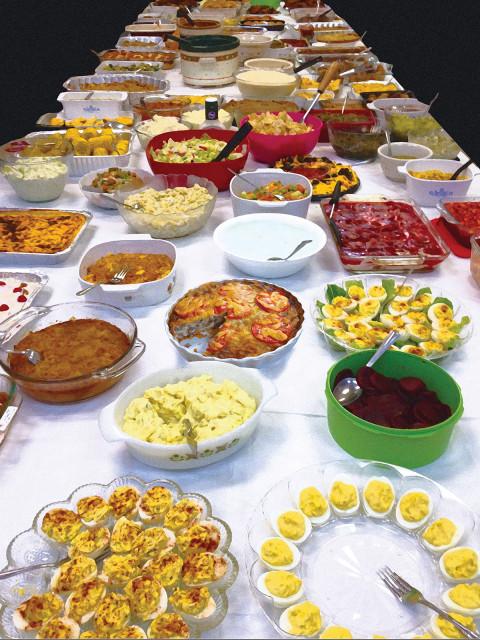
I grew up among North American Baptists in Sioux Falls, South Dakota. As a people, we ate casseroles—or, as they were frequently called, hot dishes—and Jell-O salads and sweet, gooey bars. These were our traditional foods. Our celebrations were potlucks, replete with tiny hot dogs in barbecue sauce and any number of things that can be done with Cool Whip.
In The Cooking Gene, chef Michael Twitty writes that in 2011, he remembered that he had been forgetting where he came from. He embarked on something he called the Southern Discomfort Tour to explore the culinary traditions that had shaped him, even as he had misgivings about them. As I have moved farther away from the North American Baptists in time, space, and belief, I have also been in the process of forgetting where I came from, and I’ve been feeling some Midwestern Discomfort. I’ve been wondering what the food traditions of my home can teach me about the theology of that place and those people and what I therefore have carried forth and embodied.
The thought probably would not have occurred to me if I hadn’t encountered Angel Méndez-Montoya’s The Theology of Food, in which the theologian and Dominican friar introduces us to Doña Soledad’s recipe for mole poblano, a traditional Mexican dish that has dozens of ingredients and can take all day to make. He then uses this gastronomical phenomenon to take the reader on a theological adventure of savoring, thinking, and exploring.