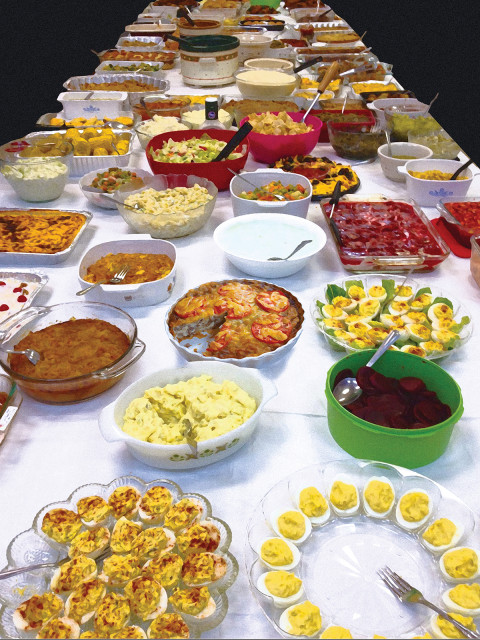
I grew up among North American Baptists in Sioux Falls, South Dakota. As a people, we ate casseroles—or, as they were frequently called, hot dishes—and Jell-O salads and sweet, gooey bars. These were our traditional foods. Our celebrations were potlucks, replete with tiny hot dogs in barbecue sauce and any number of things that can be done with Cool Whip.
In The Cooking Gene, chef Michael Twitty writes that in 2011, he remembered that he had been forgetting where he came from. He embarked on something he called the Southern Discomfort Tour to explore the culinary traditions that had shaped him, even as he had misgivings about them. As I have moved farther away from the North American Baptists in time, space, and belief, I have also been in the process of forgetting where I came from, and I’ve been feeling some Midwestern Discomfort. I’ve been wondering what the food traditions of my home can teach me about the theology of that place and those people and what I therefore have carried forth and embodied.

Read our latest issue or browse back issues.
The thought probably would not have occurred to me if I hadn’t encountered Angel Méndez-Montoya’s The Theology of Food, in which the theologian and Dominican friar introduces us to Doña Soledad’s recipe for mole poblano, a traditional Mexican dish that has dozens of ingredients and can take all day to make. He then uses this gastronomical phenomenon to take the reader on a theological adventure of savoring, thinking, and exploring.
Méndez-Montoya makes a case for food as an important site of theological reflection and for expanding our theological vocabularies to allow this. Alimentary theology is aesthetic, ethical, and political, he writes. It is expressive of the incarnation, and it teaches us how to participate in a “non-possessive rejoicing in the feeding of the concrete—not abstract—Other.” Méndez-Montoya writes that his book “envisions God both as superabundance and intra-Trinitarian self-sharing of nurturing Love, Truth, Goodness, and Beauty. . . . Following from the logic of God’s self-emptying love or kenotic sharing, the Incarnation can be seen as a material continuation of this cosmic, eucharistic banquet” as humanity is transformed bit by bit into Christ’s body. Humans are brought into the Divine, the Divine into humanity. Theology is envisioned as food.
That’s some pretty lofty rhetoric for me to try to carry to the food traditions of the place where I grew up. We were plainspoken people who tended to see food in food and theology in theology. We didn’t mix categories much. In some ways, it seems unfair to take a recipe from my childhood in South Dakota among North American Baptists and compare it with the traditions of mole. One is modern; the other draws on ancient tradition. One is plain; the other complex. One is perhaps the preaching equivalent of a sermon that aims to be relevant, while the other has the incantatory power of an ancient chant.
But as an experiment, I decided to pick one dish that was emblematic of potluck foods and consider it in light of its theology. Impossible cheeseburger pie is recorded for posterity in a cookbook called Seminary Cooking. It was put together by the wives of faculty members of the North American Baptist Seminary, where my father was a professor, in 1984. I was 13 years old. My mother’s name is listed as a contributor, and there are a few of her recipes throughout. The cookbook was a communal undertaking that gathered together recipes often served at seminary and church potlucks.
Impossible cheeseburger pie has just seven ingredients and is as easy to describe as it is to make. Preheat the oven and grease a pie plate. Brown ground beef with onion. Drain the grease. Add salt and pepper. Put the meat into the pie plate. Beat Bisquick with eggs and milk. Pour this mixture on top. Bake for 25 minutes. Top with cheese and slices of tomato and bake again until a knife comes out clean from the center.
Its relative quickness was one of the things meant to appeal to White South Dakota churchwomen who were adding potluck fare to long to-do lists. Impossible cheeseburger pie was not an original recipe. After a corporate merger between Bisquick and Betty Crocker under the banner of General Mills, recipes for a wide variety of “impossible” pies appeared on the back of Bisquick boxes and in Betty Crocker cookbooks. The idea of the impossible pie was that, during baking, the Bisquick sinks to the bottom of the pie pan and creates a crust so that the busy cook does not have to do the mixing and rolling of a regular pie crust. Impossible pies were all the rage in the 1970s and ’80s. My online research suggests that people still bring impossible pies to church potlucks, but they might have a bit of a throwback feel, the kind that comes with a wink and a sense of irony, like an ’80s music dance party. While the traditions of mole were built to last, impossible cheeseburger pie was tied to fashions of the day. It was corporate in origin and participated in the modern fascination with time-saving and processed foods. It also had a ready-made nostalgia for an older, more time-consuming kind of cooking.
Méndez-Montoya takes the reader along as he makes his own mole. I, on the other hand, was tempted to merely think about making impossible cheeseburger pie. In my years and geographical distance from the North American Baptists, I had built up a lot of resistance to this kind of recipe. Still, I wanted to have an actual embodied experience to go along with my theologizing, so I set out to make the impossible pie.
I had a difficult time convincing myself to buy Bisquick and processed cheese. Several friends let me know they thought this was elitist of me. Eventually, I borrowed Bisquick from one of these friends, and I went out to buy plastic-wrapped slices of American cheese. At the grocery store, I picked up a package of cheese and then put it back down again. Maybe I could sub it out for another kind? I noticed myself worrying about what people in line would think of me and my package of cheese product. Somehow my very sense of identity was challenged by this purchase. But eventually—on my second try—I bought the American cheese.
When I got home, I started on the recipe, determined to make it just as Lenore Lang had written it in 1984—perhaps a kind of literalism already at work. As I browned the ground beef, I was reminded of my mother’s kitchen, where ground beef was frequently on the menu, so I felt a little nostalgia for home. I poured on the Bisquick and, after the first bake, the pie came out slightly brown and sizzling. It looked OK. But, after I added the cheese and the tomato and baked it again, the taste and texture of the final product were truly terrible to me. The blandness was striking, and there was a pervasive mushiness.
“Did you make this as a joke?” my husband asked.
“Not exactly,” I said, without saying that I did it as an experiment in incarnational theology. I wondered if pickles would help.
Even as I write about this, I feel sensitive about offending the people I grew up with by insulting this food. And I know there are foodies out there who have come up with fancy reinventions of this dish. Yet it is not lost on me that as I distanced myself from the recipes in Seminary Cooking, I also rejected a great number of the theological presuppositions of the North American Baptists. For example, I’m annoyed by the idea of Jesus as my personal savior, and I’m no fan of substitutionary atonement. I no longer think of salvation as a decision that gets made in my heart. The two rejections—of the food of my midwestern childhood and the theology of it—came at the same time, although I didn’t notice their correspondence.
I feel little anxiety about naming my theological differences, but when I talk about the food, I can contain neither my snarkiness nor my concern about exposing it. I have observed that people in my acquaintance have maintained an affection for the food of home, for something like impossible cheeseburger pie, even after they’ve discarded the theological presuppositions that once accompanied it. But you don’t really hear people expressing affection for substitutionary atonement or a personalized Jesus once they’ve abandoned these precepts. For me, neither affection remains.
One thing to notice about impossible cheeseburger pie theologically is that it is a relatively humble food. It puts on no airs. The cook gets very little credit: no points for originality or presentation, for extensive labor or beauty. It doesn’t say, “Look at me!” It doesn’t point back to its maker. The woman who included this recipe in Seminary Cooking was like the recipe: she put on no airs. She didn’t attract attention to herself. She was a quiet keeper of tradition, just trying to get the masses fed on a Sunday afternoon without much fuss. There may have been some subtle competitions going on among the cooks—whose dishes were most well liked and who carried almost full casserole dishes back to the kitchen—but impossible cheeseburger pie was probably not in the running. It was eaten and appreciated for its simplicity.
But all food is a system of signs, a means of communication. Foodways can be seen, Méndez-Montoya writes, as “narrative performances of how societies construct notions of self and community, and their relationship with the world; and these may also include a belief in spiritual, invisible, and transcendent entities or realities.” Eating and drinking, culinary traditions, the relationship between savoring and knowing, the aesthetic, ethical, and political, cultural, and economic dimensions of food, the relationship between humanity and divinity—these are the complex interrelations that the theology of impossible cheeseburger pie involves, even if the cook doesn’t intend them.
If mole is, as Méndez-Montoya says, an “act of life that evokes the cosmos as a great cosmic banquet,” maybe we can imagine impossible cheeseburger pie as part of the great cosmic potluck. The people who made impossible cheeseburger pie tended much more to the potluck than to the banquet. Banquets were stiff and formal—they were, if you will, high church. We were low church, and our potlucks were freewheeling, open-ended, and frequent.
They were also, I would argue, popular devotional practices. “Table fellowship” was the devotional way to refer to them. They were tacked on to other events, usually church services. After a baptism, there would be a potluck. If a preacher or a missionary were visiting, there would be a potluck. Like almost all low-church productions, they were formalized without being formal.
A potluck is a tradition in which people bring individual dishes and share them from a common table. I say people, but among the North American Baptists, the tasks were gendered. Women made the food. Men set up the tables and chairs. Women got the food organized, found plates and napkins, did the dishes after. Men took the chairs down. And woe to a woman who decided to help with the chairs. I speak with some experience here.
Despite the gender conformity, my people did prize individuality to an extent; you needed, for example, to make your own personal and individual commitment to Christ. But here too there was an undercurrent of uniformity. When people made their individual commitments, they tended to use exactly the same words and phrases. At a potluck, individual tastes rarely got challenged. Impossible cheeseburger pie isn’t an act of self-expression. It’s a communal dish. Food that looked too pretty or tasted too good or too weird could be suspect. Frivolity was associated with wasting time and making an issue of yourself. Those were things we didn’t do. You could, however, make an unusual dish if you had served as a missionary. Then your offering of adobo or groundnut soup was a sign of your service to the church, not a self-aggrandizing exoticism.
In the potluck model of what Méndez-Montoya calls “divine care,” such care is communal. There are elements of self-reliance and elements of low-church versions of democracy, what our circles sometimes called koinonia or fellowship. At a potluck you eat the food of others. Hierarchies are very subtle and might be observed by who fills their plates first and who stands around watching or running back and forth to the kitchen in search of serving spoons. Also, the potluck is by and for the church community. Outsiders are not unwelcome, but welcoming and feeding “others” isn’t a part of the celebration. It is an intra-community moment.
The potluck is an act of faith. You don’t think you bring it all, but you also don’t think you have nothing to do with it. You bring something. Impossible cheeseburger pie, as a contribution to this feast, is partial and imperfect, even problematic, but it isn’t everything. It’s just one thing offered on a table of many offerings.
When you eat impossible cheeseburger pie, there is little mystery involved. You don’t wonder what you are tasting. It is a very clear and straightforward set of ingredients layered so as to sort themselves out. If you make the dish, you might be a little surprised when the Bisquick sinks to the bottom to form a crust—or you might not notice or care. The surprise is not the point. The people who made this dish for church potlucks did not much think of God as a mysterious being. They thought that God had made Himself (and He was unequivocally a He with a capital H) perfectly plain in the person of Jesus Christ and in the texts of the Bible. Our work was not to divine the mystery but to follow the instructions laid out in the texts almost as simply as in a recipe. There was no need to make it more complicated than that.
And yet, when I came back to impossible cheeseburger pie later in life, it presented me with an unexpected dilemma, one that also seems related to its theology. In order to make “authentic” cheeseburger pie—the one written in the cookbook—I had to use what I considered to be “fake” ingredients. Bisquick contains bleached flour, partially hydrogenated vegetable oil, dextrose, sodium aluminum phosphate, monocalcium phosphate, monoglycerides. When we make and eat this food, we are not in search of origins. We are in search of innovations: the new, the modern, the industrial, progress. This also speaks to the complexity of my North American Baptists’ relationship to the old and the new, insofar as theology is concerned. If, in our literalism, we give things a modern interpretation, this is not an act of faithlessness to the text. It speaks to the text’s timeless ability to give a take-home message to anyone.
Mole, as Méndez-Montoya tells the story, is about remembering the precolonial past, even as the encounter with the Spanish transformed food. Mole evokes a past in which each ingredient involved a relationship with specific deities. Chile and chocolate were foods of the gods, and they contained divine sparks.
If mole involves multiple forms of remembering, I might argue that my dilemma over the authentic and the fake emerged in part because impossible cheeseburger pie involves forgetting. Impossible cheeseburger pie forgets the land where it (very remotely) came from. It forgets the cows. It forgets the wheat field. Its cheese product bears little relation to milk. And as the food of White settlers, it certainly, even intentionally, forgets the Indigenous peoples of this region. It forgets that it replaced their native foods as the newcomers took over their land, killing the people as they did so. Beef replaced bison, and grains for ultra-processing now occupy the land once held by native grasses.
The White people I knew in South Dakota were in the process of actively forgetting this history. They were called conservative, but in some ways, they were constantly cutting themselves off from tradition and history. Impossible cheeseburger pie was a part of this forgetting because it was part of the wave of homogenizing foodways via corporate America. The recipe was on the back of the Bisquick box; it belonged to everyone and no one.
S
o what then is the theology of impossible cheeseburger pie? I don’t think you can do with it the kind of incarnational theology that Méndez-Montoya does with mole. The theology of impossible cheeseburger pie relies on a series of separations—God and human, mind and body, spirit and land, male and female, churched and unchurched. It even separates a person from their own experience, since in the end, it isn’t a sensory delight. With the depth of its blandness, it almost avoids the sensory. (I do hear my friend Mort, a great lover of midwestern food, arguing with me here, and I am aware that a question of individual taste haunts this essay.) But by being so bland and unremarkable, the food leads a person to participate more in a marketing scheme than in a food experience. (Buy Bisquick! You too can make impossible cheeseburger pie in just a few minutes!)
At the same time, as a casserole shared in community, it has the potential for redemption. At the free community meal my church serves four days a week, I often make a casserole using whatever we have on hand. Others participate as well. At our very best, Santiana has appeared with a fruit salad, Greg has brought a green salad with lettuce from his garden, and Shanti has made some spaghetti. Sarah brings a German chocolate cake. Maybe this is my own holdover from the church potlucks of my adolescence. Impossible cheeseburger pie is still with me, and I still embody many of its principles.
A casserole is a flexible enough form that it can be opened to new ingredients while maintaining a connection to a tradition. It can be used as a vehicle to remember instead of forget. It can be brought into conversation with other dishes so as to blunt the worst of its extremes. Casseroles can be resourceful, made from ingredients that would otherwise be thrown out. Disparate ingredients are drawn back into relationship through the imagination of the cook in a way that honors the plurality and idiosyncratic nature of the world as it is. Each of the ingredients is interchangeable with something that could perhaps be more connected to land and to people than the back of a Bisquick box. The table at which the casserole is shared can also be opened wider. Participants can be invited into acts of self-sharing that are also partaking in the divine economy.
For example, if my friend Veronica were making impossible cheeseburger pie at the community meal, the first thing she would add are handfuls of fresh spinach to the filling. I can hear Mort groan and say, “It isn’t a cheeseburger pie any longer,” because who puts spinach on a cheeseburger? But identity is no longer the point—just as in the process of our own salvation, we have to give up claims to identity.
In my hands, the cheeseburger pie probably becomes impossible leftovers pie. I would use leftover ground beef that has a little bit of chili in it from the meal Blanca cooked the day before. I might add some vegetables from a box of leftovers from the food pantry, maybe a little carrot and zucchini diced small. Small, I promise. For the crust, I might make a golden vegetable crust—grated and sautéed yellow squash and carrot combined with flour, butter, cheddar cheese, and an egg so that it will bake up crispy.
We would sit down and eat it in table fellowship that includes Jessica who is struggling with her mental health, Mike who is on day four of his sobriety, Jason and Greg and Mark and Santiana and Josefina and Nora, the construction workers who come in on their lunch break, and a few college kids who have found their way to us.
When we share our reinvented and reimagined impossible pies, we perhaps enact the impossibility of God’s own redemption, the reinventing and reimagining of ourselves and our communities through acts of self-sharing. So let the cosmic potluck go on, with expanded tables and ever-reinvented gifts.