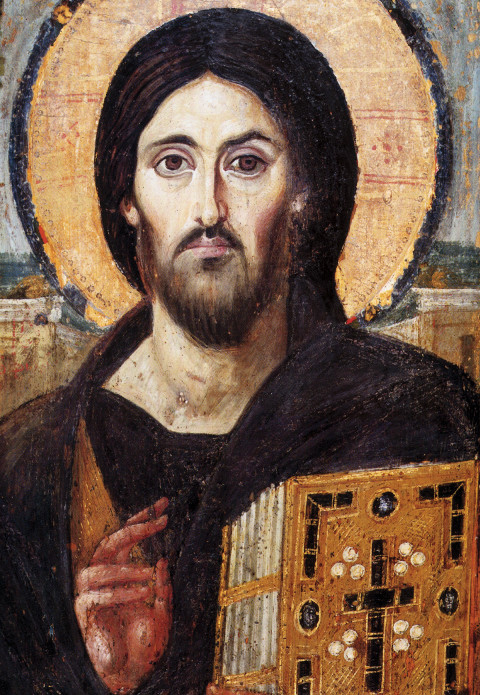
Christ’s face emerges from a shimmering gold background, his brow slightly furrowed, lips pressed in a quiet, knowing tension, one hand raised in blessing while the other clutches a bejeweled gospel book. His gaze holds us captive. One eye is stern, shadowed, and piercing; the other is softer, luminous—almost sorrowful. The sixth-century icon from St. Catherine’s Monastery in Egypt does not fully resolve into a single expression. Instead, it fractures into two: judgment and mercy, severity and compassion, divinity and humanity. Half his face regards the viewer with the unflinching gaze of a judge who sees all; the other side looks upon us with a quiet, aching tenderness, the face of one who knows our suffering. This dual gaze is unsettling. It asks, Who do you say that I am?
The icon at St. Catherine’s is one of the oldest surviving depictions of Christ Pantocrator, the traditional Eastern Orthodox image of Christ as the almighty ruler and judge of humanity. Visually it is also one of the boldest—it represents a singular vision. Various theories exist to explain the mysterious, asymmetrical face. I see it as an invitation to explore the meaning of divine judgment—and to examine our culture’s discomfort with the idea of God who judges.
Christ Pantocrator emerged in the Byzantine world during a period of theological and political consolidation. The icon was meant to assert Christ’s dual nature as both merciful savior and ultimate authority. Often displayed prominently in the iconostases and apses of churches and monasteries, icons of this type became truly awe-inspiring when they took the form of monumental frescoes or mosaics at the apex of the inner dome, where they presided over worshipers from the highest point of the building.