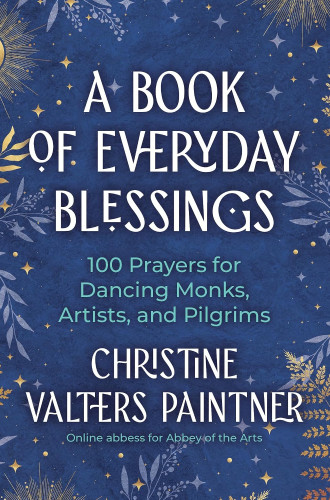
A Book of Everyday Blessings
100 Prayers for Dancing Monks, Artists, and Pilgrims
In my work as a chaplain and retreat facilitator, I keep a stash of prayer collections within close reach: John O’Donohue’s To Bless the Space Between Us, Sarah Bessey’s A Rhythm of Prayer, Janet Fuller’s Blessings for Your Students. Now, nestled within that cherished treasury, I include Christine Valters Paintner’s A Book of Everyday Blessings: 100 Prayers for Dancing Monks, Artists, and Pilgrims. This luminous, poetic album of prayers offers resources for reflection on a span of milestones and moments as well as for simply opening to a page and sensing what surfaces.
Paintner traces the etymology of blessing to the Latin benedicere, meaning “to speak well of.” Paintner plumbs this practice of praise, drawing inspiration from the Jewish, Islamic, and Celtic traditions of acknowledging “the unfolding of the day, each activity, each turning point.” She illuminates glimmers of grace in the quotidian (“For a Spark of Joy on a Bad Day,” “For Release into Sleep”), the climactic (“For Courage to Befriend Death,” “For a Wedding or Commitment Ceremony”), and the cyclical (“To Follow Mary as God-Bearer,” “On Winter Solstice,” “On Imbolc and the Feast of St. Brigid”). The prayers in this petite anthology, which can be “read, spoken aloud, or even sung,” invoke a variety of stylings for the Divine: Holy One, Healing Presence, Ancient Wisdom, Dream Keeper, Singer of the Cosmic Song. These blessings are creative and contemplative, evoking the boundless bids for attention the Spirit makes of us across our lives.
Read our latest issue or browse back issues.
This crossroads of the contemplative and the creative characterizes Paintner’s ministry. A poet, spiritual director, and scholar, Paintner serves as the abbess of the entirely virtual Abbey of the Arts—a global, ecumenical online monastery and retreat platform for those who seek to integrate contemplative practice and creative expression. She makes her home in Galway, Ireland, having left her native United States with her husband in 2012. Benedictine desert spirituality—with its appreciation for place, ritual, and solitude—shapes Paintner’s niche ministry at the nexus of monasticism and art, with echoes of expansive catholicity resonating throughout.
The abbey gave rise to many of the prayers Paintner composed for A Book of Everyday Blessings. She writes that several of them emerged from the abbey’s programmatic offerings, while others surfaced in settings of spiritual direction or preached retreat. Others trace their source to specific requests for blessing, which led Paintner to launch a call on social media for suggestions for blessings. Moved by the reflections people shared in response, Paintner “spent many hours in prayer, listening for the words that could help to create a mantle of support and protection for those praying them.” The fruit of her contemplation and expression yields its harvest in these pages.
Paintner advises that the blessings assembled in this book are not meant for liturgical rites or reserved for exclusive use by clergy. Rather, her blessings call for a vast and varied participation in naming our human longings and offering expression to our encounters with nature, time, introspection, and inspiration. Her words are widely accessible and inviting, providing a bridge between the yearning for transcendence and lived experience.
Readers attuned to hallowed echoes of spirituality in the everyday won’t have to parse Paintner’s words to find themes from scripture and the Christian tradition. A “greening vitality” calls forth Hildegard of Bingen (see Lilia Ellis’s essay “Hildegard’s living stones”); a reference to a “restless heart” rings Augustinian. While subtle enough not to alienate those who seek safety within an expansive Christian imagination, these sonorous allusions display Paintner’s fidelity to the scholarly and spiritual origins of her work.
In an age marked by spiritual fragmentation and longing, A Book of Everyday Blessings participates in the recovery of blessing as a communal, creative, and deeply human act, one that resists both prescribed spirituality and rigid gatekeeping. Through Paintner’s blessings, to “speak well of” the world, as benedicere invites us to do, becomes both a poetic gesture and a theological one: a way of reorienting ourselves to presence, to praise, and to the possibility that the holy has been here all along. As both a spiritual resource and a work of contemplative art, this collection succeeds in what it sets out to do: to widen the circle of who can bless and what is worthy of blessing. It is a book to keep close—for companionship, for comfort, for capacious creative response to the movement of God at every sort of threshold.
This review was produced in partnership with the Narrative Project.