Some things are alive, and others are not. It’s a dichotomy basic enough that every grade schooler has it mastered. Many facts are like that: so seemingly natural, so thoroughly embedded in how we understand the world, that it seems impossible anyone could think otherwise. And yet, the clean divide between living and nonliving we know today is only a few centuries old. Our categories might have been just as strange to a denizen of the medieval world as they are natural to us.
Of course, we are accustomed to thinking of the medieval past as superstitious, unenlightened, unscientific—the myth of the “dark ages” persists despite the era’s impressive intellectual, artistic, and scientific achievements. In the medieval West, extensive encyclopedias investigating health and the natural world were bestsellers, but they receive almost no attention from scholars and readers today. The renowned 12th-century theologian and polymath Hildegard of Bingen wrote one, the Physica, which did not even appear in English translation until 1998. Medieval science simply registers as too weird for our tastes, too religious, too full of falsehood.
Read our latest issue or browse back issues.
Hildegard, after all, devoted a whole book of her encyclopedia to the nature and medical properties of stones, gems, and minerals. She presented a vision in which stones, along with most of the cosmos, are brimming with life, a view modern readers will readily recognize as false. Her claim that “the devil hates and shrinks from stones” or that the vital powers of stones can cure diseases would strike most people today as false in the most bizarre way. Yet perhaps medieval science, once so beloved by readers, deserves another chance. Perhaps the very claims that are strangest to us can best help us see our own cultural blind spots.
In the Physica, stones aren’t mystical crystals set apart from the world. They are part of a harmonious creation.
How does Hildegard defend the indefensible and depict living rocks in a living world? To start with, Hildegard and her medieval contemporaries didn’t think of life as the strict binary we do today. Following the Aristotelian tradition, they held to the scala naturae, better known today as the great chain of being. As medievalist Richard Jones explains in The Medieval Natural World, while the contemporary understanding of life works in binaries (living vs. nonliving), the scala naturae works by hierarchies. God is at the top; beneath him are angels; then humans, animals, plants, and so on.
Medieval minds were especially quick to adopt the scala naturae because it fit in so well with the notion that the macrocosm shows up in the microcosm: God’s immense creation has its own mirrors on the tiniest of levels. The human body, for example, could be seen as a mini-cosmos, with all its parts arranged to support a greater whole. Many scholars also emphasize medieval writers’ tendency to view life as a kind of spectrum: Animals, plants, or stones might have fewer qualities of life than we do, but that doesn’t mean they’re nonliving. They just share in less of life than we do. The notion of being “more” or “less” alive is nonsensical to modern science, but it would have fit in well with many medieval thinkers’ understanding of the natural world.
Medieval assumptions clash heavily with our own. We are not only children of the Enlightenment; we have taken its lessons to the extreme, treating science as a byword for truth. We believe in rationalism, neat categories, science, and materialism, in “what you see is what you get.” Even fundamentalists like Ken Ham, who are often derided for denying science, routinely insist that biblical events like the flood or the creation story can be scientifically proven. Science-skeptical conspiracists of all stripes, from anti-vaxxers to the climate change deniers, are united in their insistence that the science is actually on their side. “Do your own research” has become a conspiracy theory catchphrase. It is not that science is wrong, in their eyes, but that the real science has been hidden by some nebulous elite.
The scientific method itself is virtually sacrosanct: Even those who doubt its most important conclusions still vociferously claim to support it. Among progressives, “I believe in science” is almost a credo, despite the fact that science is no monolith, responsible as it is for both vaccines and the atom bomb. Among left-leaning Christians, the need to reconcile faith with science has been one of the greatest concerns of the past century, with theologians like Rudolf Bultmann even aiming to cleanse Christianity of the irrationalism and myth so anathematic to modern scientific materialism. Our cultural confidence in science and reason is, ironically, greater than scientists’ own. Behind every scientific breakthrough or consensus lies decades of painstaking research and disagreement, and while media reporting heralds new scientific papers as having “proven” this or that conclusion, the most common refrain one finds in the papers themselves is “more research is still needed.”
The assumptions underlying Hildegard’s worldview are starkly different. Hildegard read the best philosophy and science of her day, but she also made her own unique contributions, most notably her notion of viriditas—literally “greenness”—which appears all over her writings. As Hildegard scholar Barbara Newman puts it in her magisterial book Sister of Wisdom, viriditas “represents the principle of all life, growth, and fertility flowing from the life-creating power of God.” Recent essays and books, such as Michael Marder’s Green Mass, highlight Hildegard’s rich eco-theology, which gives center stage to plants and views the whole universe through a lens of green.
In Hildegard’s books, creation overgrows with the vital force of God. Looking up at a sky untainted by light pollution or out at rolling miles of hills and forest, Hildegard felt a profound sense of wonder and love for the ineffable triune God, who animates all things. The unity and harmony of creation is, for Hildegard, a foundational principle. While contemporary Western culture prizes observation, evidence, facts, reason, and experiments as the way to yield truth, Hildegard begins on a different page altogether.
In light of her worldview, Hildegard’s views on stones are not so ridiculous. Stones have their own role to play in a grand creation, and just like the trees, plants, animals, and humans God created, stones are animated by the Spirit and made to live. Hildegard turns to the language of life again and again—not as metaphor but as a real description of a creation so full of vitality that even stones have a share of it. Stones are born; they “are birthed from fire and water” or “born from other useful and unuseful things.” They are always born or birthed, never formed or made; Hildegard uses the Latin verbs for birth to describe stones more than three dozen times in the Physica. They also grow and change, becoming what they are (just as plants, animals, and people do) in part due to their environment. “Sardius grows in the afternoon,” she writes; “topazius grows in the ardor of the sun”; and “carbunculus grows in the eclipse of the moon.”
Unsurprisingly, given her reliance on viriditas, Hildegard’s favorite stone is the green smaragdum, a category that encompasses emeralds and similar gems. The emerald takes on its vitality in much the same way that grass and plants do: it “grows in the morning, at the birth of the day . . . and at that time the viriditas of the earth and grasses thrives the most.” Hildegard even notes that the sun gives emeralds their life, just as it gives plants theirs. This is a striking illustration of how different the medieval understanding of life was from our own.
The same vital force that gives plants life and animates the whole cosmos explains stones’ healing powers. “Whoever has pain in their heart or stomach or side or in any other part of their body,” she says, “should have a smaragdum with them . . . because its viriditas is medicine.” In Hildegard’s encyclopedia, stone medicine operates on the same principles as herbal medicine. “All the strength of the ruta is in its viriditas,” she explains; of ground ivy, she writes: “its viriditas is sweet and useful, so that a person who languishes and whose flesh fails . . . let them often eat it cooked, and it will make them better.” The same is true of trees; of the Tilia tree, Hildegard writes, “bad humors flee from its good viriditas.”
Underlying Hildegard’s medical beliefs was not mere superstition but rather a vast cosmic vision in which all things are united in God. Even when claiming that stones ward away demons, Hildegard relies on a worldview in which God’s goodness in creation can change the world for the better: “The nature of these same precious stones seeks what is good and useful.”
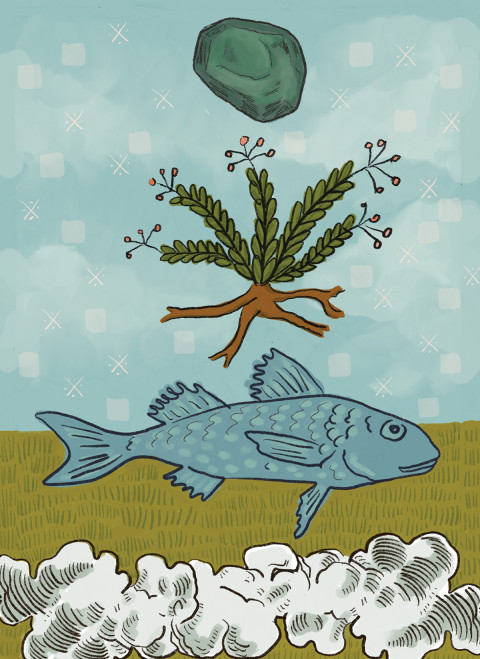
What is perhaps most intriguing in the Physica, however, is Hildegard’s treatment of stones within their larger environment. Stones provide a place where creatures might find food; the bersa fish “sometimes enters among rocks and stones and little caverns, and within them seeks some good and healthy plants by which it might be fed.” Here, three creatures from across the spectrum of life—fish, plant, and stone—meet together in one place. Stone supports plant and plant supports fish, demonstrating interdependence among created things. Hildegard stresses the harmony between animals and stones to an extent that may seem comical to modern readers. A pregnant rodent, for example, “searches for the smallest of pebbles, and swallows them, however many she can keep in her throat, and runs to her cave, and there she spits them out and blows on them, and lays herself on them, and warms them, and at once gives birth.” The Physica does not treat stones as mystical crystals or magic objects set apart from the world but rather as part of a harmonious creation—just as other creatures are.
Views like Hildegard’s earn a torrent of criticism today: They are anthropocentric, overreliant on pseudoscientific folk wisdom, and embedded in a pietistic worldview no modern rational person could accept. And yet, we should think twice before insisting our own age has all the answers. Many of our limited cultural perspectives turn to the language of science to give them a veneer of objectivity and neutrality, even when the science itself doesn’t agree.
The most dominant understanding of stones, minerals, and gems today—the natural resource model—does exactly that. The phrase “natural resources” seems objective enough: they are, indeed, naturally occurring substances that help human beings by providing the chips for our phones, metals for MRI machines, and dazzling gems for jewelry. Elementary schools teach students about natural resources, university science departments frequently combine the study of natural resources with environmental science, and government agencies devote special attention to natural resources.
But to call a stone, mineral, or gem a natural resource is to take an anthropocentric perspective, implying that it exists for us, that its purpose is to be extracted out of the ground and put to human use. Nothing is naturally a resource. The minerals we mine existed billions of years before us, and they quite possibly will continue existing billions of years after. We can use them, but they do not exist strictly for us. And the centuries of human mining history mark the tiniest blip in comparison to the massive geological time scale of the earth. The natural resource model is not scientific fact; it is economic ideology wrapped in scientific guise.
In a very real sense, Hildegard’s worldview gets it right exactly where ours fails. We cannot mine so-called natural resources to our heart’s content. Whatever we extract, we extract at a cost—an economic and labor cost, yes, but also an environmental one. Problems like child labor and slavery in mining are rightly garnering more attention from activist groups, and environmental groups are working to curb damaging practices like fracking. But geoconservation—the practice of protecting earth’s geological landscapes—receives almost no attention, and geodiversity—the geological analog to biodiversity—receives even less.
However, biologists and geologists are increasingly recognizing the intimate connection between geodiversity and biodiversity. Some now argue that protecting geological landscapes is crucial for protecting ecology, for the very reason Hildegard recognizes: Minerals are entwined with their environment.
A recent paper by geodiversity scholars at the University of Oulu even went as far as calling geodiversity “the foundation” for biodiversity. The authors of the paper point out that geological factors influence everything from climate to topography, leading to a codependence between living and nonliving nature. We cannot simply discard the nonliving, as an extractionist mentality might suggest; there is a far greater harmony beneath things. The authors note that geoconservation is a relatively new field. Collectively, we have been slow to recognize what was foundational to natural science just a few centuries ago.
This doesn’t mean we need to naively return to the past. We don’t need to agree with Hildegard that rocks are alive or embrace their mystical healing powers. We should not study history through rose-tinted glasses, imagining a brighter past we might return to. But nor should we assume that we are light-years ahead of our ancestors when it comes to understanding the world or that we’ve solved our problems to the best of our abilities. We study the past not to go backward, but to go forward. “Every age has its own outlook,” said C. S. Lewis. “It is specially good at seeing certain truths and specially liable to make certain mistakes. We all, therefore, need the books that will correct the characteristic mistakes of our own period.”
Our age has succeeded more than any other in history with the things that are seen. No reasonable person can doubt the immense powers of science and reason, which have banished hunger in much of the world and cured diseases that could not be cured for virtually all of human history. Likewise, capitalism and markets have brought unprecedented prosperity to billions of people. But the contemporary West has lost something of the humble wonder which abounded in its medieval texts, and we are paying the price.
Correcting the flaws of our age might mean relinquishing our certainty, our insistence that we can master the world by observing it, our cultural misunderstanding of what science is and how it functions. Learning from writers like Hildegard can help us recognize the limits of our own power and admit that there is much we cannot know and cannot do. We may not even realize that many of the concepts we take for granted are not at all natural but endemic to our own times, with all their flaws and strengths. As we barrel toward a climate devastation of our own making, the stakes have never been higher.