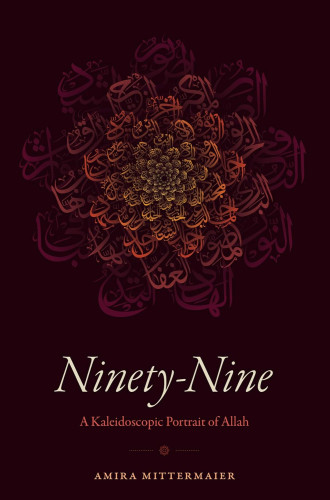
Ninety-Nine
A Kaleidoscopic Portrait of Allah
One morning in Agouza, Egypt, near Cairo, Amira Mittermaier passes an older woman selling flatbread from small plastic bags. She hears the woman utter two words, yā Karīm, O Generous One, and turns around. No one else is there, and the woman is not addressing her. She is addressing God. Perhaps also herself, standing in the heat, calling on generosity in a life that has not offered her much of it.
Mittermaier writes the scene up in her field notes that evening. She wonders whether she had any business listening at all. “Maybe that form of God-talk is none of my business. Maybe all those utterances and prayers are not for me to eavesdrop on.” She decides, at the least, to buy bread from the woman the next morning. The next morning, the woman is gone. “People disappear into Cairo’s dense urban fabric. God’s traces remain.”
That scene, early in Ninety-Nine: A Kaleidoscopic Portrait of Allah, holds almost the whole book in miniature. A prayer addressed to no human listener and an anthropologist who cannot decide whether to witness or withdraw. A figure who vanishes, leaving only a trace of what was addressed. The book, made up of 99 short chapters drawn from more than 100 conversations the author had with Egyptians about who God is to them, proceeds by accumulating such traces rather than by pinning anything down. The number in the title is significant. In Islamic tradition the names of God are conventionally counted as 99, but the classical list is contested; some traditions say there are 3,000, of which 1,000 were given only to the angels. Ninety-nine points beyond counting, toward the more.
Mittermaier is a professor of religion and anthropology at the University of Toronto and the author of previous books on dreams and Islamic charity. The daughter of an Egyptian mother, she left Cairo at age 18 for medical treatment in Germany. She has been returning to Egypt for 30 years. She is, by her own account, “definitely not pious” and “definitely not an atheist.” Agnosticism, she says, has never quite fit. What she prefers is deferral, throwing the belief question into the air and not letting it settle. That suspended posture lends the book its range.
Mittermaier’s own stance, though, proves more inward-
looking than that brief self-description first suggests. In the book’s Sufi chapters, she no longer only records the devotional imagination of others. She herself imagines angels moving through Cairo’s smog, close to the asphalt, searching for acts of remembrance, and then arriving with her at the Al-Sayyida Nafisa Mosque. At the hadra, a Sufi gathering of collective recitation whose very name means presence, the assembly becomes crowded with more than its visible participants: saints join in, God and the Prophet Muhammad draw near, and the space fills with angels. Yet, even here, surrender does not come easily. She admits that her mind keeps crowding back in and asks why she could not fall into sync. What enters the book here is the witness of a scholar drawn, with rare openness, toward the devotional world she has come to study, yet still unable to yield to it without resistance.
One of her interlocutors voices a question that recurs throughout the book. After the Rabaa massacre in August 2013, in which Egyptian security forces killed hundreds of Muslim Brotherhood supporters in a Cairo square, Mustafa, who helped drive the wounded to the hospital and saw people die in his car, asks, “Where was God?” The answer arrives in broken form: between people, and also terribly far away.
Ninety-Nine is grouped into seven sections, whose titles do most of the conceptual work. “Where” is an introduction of sorts. “Up There” holds the inherited God of throne and hellfire that Egyptian millennials are trying to leave behind. “Somewhere” takes up their experimentation, with God found in therapy, anarchism, travel, and new Sufi orders. “Right There” holds the tension between God-as-almost-human and God-as-far-removed, a God whose hand may be felt, whose voice may be heard, and for whom prayer can become, in a dervish’s telling, a daily miشrāj, a repeated ascent into audience and intimacy. “Everywhere” moves into Cairo’s Sufi worlds, where the Divine spills into dust and water and the scent of musk, clings to shrines and bodies, and leaves its blessing in matter. “Nowhere” gathers the doubters and the wounded: a God under the rubble of Gaza. “Maybe Here” folds the book back through conditional prayer, the legendary servant Khidr, and multiplicity, refusing resolution.
The chapters inside these sections are short, most of them two to four pages, some a single page, and they follow no chronology. The interlocutors are eclectic: dervishes and doubters, Salafi housewives and queer agnostics, a tile installer who sleeps in God’s palm, an anarchist who lives by the baraka, or spiritual blessing, of his mother’s prayers, a young woman who dreams of God as a beautiful boy in an elevator and kisses him. Mittermaier is especially drawn to what she calls the postrevolutionary generation, middle-class millennials who fought at Tahrir Square in 2011 and who, in the years after the military coup in 2013, rethought and rebuilt their relationships with God, often outside the mosque.
Mittermaier is not blind to the critique that this crowd is privileged or consumerist. She hears it from a cynical former Muslim Brotherhood member who says his generation’s Sufism is “a drug that numbs your pain.” She records the critique and holds her ground anyway: these imaginings belong to the tradition.
Her method is conversation. She collected stories in the years after the uprising, through Mohamed Morsi and the coup, through COVID and Gaza. Her research assistants, themselves Cairenes trying to work out their own relationships to God, conducted interviews when she could not be in Cairo. What fills the book is a chorus. There are voices, placed next to one another, leaving their marks.
The 99 names of God are, in one sense, a catalog. Al-Rahmān and al-Rahīm: Merciful, Compassionate. Al-Qahhār and al-Muntaqim: Subduer, Avenger. Al-Muhy and al-Mumīt: Life-Giver, Death-Bringer. Preachers in Cairo teach believers about the names one by one, sometimes suggesting that if a person masters all 99, the full picture of God will come into focus.
Mittermaier considered organizing her book that way, one story to each name. Then, she writes, it hit her: “the trap of knowability.” There is no full picture. The 99 is not a sum. “Letting myself be inspired by the number ninety-nine has come to mean something else for me: embracing a plurality of voices; allowing overlaps, echoes, and contradictions; welcoming excess, unknowability, elusiveness. In short: accepting that there is always more.” The form is faithful to the subject. Any book honest about God must admit what escapes it.
This is the governing intelligence of the book. The number 99 is an orientation that points toward what exceeds counting, and the form of the book enacts it. Each chapter stands on its own: a portrait or a sustained meditation. Each chapter is also a refraction of something that will not sit still. Placed next to one another, the chapters open outward. A young Sufi tells Mittermaier, “We all project tons of things onto God, but God Himself is outside all our projections.” In the closing chapters, Mittermaier names what she has been doing. The book’s theology, she suggests, is apophatic, a theology of unsaying.
That same logic returns in her late chapter on Khidr, the mysterious guide of Qur’anic tradition who is endowed with knowledge of the unseen, al-bātin. Through him, she arrives at one of the book’s quietest recognitions: Questions can only take a person so far; some forms of knowledge come only through experience, submission, or illumination. The invitation organizes her book as it organizes his speech. Hence the refusal of the five-chapter monograph or packaged takeaway.
The form resists the academic shape she declines, and anthropology at its best can only line up its questions beside the world and listen. As Mittermaier says, when one is trying to capture God, it is best to stay close to the ground; when running after God as an anthropologist, it is best to crawl.
One of the book’s most complete stories is Sherine’s, and it takes a single page. On the 15th day of Ramadan in May 2018, she starts her car and drives down an empty street, going slowly, and a four-year-old boy runs out from nowhere and strikes the front of the car. He dies in her arms on the way to the hospital. Right there, Sherine sees God manifest through every name. God is al-Qahhār, the Subduer. God is al-Muhy wa al-Mumīt, the Life-Giver and the Death-Bringer. God is Musabbib al-Asbāb, the Cause behind all causes. She breaks down and can’t sleep. “I’m a killer,” she says, and she means it. She faces the public prosecutor and is ready to accept any punishment. The boy’s family asks for none. The mother, in the hospital, says only that God is the Forgiver, and Sherine understands this to mean that the mother cannot yet forgive her, and should not.
She pays the full Islamic blood money. She also fasts for two consecutive months, following the Qur’anic prescription for accidental killing. Her last day of fasting falls on the Prophet’s birthday. Later she dreams of the boy in a garden and asks him to tell his mother she is sorry. She longs to kiss the mother’s hands and feet.
Years later, a message reaches her through a mutual friend: The mother writes that the boy was a beautiful person, that they are two sides of the same coin, that Sherine should lift herself up. What Sherine’s chapter does, more than any other in the book, is refuse to close. The wound stays open because closing it would be a lie. Faith, in her, is something harder than consolation: a way of staying inside what cannot be made to make sense.
Magdi carries the book’s hardest theology. He joined the Muslim Brotherhood six months before the military crushed the organization. On the day of the Rabaa massacre, he was consoling a friend who had lost his wife in a car accident. Hundreds were killed that day in the square. Magdi has struggled ever since with what it means that this happened to people who tried so hard to be godly. He never doubts God’s existence, yet after Rabaa he doubts that God cares. He asks sheikhs and gets standard answers about ibtilā’, the idea that God tests us. He is not satisfied. Eventually, rereading Naguib Mahfouz’s Children of the Alley, Magdi arrives at an image: God is up on a mountain, facing the other way, depressed. God created the world and no longer interferes. He is disappointed in his children. He cannot kill the evil one; that son is still his son.
Mittermaier tells Magdi that Hans Jonas, the German-born American philosopher, argued after Auschwitz that we can understand God’s silence only if we abandon divine omnipotence. John Caputo has written of a “theology of perhaps.” Magdi is delighted to learn he is not alone. Then Gaza arrives, and Magdi is furious. What kind of God tortures people like this? He says God seems sadistic, “a God who takes pleasure in torturing His subjects to then reward them with a paradise they never asked for.” And still, in the same breath, he says: “I’m 100 percent certain that God exists.”
That contradiction is where the book lives. Not Rabaa or Gaza or the sheikh’s textbook answer, but the place where the certainty and the fury refuse to cancel each other.
“Since Gaza, I, too, have been trying to figure out what to do with God under the rubble,” Mittermaier writes near the end of a chapter called “Under the Rubble,” which is the hinge of the book. Her friends, she says, are better than she is at holding the contradictions. The admission is the book at its most honest and vulnerable.
The chapter places two Christmas sermons of Munther Isaac, the Palestinian Lutheran pastor in Bethlehem, alongside Cairo after Rabaa and Cairo after Gaza. Isaac, preaching about the bombed churches and the dead children, cites Palestinian theologian Mitri Raheb: “The God of this land isn’t like all the other gods. His land is plowed with iron. His temples are destroyed by fire. His people are trampled underfoot, and He does not move a muscle.”
Magdi’s depressed God hardens after Gaza into a sadistic God. Sufi communities in Cairo hold dhikr sessions for Gaza or recite the litanies reserved for spiritual warfare. Videos circulate of parents in Gaza whose children have been killed proclaiming lā ilāha illā Allāh: There is no deity but Allah. A woman in Gaza, during the height of the bombardment, writes on X: “If Allah lifted the veil for just ten minutes and we could see the sky of Palestine, we would see waves of angels ascending with the souls of the martyrs.”
Some of Mittermaier’s friends marvel at the Gazans’ steadfastness. Others find it offensive to speak of divine tests at a time of ethnic cleansing and mass starvation. They say we should not romanticize the Palestinians because it distracts from what is being done to them. The chapter sets these responses beside one another, true to the book’s form. Hans Jonas and John Caputo are in the room, yet they arrive through Magdi in a Cairo coffee shop, and the chapter returns to him rather than to them.
A passage that lingers arrives a few chapters later. It is April 2024. Mittermaier is back in Cairo, visiting Ayman, a psychiatrist and former revolutionary whose friends are asking hard questions of God. Ayman tells her that all these questions come down to one: Rabbinā feen? Where is God? Where is God during massacres, wars, genocides? When people ask Ayman where God is, he asks: Where are you? When people want to put God on trial, he holds up a mirror. When people ask about divine justice, he asks about human choices. “In the end,” Mittermaier writes, summarizing his position, “if God gets tired of us and turns away, only we are to blame.”
Ayman refuses to let God become the hiding place of human responsibility. The book, which has thus far given the reader many versions of the Divine that are unbecoming, turns here and recovers the harder question, which is the one the prophets asked: Where are you?
Mustafa, after Rabaa, answers his own question in two ways at once: God is between us, and God has deserted us. Ayman, after Gaza, refuses to let the second half of that answer absorb the first. If God has deserted us, the book seems to suggest through him, it is because we have first deserted one another. This is a theology that Egyptian Muslims and Palestinian Christians can speak together, and it may be the book’s most serious claim.
After 2013, politics became dangerous in Egypt. Protests were banned, and tens of thousands were arrested. Many of those who had occupied Tahrir Square two years earlier withdrew from public life, and God moved indoors with them. Mittermaier follows this migration closely. Allah now shows up, she writes, in yoga classes, overpriced coffee shops, and therapy sessions. Her interlocutors read Elif Shafak and Eckhart Tolle. They travel to Rishikesh, attend silent retreats, and take up meditation. A striking number of them join Sufi orders, some of which fill up with former revolutionaries who kept wanting some echo of the collective ecstasy of Tahrir. Others follow sheikhs from Gambia or Germany. They practice dhikr in rented halls in Zamalek. They go on retreat in Konya, at Rumi’s shrine.
Mittermaier flags the obvious critique of this crowd and records it in their own voices. A former Muslim Brotherhood member in his 20s tells her that his generation’s Sufism is a way of running from God’s darker sides by exaggerating the good ones. A cynical friend speaks of people who glamorize their sheikhs on Facebook and think being Sufi means “being filled with butterflies.” The book stays with the crowd anyway. Its position is that these imaginings belong to the tradition, however unevenly, and that the more interesting question is what they are doing and why.
What the book names, without quite pressing, is this: The generation that turned toward yoga and meditation and Sufi retreats was not, in the first place, choosing between spiritual options. It was living under an authoritarian state that had made most other forms of collective life lethal or illegal. The question the book leaves open is whether what it documents is spiritual renewal or drift, a historically intelligible reassembly after political defeat. Each answer is available in the material. Again, the book does not force the choice.
In the end, the postrevolutionary chapters are at their most truthful when they let the question stay open. A generation that has been forced indoors is looking for God in the rooms where the state has allowed it to gather. Whether this is faith or adaptation or both at once is not a question anyone in the book, including the author, can settle. What Mittermaier does, and what her form allows her to do, is refuse the verdict.
Ninety-Nine belongs to neither theology nor anthropology as they are usually practiced. It is closer to what Alexievich did with the voices of Chernobyl, or what a poet does when a poem agrees to be many things at once. Mittermaier collects fragments and lets them sit beside one another. And she admits, in the closing chapters, that the fragments do not add up to the whole. They were never going to. “Any portrait of God,” she writes, “will always and inevitably be incomplete.”
What is unusual is that the incompleteness is the book’s discipline. The bread seller disappears. The boy dies in Sherine’s arms, and she still calls herself a killer. Magdi is certain God exists and just as certain that God is cruel. Ayman, during Gaza, asks where we are. Mustafa, after Rabaa, says God is between us and God has deserted us, and he will not say which he meant first.
To my ears, these God stories faithfully collected over the years read as a form of pilgrimage. By listening, intently, to the intimate reflections of what is sacred for others, we overhear our own unconscious prayers.