Voices

Christ in my nerve endings

Living with chronic pain is deepening my understanding of the incarnation.

During a recent silent retreat, I came across a poem by Symeon the New Theologian, an 11th-century Eastern Orthodox monk. The first stanza rattled me so thoroughly, I broke silence by gasping and then crying:

We awaken in Christ’s body
as Christ awakens our bodies,
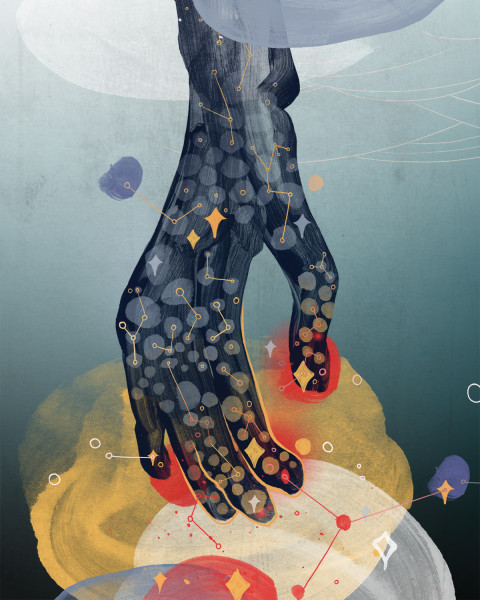
and my poor hand is Christ, He enters
my foot, and is infinitely me.

The words had the impact they did because a successful treatment regimen for early breast cancer has left me struggling with peripheral neuropathy. Nerve pain is like no other pain I’ve ever experienced; it’s weirdly eclectic.  Sometimes it stabs. Sometimes it burns. Sometimes it tingles. There are days when I feel like my toes are encased in ice and others when my fingertips feel so raw, even the gentlest graze of the skin is intolerable.
My physicians are still looking for solutions, so they can’t give me what I crave most: an end date. Maybe these symptoms will disappear tomorrow, maybe in a few months. Or maybe this is my new normal, and I have a lot of spiritual work to do—which brings me back to Symeon’s scandalous poem. My poor hand is Christ?  He enters my foot, and is infinitely me?

I’ve believed in the incarnation my whole life. My evangelical parents raised me on the core truth that Jesus willingly became a human being in order to save us from our sins. In the Episcopal tradition that informs my faith now, the incarnation is foundational. It grounds the sacredness of creation, the grace and efficacy of the sacraments, the inherent dignity of all life. Because the Divine has lovingly broken into our earthly realm, every corner of the cosmos is infused, upheld, and shot through with the hallowing presence of God.

Or so I have blithely claimed, never needing until now to ponder the possibility that “every corner” might include not just the mysterious depths of the oceans or the swirling wonders of interstellar space but also my buzzy thumbs, aching palms, and frozen toes.

I’ve never had to live with chronic pain before, so this is uncharted territory. I’d be lying if I said I’m navigating it gracefully. When the neuropathy first started, I’m ashamed to say I reacted with shock and outrage, as if I should somehow be immune from the debilitating medical conditions that afflict so many others. My prayers were short, blunt, and frantic: “Cure, please, now.”

These days I’m not as frenzied, but I’m still sad, scared, and overwhelmed a lot of the time. Though I try not to waste energy on the “why” question, it pops up unbidden. So does, What does the pain mean? What is it for? What am I supposed to learn from it? On good days I try to lean into Paul’s “God’s strength is made perfect in my weakness” idea (2 Cor. 12:9), but truth be told, “perfect” feels like a laughable stretch.

Meanwhile, I’m realizing that when it comes to our culture’s obsessions with productivity, stoicism, and self-sufficiency, I have drunk deeply of this toxic well. It’s hard to separate my self-worth from how much I can accomplish in any 24-hour period. These days it isn’t much, and that stings. It is just as hard to ask for help, or say, “I’m sorry, I can’t,” or give myself permission to rest.

Worst of all, the temptation is strong to divide and dissociate. To live in my head and cut off the parts of me that throb, stab, ache, and go numb. Suddenly, my hands and feet seem less worthy of esteem, less resonant with meaning, less deserving of grace.

Perhaps this is why Symeon’s poem made me cry out loud: it describes an incarnation that is appalling in its intimacy. It is so thorough and yet so specific, it implicates every atom, cell, nerve, and tendon, wrapping all flesh in unconditional belovedness. In the wide embrace of this incarnation, everything I am and everything I have belongs. I don’t have to divide and dissociate, because my fully enfleshed participation in Jesus’ life is welcome, not just when my body is whole and healthy but also when it is frail, wounded, broken, and exhausted. I really can look at my poor hand and see Christ. “I move my foot,” writes Symeon, and the Divine “appears like a flash of lightning.” I can offer up everything in me that is “maimed, ugly, irreparably damaged,” because Christ “awakens as the Beloved in every last part” of my body.

In Black Liturgies, Cole Arthur Riley reflects on her own struggles with chronic pain and writes that she’s had to “become a creature of unflinching hospitality to every new ache and twitch. Not that I would lose hope for a life with less pain, but that I would not drift too far from the present one.  Because that distance, between what I crave my body to be and what it is, so quickly becomes the path to disembodiment and then, despairingly, to self-hatred in all forms.”

I am not yet as hospitable as I would like to be, but I am trying: to remain open, to pay attention, to welcome Christ’s body. Because there is a hard but infinitely tender invitation at the heart of the incarnation. It is an invitation to unconditionally love each part of ourselves as if that part were Christ. Because it is. In the lavish economy of the Divine, Christ is inextricably close to bodies in pain. Christ surrounds and infuses the dust God once breathed into being. Christ awakens in the bodies that he surrendered his own body—pierced hands, pierced feet—to save. 

Debie Thomas

Debie Thomas is a seminarian at Church Divinity School of the Pacific and author of A Faith of Many Rooms.

All articles »