When I was in high school, my civics class put Odysseus on trial for the death of his men. In partnership with our world literature class, we were divided into defense and prosecution teams and tasked with scouring The Odyssey for evidence we could use in a courtroom simulation. I ended up playing the role of Zeus as a witness for the defense, arguing that the gods were ultimately responsible for the various misfortunes that resulted in all the men dying. Ergo, Odysseus could not be held responsible. We won the case.
Looking back, it was a rather simplistic argument, the kind teenagers make when they are fixated on deflecting blame and looking for loopholes in adult judgments. But we weren’t wrong. The epic poem is driven at least as much by the action of the gods intervening to punish or aid mortals as it is by the choices of Odysseus or any other human.

Read our latest issue or browse back issues.
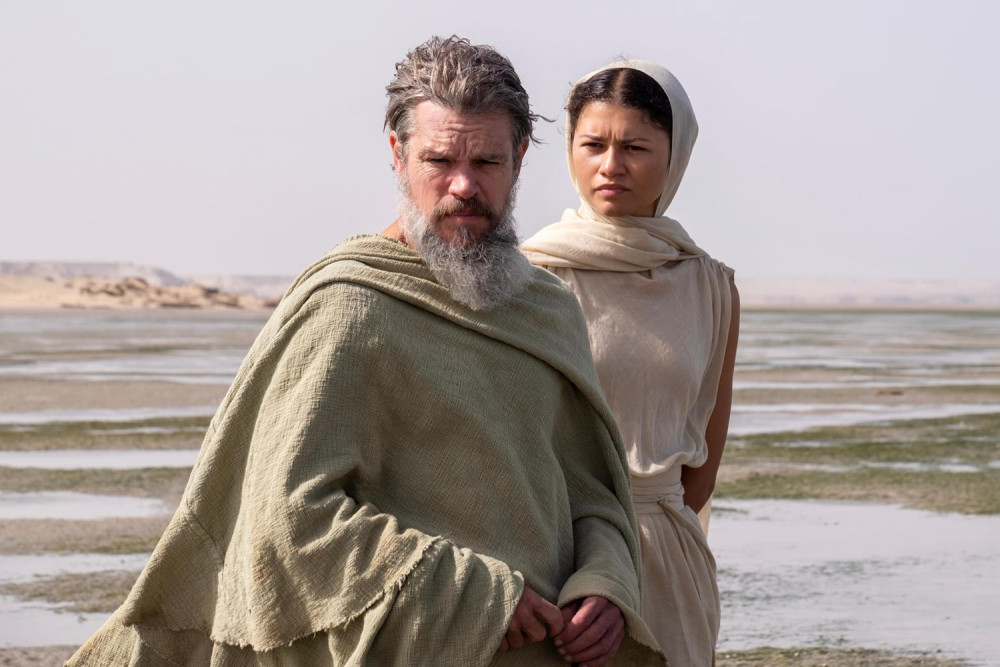
If we erred too far in deflecting human agency, director Christopher Nolan, in his epic, visually stunning film adaptation, errs in the other direction. Other than a mournful Athena (Zendaya), who is less the goddess of cunning who manipulates the physical world on Odysseus’s behalf and more a manifestation of his conscience, the gods are entirely absent.
They are mentioned, of course. When Odysseus (Matt Damon) wounds the Cyclops, who is a son of Poseidon the sea god, the whole crew knows they are in for some rough weather. When the men slaughter the sun god Apollo’s sacred cow, they seal their fate. But the gods in Nolan’s world are more abstract principles of fate or morality than beings with power or agency influencing the mortal realm or requiring propitiation and worship.
There are still one-eyed monsters and giant warriors, witches and sorcerers, sirens with their bewitching songs, and the impossible choice between whirlpool and man-eating monster. These are narrated as flashbacks by Odysseus while he is ensorcelled by Calypso (Charlize Theron), who insists that her imprisonment of Odysseus is really an act of kindness. Woven into these flashbacks are even farther back flashes of the Trojan War and Odysseus’s famous master stroke, the Trojan horse, which won the war for the Greeks. While Odysseus is misled and beguiled, stretching what should have been a journey of a few weeks or months into a decade, his faithful wife Penelope (Anne Hathaway) and his son Telemachus (Tom Holland), whom he left behind as an infant 20 years earlier, are besieged by greedy suitors intent on forcing Penelope to choose a new husband and a new king for Ithaca. Once Telemachus sets sail for Sparta in search of word of his father, we have another voyage full of perils and new characters, like Menelaus (Jon Bernthal) and Helen of Troy (Lupita Nyong’o).
These interwoven timelines and geographic shifts are Nolan’s specialty, narrative techniques he’s been experimenting with since his breakout film Memento (2000) and expanded in his twisty narrative loops like Inception (2010), Interstellar (2014), and Tenet (2020). He keeps this story moving with speed and grace, carefully calibrating between the intimate story of a grieving wife and confused son and the violent, cruel world of war and open sea. He grounds the atmosphere and landscape in a gritty, realistic naturalism that emphasizes the heroics and enterprising genius of his ancient-world characters. The Trojan horse, for example, doesn’t just appear at the gates of Troy but must be hauled by dozens of men with ropes and pulleys and brute strength up from the beaches outside the city. Inside, Odysseus and his men cling perilously to its wooden walls, half-submerged in water, covered in human waste as they wait days to see if their gambit will work.
Perhaps most surprising is the way Nolan brings the story into a Christianly inflected moral universe (but without making it a Christian movie). The Greek principle of xenia, the reciprocal bond between strangers and hosts that demands hospitality and gift exchange, is updated as a general moral principle articulated by one character as a version of the golden rule and extended by Odysseus even to acts of war. The Odysseus of Homer’s poem does not spend time worrying if his feats of cunning to win the war are ethical or if he has an obligation to treat his enemies with kindness and fairness. Nolan’s Odysseus seems to think of little else. This is a somber Odyssey, absent much of the humor and wily cunning that animate the original poem. Nolan’s Odysseus is a man haunted by the effects of his genius and broken by the devastation of war.
There are more than a few traces here of Nolan’s other recent cinematic hero: Robert Oppenheimer, father of the atomic bomb. It is as though, after spending so much time with one genius whose brilliant invention ended a war and ushered in the end of certain assumptions about civilization, Nolan can’t imagine war in any other way. Even if it is not a message the ancient Greeks would have understood, it is probably one our culture needs to hear on repeat. No wonder Nolan had to get rid of the gods—it’s what allows him to shift the fate of the characters squarely to the human realm.
Like all soldiers attempting to reenter domestic life, once he lands at Ithaca Odysseus is wary of how things might have changed, on guard against betrayal and deception. But he is also met by faithful servants, friends, and the paragon of faithful wives. The boorish suitors have so riled up the bloodlust of their hosts (and the audience) that there is cathartic pleasure in watching them get their comeuppance. Here is where Nolan’s vision and the original poem find common ground: where an ancient society grounded in an ethic of war, honor, and revenge meets our contemporary moment that is rightfully wary of such commitments, turning one of our most ancient adventure stories into a meditation on war, the bonds of society, and what we owe one another.