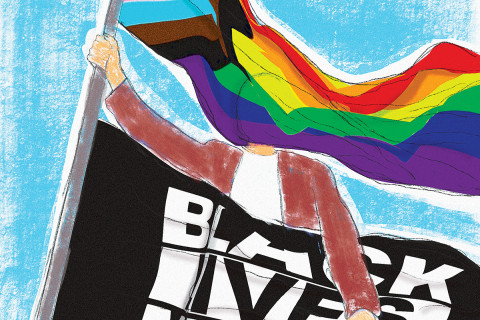

I used to believe in law and order. My evangelical faith communities pointed to Romans 13—where Paul tells the revolutionary early church to submit to whoever claims to rule the world—rather than centering our theology on Jesus’ injunction to “turn the other cheek,” an act of nonviolent resistance. However, I now realize that my belief in law and order had less to do with my Christianity than with my Whiteness. I came of age during Obama’s tenure in the White House (though I cast my first vote for Bush number two during his second term), and so I believed that the worst of America was behind us. After all, we had a Black President! Our country had ascended to the pinnacle of civil rights dreams! For years, I did not understand that “law and order” still meant a violent hierarchy, an order that set those with darker skin on the lowest tiers through extortion and force.
Of course, I write this today against a backdrop of terror. In Minneapolis and St. Paul, Minnesota, the Department of Homeland Security has descended with a troupe of poorly trained masked men who shoot before thinking. Already citizens have died without cause. Commenting on one of these deaths, the president of the United States, holder of the supposedly hallowed office, called one of these deaths an “unfortunate incident.”
The deaths of Alex Pretti, a White 37-year-old ICU nurse in the local Veteran Affairs hospital, and Renee Good, a queer Christian mother of three, remain a “political Rorschach test” in the words of reporter Julia Harte. And in both cases, spectators recorded video of the scenes. Twice in three weeks, we have watched citizens of our nation killed by a masked police force without a hint of due process. (The Constitution guarantees that even the guilty and noncitizen receive the plodding justice of our justice system, by the way.)
While social media debates the “incidents” from all angles, Department of Homeland Security officials spout their spin. Kristi Noem accused the dead of “domestic terrorism,” Trump called them paid agitators and “insurrectionists,” and in response to calls for officers to be censured or tried, the Department of Justice opened an investigation into Good’s wife, Rebecca Good. Meanwhile, the Leftist Working Families Party called both deaths political “executions,” and a District Court judge in Portland, Oregon, warned that the actions of DHS—particularly the violent suppression of protest—resemble the tactics of “an authoritarian regime.”
I suspect the entire institution of ICE has unveiled a fracture in America that will mend slower than bones. (Then again, I’m an optimist.)
However, I find myself deeply troubled that the most publicized deaths at the hands of ICE remain the White American victims, citizens who chose to exercise their freedom of speech with an understanding that the Constitution and our justice system would protect them. Yes, the bravery of these White citizens is commendable, but last year 32 people died while in Border Patrol’s custody. Already in 2026, ICE agents have been responsible for 7 deaths. The coverage of these deaths has been much spottier than the dedicated storytelling devoted to Pretti and Good.
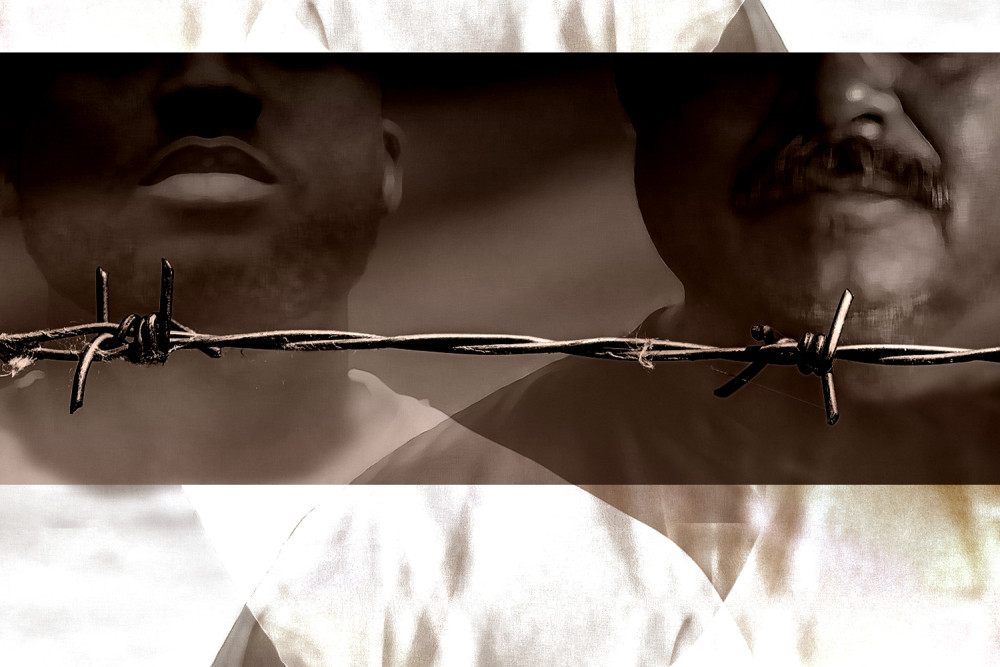
Perhaps one reason is that non-White Americans and immigrants comprise the majority of these deaths. Most occurred within detention centers under suspicious or negligent circumstances. Geraldo Lunas Campos’s death by asphyxiation has already been called a homicide by a medical examiner. Other January detention deaths remain under investigation, such as the deceased Víctor Manuel Díaz, Parady La, Luis Beltrán Yáñez-Cruz, Heber Sánchez Domínguez, Luis Gustavo Núñez Cáceres. And Keith Porter, Jr. was killed in Los Angeles by an off-duty ICE agent.
ICE does not exist to harass White American citizens. Most White American citizens have no reason to interact with ICE at all, not unless protestors place their bodies between ICE and their intended targets. ICE exists to terrorize the immigrant, the undocumented, and, apparently, the Brown; these are the intended victims. (The Supreme Court has made allowances for ICE to stop potential targets based on their racial profile alone.)
And I fear where this ICE effort will lead our nation. I fear the rising reports of abuses immigrants face within ICE detention. I fear the human rights violations that will never be reported. I fear what is not televised.
When I heard of Pretti’s death, I was reminded of another highly publicized execution in our nation’s history. In 1964, civil rights leaders initiated “Freedom Summer,” mobilizing over 1,000 White and Black college students to aid Black Mississippians in registering to vote. Though this demographic made up one-third of the state’s total population, only 6.7 percent were registered to vote due to intentional disenfranchisement and intimidation by White-run local governments and citizens. So, civil rights groups like the Council of Federated Organizations had organized to increase the Black share of the vote in the state, utilizing mostly White, upper-class, northern students as its volunteer canvassers. White America believed that their White children would be safe from race violence, even if they aided the cause of African American freedom.
But one week after the first group had arrived in Mississippi, three young men went missing: James (J.E.) Chaney, a Black Mississippian, and two White northerners, Michael (Mickey) Schwerner and Andrew (Andy) Goodman. The three men had driven to Philadelphia to investigate the arson of Mount Zion Methodist Church, where a few days earlier, Schwerner and Chaney had spoken, encouraging members to register as voters. The three young men never returned from their trip to examine the church remains.
The case of three missing civil rights workers electrified the country. Reporters gave daily updates. The FBI, DOJ, and Oval Office followed the case closely, corresponding with civil rights leaders and the families. The Navy and National Guard participated in the local search for the missing men, and J. Edgar Hoover’s FBI even offered protection and surveillance to those civil rights workers who stayed to complete their task.
The disappearances affected the Freedom Summer volunteers deeply. As one Black student volunteer, Gwendolyn Zoharah Simmons, reflected later, “Learning that three of our members [had been killed], two of whom were White, really blew away all my ideas that we would have protection from … the majority of the summer volunteers [being] White. … Everybody was in grave danger. [We feared that …] these Mississippians would kill all of us, White and Black.”
In fact, many officials had feared a bloodbath when they learned of civil rights leaders’ plans to enter the fractious environment of Mississippi politics. The recent passage of the Civil Rights Act in the Senate caused local officials to lash out against the federal government. They resisted following the law, which led to a resurgence of the state’s Ku Klux Klan, who happily filled the “vacuum of authority in Mississippi.” The Klan amassed a force of 10,000 White Mississippians, many of whom were law enforcement, write journalists Seth Cagin and Philip Dray in their comprehensive account of the event, We are Not Afraid. Robert Kennedy, the United States Attorney General at that time, considered these officials responsible for what happened next: “By their openly expressed contempt for the federal government, no less than by their tolerance for the Klan, local officials … were guilty of allowing the complete breakdown of law and order,” Cagin and Dray explain.
While FBI agents investigated Neshoba County and reporters hid behind every bush, KKK violence did not abate entirely. That summer, Freedom Summer organizers catalogued over 80 assaults, 1,000 arrests, dozens of churches and buildings levelled by arson or bombs, cars damaged or destroyed, and at least three additional murders. According to historian John Dittmer, “The summer of 1964 was the most violent [in Mississippi] since Reconstruction.”
Yet despite the danger, the students continued their efforts that summer, registering 17,000 Black Mississippians. (The state only accepted 1,600 of those registrations onto their voter rolls.) Meanwhile, the volunteers waited for news of their missing colleagues.
Finally, 44 days after the disappearances, the FBI received a tip. On the property of Herman Tucker, they discovered the boys’ decaying bodies beneath a newly dug earthen dam, victims of the local Ku Klux Klan. James Chaney, Andrew Goodman, and Mickey Schwerner, returned to their families, could finally rest in peace as heroes of the movement.
Still, the murders had revealed a rotten edge to the nation’s new concern with justice. In real time, Black civil rights activists saw that “it had taken the killing of whites to get the country to pay attention to the brutality blacks had suffered for decades in the Deep South,” according to Cagin and Dray. (The same could be said within contemporary America—it took the deaths of Good and Pretti to gain White America’s attention about the violent abuses occurring in the enforcement of our immigration policy.)
Even while the FBI searched for the three civil rights workers, James Chaney’s death received less media attention than the deaths of his White compatriots. While the Goodman and Schwerner families met with top government officials from the DOJ and FBI, even conferring with President Johnson himself in the Oval Office, Chaney’s family did not receive a similar invitation. As Cagin and Dray point out, “The primary news ‘angle’ to the disappearance—pursued almost exclusively by white newsmen—was that white civil rights workers were suspected of having been killed.” The White deaths of civil rights activists was newsworthy, unlike the ongoing threats, abuse, and deaths Black activists. The murder of a couple of White young men had shocked the nation in a way so many Black deaths had not.
The American public had assumed that the White boys would be safe. As one of the mothers, Carolyn Goodman, later wrote, a southern-born Black actor she knew had assured her sometime in July 1964, “I tell you they’re alive. They wouldn’t kill White boys.” She took comfort in his words: “For days that tossed in my mind. I hated the thought of seeking comfort in Andy’s color. Yet I kept silently asking myself. ‘Would they kill White boys?’ and would reassure myself, ‘No.’ Then I began to think … maybe, yes.’”
White Mississippians had killed Andy. And they had also killed thousands of African Americans before the deaths of Mickey Schwerner and Andrew Goodman. For example, they had killed James Chaney first, according to the later confessions of the perpetrators.
Yet so many of us White Americans mirror the thinking of a recent Threads user who wrote, “I’ll be honest, I didn’t expect it to be the white people they would publicly execute first.” Here, Karen speaks the same quiet truth aloud: yes, we’re all in this together—we are neighbors, friends, and communities. Yes, we are knitted to each other in a shared ecosystem. And yes, we may all disagree forcibly with the immigration policies being enacted by our overlords. However, the system of US immigration laws and enforcement has not set itself against White American citizens. We are not the intended victims of the laws enforced by ICE; we are, in fact, the intended victors.
By contrast, our Brown neighbors have a target on their backs, and their communities bear the brunt of DHS cruelty. To the administration, we White allies and activists are standing in the way of their law and order, while the Brown Americans and immigrants in our midst are, to them, barely human. Let us not forget who the administration has made the real enemy: it’s not us, White America.
This moment—when our Brown neighbors are being targeted by the state and its paramilitary power—calls for solidarity. And standing in solidarity might require more of us than our words. If necessary, we too may decide to place our bodies between the state and those targeted by the state. As the Episcopal Bishop Hirschfield reminded a crowd that had gathered in New Hampshire to mourn the death of Good, we may be entering a new era of martyrdom: “Now is no longer the time for statements but for us with our bodies, to stand between the powers of this world and the most vulnerable.” I pray there will be no more killings, no more need for vigils for immigrants or their allies. But I also pray that the Church of today will rise to this challenge.