You probably haven’t heard about the German man and woman who walked into an art museum and flung mashed potatoes at an impressionist masterwork.
It is 2022 and two 20-somethings, a blonde man with a bun and a woman with dark hair past her shoulders, walk into Museum Barberini in Potsdam, Germany. They mill with a daytime crowd before taking aim at the oil painting of a sun setting over haystacks, the reconstituted potato flakes dripping down the plexiglass—originally installed, no doubt, to protect the canvas against errant rays, glare, and vandalism.
Meanwhile, the man and woman step behind the “do not cross” barrier while applying superglue to their palms, allowing them to stick themselves to the drywall below the frame. They kneel, and the woman delivers a soapbox speech in German: “People are starving. People are freezing. People are dying. We are in a climate catastrophe. Does it take mashed potatoes on a painting to make you listen? When will you finally start to listen and stop business as usual?” Here the video of the event ends, leaving the question unanswered.
Rewatching the scene, I note the coordination of their movements, their neon orange hi-visibility vests, the calm of the woman’s partner-in-protest. The activists have chosen this method for the sake of shock value: They know the media will cover the defacement of a near-priceless work of art but not a rally on the steps of a parliament building. Maybe some of their fellow citizens will slow their scroll to consider why these two have turned a potato into a weapon.
Or maybe not. I suspect that you haven’t heard of this stunt. I had, but I had not been aware (until writing this essay) of the activists who had repeated this performance at our own National Gallery in Washington, DC, a middle-aged pair who had finger-painted on the plinth of a wax Degas dancer, echoing the protest of their European counterparts for disinvestment from oil for the sake of climate reparation.
What stands out most to me is the futility of their protest, the harsh sound of the German woman’s speech, and the resignation inherent within it. The best outcome these two protestors can hope for is that their arrest will be delayed—at least as long as it takes to unstick their palms from plaster—and that this delay will help the filmmaker to upload the longest possible shot to the internet.
Everyday acts of protest like these continue to occur for the sake of making the public aware of the climate catastrophe that is upon us. Some of these efforts make the news. Others are uploaded to social media or video streaming services in hopes of gaining thousands of likes, views, and reshares. Yet few garner such attention. Those that do only reach the likeminded, the already-convinced, and even these viewers engage for only a few seconds before dragging their thumb to view the next image.
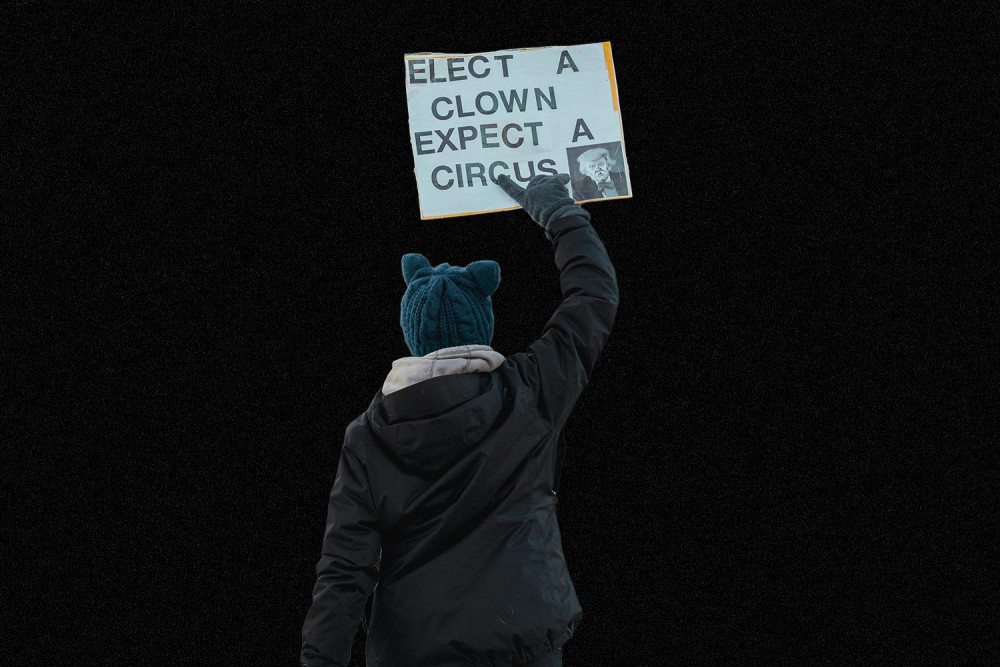
I once had greater hopes for these acts of protest, especially acts of political protest like we’ve seen in the US. The past ten years we have witnessed a remarkable rise in dissent, especially since the beginning of Trump’s second term. Over the past year and a half, millions have swarmed the streets of their cities to attend “No Kings” rallies. Immigration became a flash point around which Americans who disagreed with the administration could register their discontent, and Chicagoans and Minnesotans patrolled their neighborhoods with whistles, rallied at their local detention centers, and raised funds for those who had no choice but to remain homebound to avoid persecution.
Further, you could count the recent election wins of leftist populist candidates (like New York City Mayor Zohran Mamdani or, in my home state of Colorado, House of Representatives Democratic nominee Melat Kiros) as a protest reaction against stodgy institutional politicians (i.e. those lounging in the algae-infused waters of “the swamp”). Perhaps electoral wins means that a resistance movement is gaining steam.
But what has all this protest achieved? A year and a half into the 47th president’s term, is the dissent influencing the behaviors of our elected politicians, shifting policy, or gaining meaningful attention?
Yes and no. The Democrats blocked funding for ICE, for a while. The left also added a few more populists to the Democratic ticket. But the most heinous moves of the GOP—including its immigration policies—have not slowed and have even gained in strength, each month checking off another Project 2025 goal.
Worse, while we the people have raised posters and voices in the streets, the ruling GOP government has actively suppressed the American right to free speech. The right to protest seems to be up for debate. Consider how the FCC wielded its influence on CBS to cancel Stephen Colbert’s show, citing its obvious bias against Republicans. Consider the federal agents who showed up at a polling place recently to request that a woman remove an Instagram post that repeated the name of the officer who had shot and killed Renee Good in Minneapolis. Or consider how journalists have faced unusual threats and pressure from the White House and its allies—including Congress defunding media outlets that have covered the president unfavorably or published leaked information, the president filing defamation lawsuits against journalists and publishers, and the White House revoking critical journalists’ press credentials. Thousands of such journalists have also been arrested while covering political protests (including Don Lemon, former CNN anchor).
Or consider the recent arrests of “antifa” activists charged by the DOJ with “domestic terrorism,” including 15 in Minneapolis and 21 in Texas. The defendants of the Prairieland Detention Center protest received sentences from 30 to 100 years in federal prison—lifetime sentences. (One man who hadn’t even attended the protest received a sentence of 15 years for removing a box of printed zines from his garage. The zines advocated anti-capitalism, mutual aid, and direct-action protest tactics. Government prosecutors labeled these as “propaganda,” saying the couple had “created and distributed insurrectionary materials” on the printer found in the garage and cited this as proof of a criminal conspiracy against the government.) Scenes like these recall the undemocratic seasons of our national history, such as the McCarthy era, when disagreement meant deportation, a lifetime in prison, or economic ruin.
And the president himself has directed these policies, as he clarified in a speech delivered on July 3 at Mount Rushmore. With the faces of past leaders peering over his shoulder, he called the nation’s dissenters “communists.” (Evidently, the wins of the Democratic Socialists have spooked the chief executive. Though I’m not aware of any of the aforementioned candidates calling themselves communists, they probably do appreciate the works of Karl Marx, as many of the sunniest tenets of democratic socialism and communism overlap. With this in mind, Trump repeated the C-word so many times that, as New York Times reporter Shawn McCreesh commented, “You might’ve thought the Cold War was still on.”)
“These are not mere political disagreements like differences over taxes or regulations,” the president said. “Communism is a mortal threat to American liberty. It is the greatest threat to our country, including World War I, World War II, Pearl Harbor, or even 9/11.” These enemies, these “radicals and extremists,” “illegal immigrants [and] criminals” who “peddle Marxist lies about our heritage,” must be expunged, he argued—and we will do it. We will “send them into exile.” (In the same speech, Trump urged Republicans to vanquish the communists by passing the SAVE America Act and abolishing the filibuster post haste which would, in the president’s words, guarantee that “we will not lose an election for 100 years.”)
Added together, the president’s words and the actions of his Justice Department send a clear message to America’s protestors: dissent endangers this president, so words of dissent, even ideas of dissent, will face the full force of Trump’s ire with little to no judicial or governmental resistance. For a time, most people’s sense of activism had been reduced to social media performance—black squares on Facebook after the killing of George Floyd. But now activism is once more a political activity with consequences. Big Brother has entered the chat.
We are not the first nation to face down authoritarianism—a small comfort. In light of threats to rig elections and to lock up leftist protestors for lifetime sentences, protest cannot continue at scale, not without protestors facing dire consequences. (For example, what will happen to America’s will to protest if the Democrats—the only hope of balancing power in a two-party political system like ours—lose the midterms? If governmental power remains lopsided, or even becomes fixed through the gerrymandering and other disenfranchising policies of the party currently in power, will the American public be able to maintain a steady cadence of visible protest?)
Not everyone will choose to serve a lifetime sentence for the sake of their principles or for their neighbors’ wellbeing. Not everyone can. But some should. In fact, some already are. And we must continue our daily resistances. We may move our protest offline, investing in local efforts rather than public ones. (After all, the primary work of protest is not internet-worthy performance art; it is the act of humanizing those dehumanized by the powerful and cruel.) We may choose to code our resistance, to communicate resistance in subtler shades.
Yet despite the powerlessness we may feel—despite the way our voice turns harsh and desperate in the face of urgent injustice, like the pleading of the German woman who kneels before an unfeeling museum crowd—at these times, protest becomes even more vital. Directing our lives toward justice becomes an urgent matter of embodying our faith. After all, we Christians believe in the resurrection of the dead and the life of the world to come. How else does change happen except through the bodies of those who resist? As the German woman asked, “When will you finally start to listen and stop business as usual?” The answer to her question is now.
*******************
In this video, Liz Charlotte Grant chats with the Century's community engagement editor Jon Mathieu about the shifting landscape of free speech in the US—and what it means for protestors.