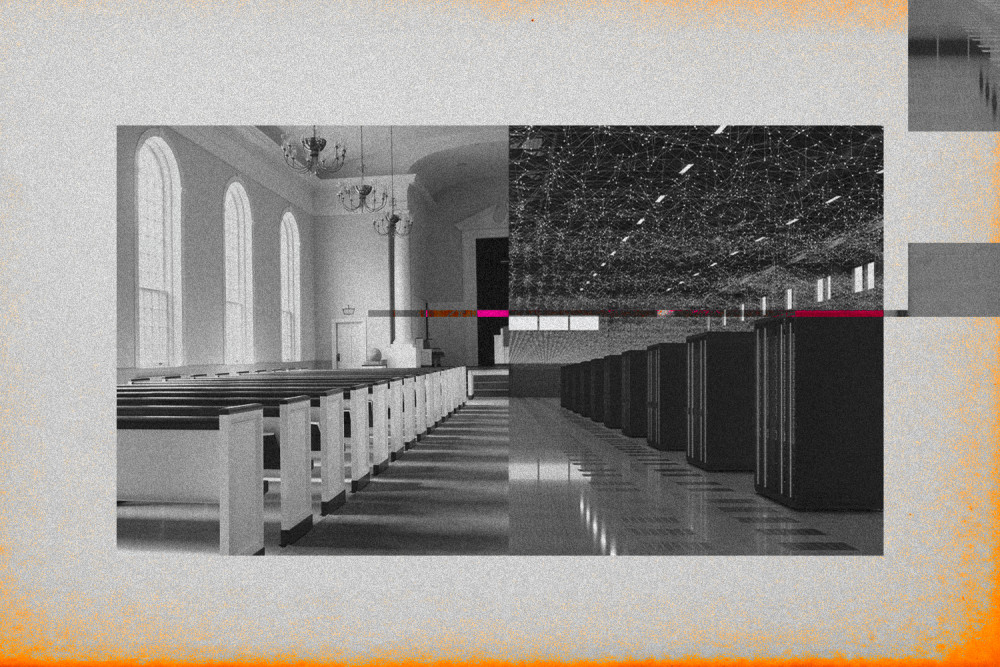
At a prestigious East Coast seminary, I listened to a scholar lecture me on the promise of artificial intelligence. We discussed the ethical dilemmas of AI and considered this emerging machine’s abundant possibilities for the scholar of religion, the theologian, the ethicist. At one point, the lecturer tried to use the chat bot’s audio listening function but forgot to mute its microphone after asking it a question. Hooked up to room speakers, the AI continued listening, only to hear itself and, entering what seemed like a state of confusion, to glitch while the lecturer frantically assessed its errors. One person in the audience—also convinced by the promise of AI—sought to defend our courageous speaker, marshaling the potential scale of the work AI makes possible to exposit its scholarly utility. As the lecturer worked to fix the machine’s feedback loop, the audience member used the metaphor of a manager and her employees to give us a sense of AI’s multiplying effects. With AI, they averred, everybody can become a manager. You need not be only an employee.
What I heard in that moment was the intimate fusion of religion, technology, and capitalism. It is hardly new. Just over a century ago, one of the founders of modern sociology, Max Weber, argued that capitalism required a religious, puritan psychology to justify the work ethic required for capitalism’s emergence—making capitalism, then and now, a secularized religious habit. Today, scholars continue to flesh out the religious underpinnings of this economy, which has gone ever more global and has absorbed ever new forms of technology into itself.
In considering the ways that capitalism and religion intersect, Kathryn Lofton offers this definition of religion: “Whenever we see dreams of and for the world articulated, wherever we see those dreams organized into legible rituals, schematics, and habits, we glimpse the domain that the word religion contributes to describe,” writes Lofton in Consuming Religion. “Whenever we see the real ways we organize ourselves to survive our impossible distance from those dreams, we grasp why religion exists. . . . Because religion has been a word used to summarize the habits by which we demarcate ourselves as certain kind of dreamers.”
AI seems to be yet another kind of religious dream, its advocates techno-religious dreamers. In a recent essay bemoaning tighter state-based AI regulation—the recent datacenter moratoriums no doubt the implicit political context—Meta CEO Mark Zuckerberg speaks of AI as a “superintelligence” that will herald a better future. In Zuckerberg’s account, AI seems to do everything while taking nothing. It is all promise without serious material costs. He speaks of AI like theologian Karl Barth speaks of God. It is our Infinite Other, qualitatively different, capable of reconciling us to ourselves despite our helplessness in the far country of our finite-laden and precarious ways. Lo, the kingdom of God is near once again. We have crossed a threshold and built the future, think Zuckerberg and his techno-optimist acolytes. He seems to have convinced some of us theologians to join him.
The religious dreams of AI have been around for years, and the arguments for the benefits of such dreams have been well-rehearsed. What AI promises to theology and religious education is simply what it promises to every other form of labor and activity, what it offers to modern industry more generally. Efficiency. Speed. Data analysis of the most robust and technologically sophisticated kind. And if you need it, companionship (so long as you suspend the flesh, the heart, and the embodied consciousness essential to the best companions—that is, people). I understand that some of these dreams feel so attractive and desirable that they invoke demands for a desperate leap of faith. Even I find my heart warmed when arguments are made that AI could give workers a few more hours to their day or could be used to connect to loved ones. I think of my niece and nephews, my wife and my friends—shouldn’t I use what tools I can to dedicate a few more hours to them? Why not seize this technology while it glitters enticingly before us? AI can help us think better. It can make us better family members and friends. It can give us back our mornings and our nights. It can offer us the truth.
Even as I doubt the plausibility of such a promise, I can relate to the alienated form of life from which AI merchant venturists and sophists promise to release us. AI crashed upon a society in which many people spend much of their waking lives working for little pay, juggling student loans and credit card debt, trying to adjust to increased costs of living, and toiling away at ever meaningless forms of work. It came to this society and promised the most novel kinds of revolutions: abundant free time, cancer cures, complete intelligence. It’s easy to be enchanted, to think, “Ah yes, here is a salve to my economic alienation and my self-estrangement.”
But who, I wonder, will be sacrificed in the name of general artificial intelligence’s expanding, universal, and salvific promises?
To name sacrifice is a way of entering deeper into a criticism of the religion of large language models and the capitalist economy supporting it. The theorist who comes immediately to mind whose words might help us understand how sacrifice is baked into AI’s economy—both for users and for the workers charged with building its infrastructure—is Karl Marx, the great 19th century critic of capitalism. In the pro-capitalism US we know Marx by way of the failure of the Soviet Union, the rise of “communism” in China, and—if you are not on the left—that infamous text he wrote with his colleague, friend, and benefactor Friedrich Engels, The Communist Manifesto. The manifesto, and Marx’s work more broadly, helped to inaugurate a radical vision of a world in which workers are not exploited, where they decide what and how to produce and how to be compensated.
Marx was a dreamer, and I see him as a man of religion despite his critique of it. As the Argentine Mexican philosopher and liberation theologian Enrique Dussel has argued in the recently translated The Theological Metaphors of Karl Marx, Marx leveraged religious language in order to understand the murderous logic inherent in capitalism’s expansion across the world. Maximum profit, buttressed by modern scientific industrialization, requires the continual theft of worker’s labor power and nature’s own abundant resources. Dussel points out how Marx describes such material alienation in his magnum opus, Capital: “Capital,” writes Marx, “is dead labor that only reanimates itself, like a vampire, when it sucks living labor, and which lives more, the more living labor it sucks.” Taking away a life to create life. The name for this, even in an economy void of explicit religion, is sacrifice.
Marx’s understanding of the sacrifice endemic to capitalism unveils the religious dimension to the on-the-ground reality of the dreams of AI, of Zuckerberg’s so-called universal promise. Data centers are notoriously resource intensive, and while not all new data centers are used for general AI models, the data centers that are being built by AI companies are massive. Open AI, for instance, is building a data center using upwards of ten gigawatts of electricity, which some say is the equivalent to the power of ten nuclear reactors. Indeed, the US government’s foreign policy initiative Pax Silica makes the quest for computation an imperial project and, while promising development, threatens power grid overuse and water pollution in places like the Philippines. In an age of global climate change, data centers and AI encroachment seem to move against the imperative that we use less energy-intensive technology when possible. It is this kind of expansion that has led journalist Karen Hao to describe the AI industry as an empire.
But the environment is not the only sacrifice to technological religious dreams. Workers, too, are being offered up. Tech journalist Jasmine Sun explains in the New York Times how the tech industry in Silicon Valley readily agrees that AI’s increasing hegemony of work will lead to a “permanent underclass.” Her op-ed is filled with comments from tech workers and executives who are worrying about underemployment, joblessness, and the replacement of workers with technology. One gets the sense that the dream for a utopia ushered in by AI outweighs the immediate harms inflicted upon everyday workers. Phil Christman has called AI “jumped-up large language models fueled by venture capital and systematic plagiarism”—that is, work theft, the living labor of writers and thinkers. Marx would call this the same thing he called industrial capitalism in the 19th century: vampiric. If the AI industry is alive, it is because those who dream about it and will it into existence are happy to sacrifice many people along the way.
As we wrapped up the lecture on AI, I felt deep sadness about the state of theology in the academy. I sensed that economic values are taking precedence over theological and humanizing values. Should we really encourage the use of such technology if its cost is life—life abundant? I do not want the sacrifice of workers and landscapes to be a condition in which I might learn to think and speak about God. We scholars, despite our credentials and our access to elite resources, are an alienated bunch, no doubt burdened by our own pressures for output and financial, material security. But that puts us alongside the weary and downtrodden workers, the poor, all those who dream for freedom and who take up religious practice in search of salvation. So the problem with AI is not that we dream, but that we cannot dream for a freedom radically discontinuous with our sacrificial society.
Two prophets challenged us to be better dreamers. One, watching the birth of a vampire that has latched onto us, declared that workers “have nothing to lose but their chains. They have a world to win.” The other began his ministry with this declaration: “The Spirit of the Lord is upon me . . . to release the captives . . . to let the oppressed go free.”
To take these words seriously is to take a real leap of faith—to actually dream.