Despite reasons for celebration and unity this year—the World Cup or commemorating America’s semiquincentennial—the truth is that our country still feels fractured. These divisions extend beyond political ideologies because they’re fueled by anxiety and institutional distrust. The Bible often becomes a pawn in these debates; each side uses it to justify or legitimize their positions. Americans have long turned to the Bible to explain who we are as a nation. But can the Bible help us overcome our deep divisions?
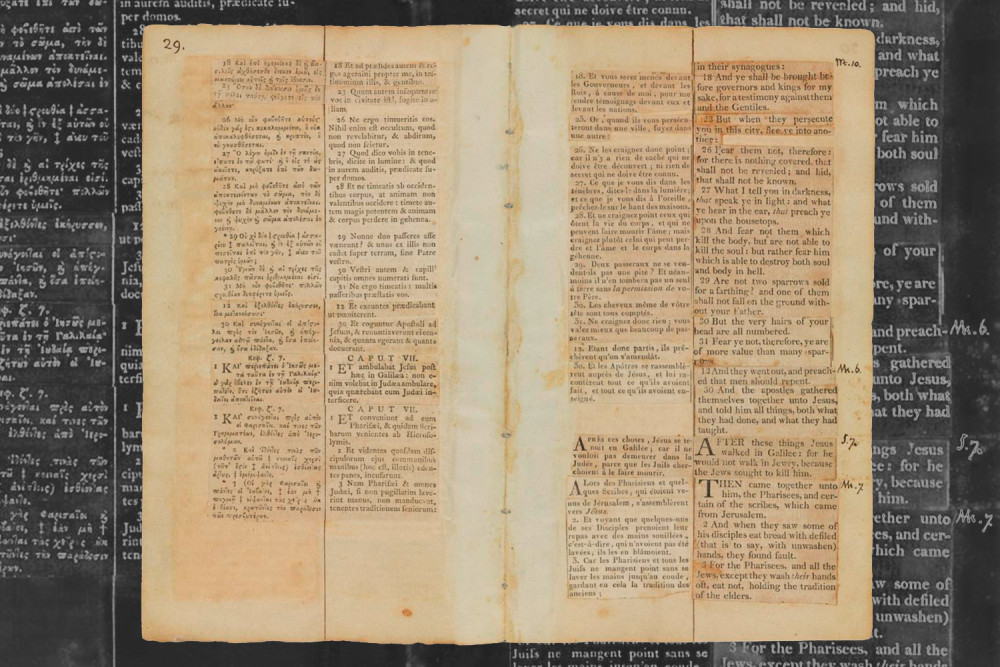
The selective use of the Bible is not new. Thomas Jefferson literally took a razor to his Bible. His The Life and Morals of Jesus of Nazareth is a redacted set of the Gospels that deletes the miracles, resurrection, and other supernatural elements of Jesus’ life. The result is a document that simply collects the ethical and moral teachings of Jesus. Jefferson’s Bible is not only a historical artifact, but it is also proof that various views of Christianity existed in the early republic. It is also a cautionary tale of how truth can be flattened by the weight of time. It raises the question that haunts our republic to this day: Do we allow Scripture to shape our identity, or do we reshape Scripture to fit the nation we imagine ourselves to be?
Some Americans, like Jefferson, continue to create their own “Bibles.” We often choose the passages that support liberty and equality, or prosperity and national destiny, while ignoring texts that challenge our assumptions. As a result, the Bible remains a site of contestation for American identity, a place where we wrestle with—or deceive ourselves about—who we are and who we hope to be. The actions of this nation continue to be contested and defended through competing interpretations of scripture. In the midst of centuries of such Bible disputes, some specific transformative voices arose at critical junctures. They did not simply quote the Bible; they used it to expose gaps between American ideals and American realities. Exploring a few of these figures and how they used the Bible in public speeches during another tumultuous period in our history, the 1850s and ’60s, might provide insight to help us move forward.