Two big streaming hits of the past year, Ghosts and School Spirits, feature spectral beings caught between this world and the next. Their only way out? Facing their pasts. Both shows are really talking about trauma, and that might hold some lessons for how we individually and corporately think about the past.
Set in upstate New York, Ghosts features Rose McIver as Samantha, who can see ghosts after a near-fatal accident. This is mostly a massive inconvenience, since the grand mansion that she inherited and seeks to turn into a thriving bed and breakfast faces a constant barrage of requests from its spectral inhabitants. Some of them have been without a “living” who can communicate with them for a thousand years, and they have food they’d like to smell and rooms they want to inhabit. The ghost drama that surrounds them is mostly played for laughs, but they all are seeking to ascend to a higher plane—or at least avoid being sent to a lower one.
One of the ghosts, Alberta, has to revisit her own murder, even while she navigates how to tell another inhabitant of the mansion that she killed one of her offspring. Another ghost tries to sell his story through a living character, as he resents that his contributions to the Revolutionary War are all but forgotten. What does it mean to live a life that no one remembers?
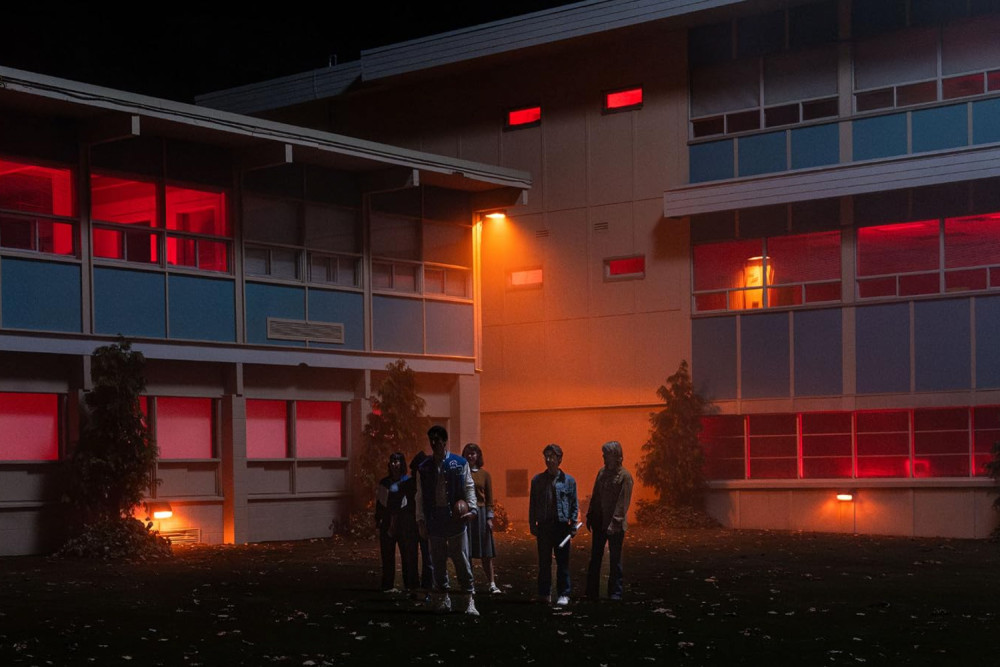
In School Spirits, the titular spirits are trapped in their high school and must figure out why. The seemingly random ascension of a ghost triggers flashing lights and a sense of terror for the other specters. At the same time, most ghosts are trying to get “their door,” which only lies at the end of their worst fears and most traumatic moments. For some, it is their murder by a teacher, for another a scene of bullying that resulted in death. For all, it is only at the end of their trauma that their salvation lies. We all have trauma, whether living or ghost, and the key to being able to move on is how we deal with it. Many of these ghosts have spent decades decidedly avoiding that, and so they are stuck in their high school, which, honestly, sounds like hell to me.
Trauma has become a buzzword in our culture. “Trauma-informed” as an adjective now appears not just in front of words like therapy, but also, increasingly, church. I know that I am seeking ways that liturgy and scripture readings can become more trauma-informed. Our individual pasts are certainly up for evaluation, and those who experienced trauma are increasingly likely to name it and expect their community spaces to practice care. That seems like a healthy step to me.
At the same time, we are experiencing a regression in our ability to look at our country’s traumatic past, even as we live through a traumatic present. Recently, the Trump administration placed placards at the Smithsonian warning of “inaccurate information” and the Department of the Interior took down signs that taught about the history of slavery in this country.
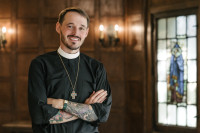
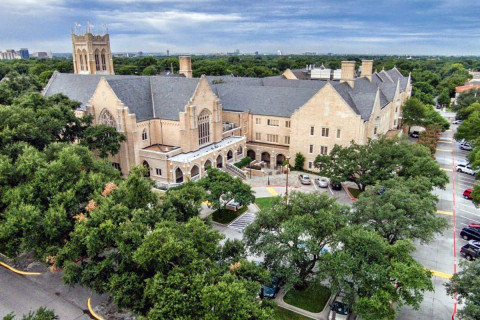
I faced my own miniature version of this when my church began to push for reparations. We are in Evanston, Illinois, the country’s first municipality with a reparations program, but I heard consistently that “it all happened a long time ago” and that the past was not worth addressing. I led my predominantly White church in its reparations effort with a Black congregation in town, led by Michael Nabors, that split from ours in 1882 over issues of segregated seating and lack of leadership opportunities. We wrote Race, Religion, and Reparations about that partnership.
Many of those who did not see the point in addressing the past are now some of the biggest advocates for reparations. People can change when they are put in a place to really wrestle with the pasts (that are not really pasts) in our midst. In our case, it was looking at the redlining maps that showed clearly the ways that our town had enforced and benefited from redlining at the expense of Black residents.
Confronting the past does not have to mean a morose focus on guilt. Addressing the past is one of the ways that communities that have suffered and perpetuated harm can find a way to journey into the future together.
In Caste: The Origins of Our Discontents, Isabel Wilkerson uses the metaphor of a house to talk about America’s past:
Not one of us was here when this house was built. Our immediate ancestors may have had nothing to do with it, but here we are, the current occupants of a property with stress cracks and bowed walls and fissures built into the foundation. We are the heirs to whatever is right or wrong with it. We did not erect the uneven pillars or joists, but they are ours to deal with now. And any further deterioration is, in fact, on our hands.
We are all living in a house together, one that is haunted by the stories and histories of the past. Our ability to live together is dependent on whether we address what happened or let the trauma build even more. For Christians, the question is even starker—how can we repent if we don’t even acknowledge what has happened?
Ghosts and School Spirits have plenty to say about that. Repentance and truly addressing what happened in our individual lives and as a country is paramount to our healing. I think there is a reason that these shows are so popular at this moment in our nation’s history. They are pushing us to delve deeper into the past as a condition for our own future flourishing. If we want to find our door, as the cast of School Spirits puts it, we will first have to wrestle with what happened. Otherwise, we will wind up stuck in our own private and corporate hell.