The Greeks have the Acropolis, the Romans their Colosseum, the Egyptians the pyramids, and the people of Israel their writings. These writings can easily be read today, 2,000 years after they were committed to parchment, since they are written in the same Hebrew that is still used by contemporary Hebrew speakers in Israel and elsewhere. Not stone, not brick, but the word of the living God as delivered through the prophets some 2,800 years ago.
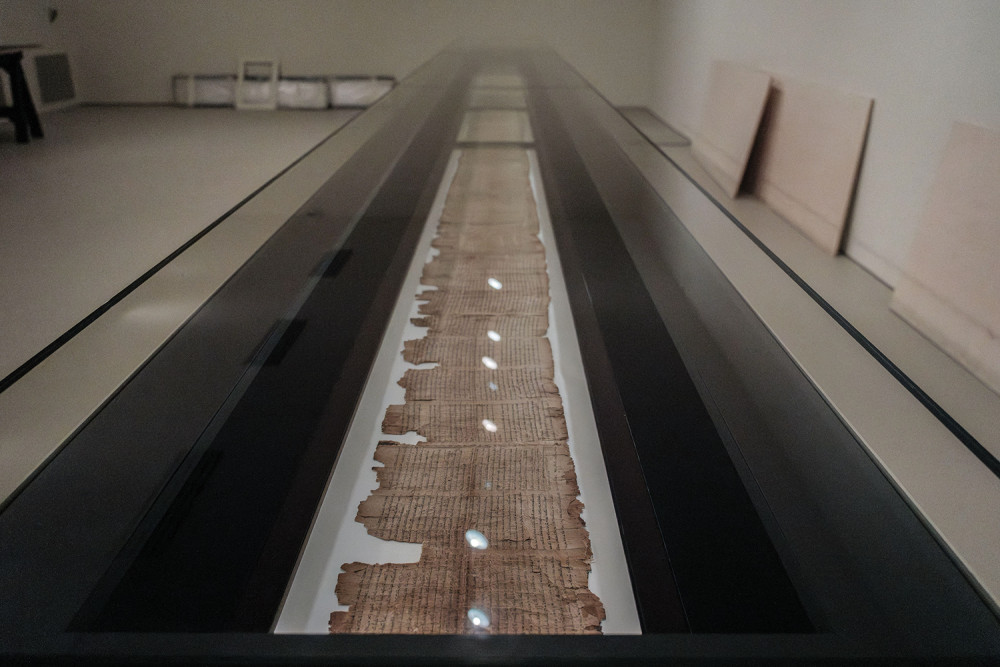
This summer, the Israel Museum in Jerusalem exhibited one of the most important of these writings. The exhibit, titled A Voice from the Desert, presented the entire book of Isaiah in a single scroll. It was found alongside many incomplete parchments some 70 years ago in the arid desert lands adjacent to the Dead Sea in what was then part of Jordan. Between 1947 and 1954, the Dead Sea Scrolls were discovered in caves, where they had been stowed long ago, wrapped up and secreted away in cooking jars. Their inaccessibility, plus the desiccated desert climate, helped preserve them through the long centuries until a Bedouin shepherd boy stumbled upon seven of them in 1947 while looking for his lost goat.
Then another miracle took place. Not knowing the value of what he found, the young shepherd sold the fragments to a Bethlehem antiquities dealer, who brought four of them—including the Great Isaiah Scroll—to Athanasius Samuel, the metropolitan of the Syrian Jacobite monastery in Jerusalem’s Old City. Samuel realized that the parchments were written in ancient Hebrew and thought he could sell them for a small sum to collectors, so he purchased them.
To confirm the antiquity of the scrolls, Samuel took them to a leading Jewish archaeologist, Eleazar Sukenik, who immediately recognized their importance and offered to buy them. Samuel declined and sought further proof of their authenticity. He showed them to John Trever of the American School of Oriental Research, who not only concurred with Sukenik regarding the scrolls’ authenticity but also photographed them.
In the midst of these discoveries, the 1948 war broke out. Fearing for the scrolls’ safety, Samuel sent them to be stored in a bank vault in Beirut. When he later emigrated to the United States, he took the scrolls with him. He hoped to find a buyer, but selling the scrolls proved to be an impossible task, in part because of their provenance. Both Jordan and Israel claimed ownership. Although they were found in what was then Jordan, the newly established state of Israel felt that the scrolls belonged to their heritage. For a while, the scrolls were stored in a safe in Massachusetts.
In 1954, Sukenik’s son, archaeologist Yigael Yadin, was visiting the United States to lecture on three other scrolls that his father had purchased for Hebrew University in 1947. By coincidence, an acquaintance of Yadin mentioned an advertisement in The Wall Street Journal offering four scrolls for sale. They were still in Samuel’s possession. Without revealing who wanted to buy them, an American intermediary, Samuel Gottesman, helped purchase the scrolls for the state of Israel for $250,000. The fear was that if Samuel heard about who wanted to buy them, the deal would be off for political reasons.
In July 1954, the four scrolls were flown to Israel, each in a separate airplane. The following January, the government announced plans to build a special building for the Dead Sea Scrolls, which would be located in the complex of the newly planned Israel Museum and called the Shrine of the Book. During construction, the Isaiah scroll was displayed in the Hebrew University’s Terra Sancta building for a decade, and then in the National Library in Givat Ram for a year. In 1965, it was put on display as the focal point of the newly opened Shrine of the Book.
It stayed on display for only three years. In 1968, the Isaiah scroll was removed from public display because of fears about its fragility, and a facsimile copy was put in its place. Although parts of it were occasionally shown in special exhibits, the original scroll was only accessible to a few scholars. It remained that way for decades. Eventually, the scroll was digitized—a time-consuming project that was completed in 2011—and the whole thing can be viewed online.
Earlier this year, the Great Isaiah Scroll went on display in its entirety for the first time since 1968. Although the war with Iran shut down the exhibit for several months due to safety concerns, visitors were allowed back in the late summer and the exhibition was extended through early October.
Because any exposure comes with risks to the scroll, only 25 people were allowed to enter the climate-controlled gallery at a time, and for only seven minutes. No photographs were allowed. Outside the gallery were displays about the scroll, including videos explaining how the ink was made and how the parchment was transformed from animal skins. In addition, there was a wall-length copy of the scroll, with many of its most popular sayings highlighted and explained. There was also a large video projection of the cave in which the scrolls were found and the surrounding area. Each of these displays added texture to the experience of being confronted by this unique artifact, which is 1,000 years older than any comparable biblical manuscript.
As for the scroll itself, there are many visible signs that it was in everyday use at one time. The threads that were used to sew the scroll together can be seen, as well as corrections and additions to the original script. Even more evident are the places where the scroll has been torn and the holes replaced by different parchment. Scholars believe that the scroll was actively used for about 100 years.
For visitors who read Hebrew, this exhibition was a unique experience. To see the 7.17-meter-long scroll in all its fullness, spread out over 54 columns, is something almost mystical. To know that this scroll was used by Jews all those centuries ago, studied and learned from, is enough to make even the most assimilated Israeli Jew feel a connection no other medium could rival. The knowledge that this ancient text, written some thousands of years ago, was carefully preserved and utilized for the sole purpose of continuing the tradition—and that it hasn’t lost any of its power to educate, cauterize, and bring comfort to the people, even in the most difficult of times—is further proof of the robust nature of that tradition, evidence that it never dies and its messages are never lost.
But who was Isaiah, the man behind this text? What we learn from the Bible is that he was an aristocrat, a nephew of King Amaziah. In the biblical narrative, Isaiah lives and preaches for over 45 years, through the monarchies of Uzziah, Yotham, Ahaz, and Hezekiah. His language is both clear and poetic. There are between 90 and 100 words found in the scroll that do not appear anywhere else in the Hebrew Bible, which demonstrates that he was a master of the vocabulary and was able to create neologisms as he felt necessary. According to the rabbinic tradition, Isaiah was brutally murdered by Hezekiah’s son and heir, Menashe. This death is a further indication of how deeply his preaching influenced the kingdom of Judah, even in his old age.
Then again, there is no agreement as to whether Isaiah is in fact a composite of multiple prophets. Scholars argue over the number of Isaiahs. In any case, Isaiah’s words carried a powerful resonance—not only with his contemporaries but also with the many generations that followed him. What was once applicable could, and did, repeat itself and find a listening ear over and over again.
It may well be that there was more than one claimant to the name, but on the scroll they are all united. Their teachings are the same, whether Isaiah is scolding his fellow congregants, as in his opening statement (“An ox knows its master, an ass its master’s manger, but Israel does not know. My people do not understand,” 1:3), or articulating his deep awareness of his role and why he has been chosen: “The Spirit of the Lord God is upon me, because the Lord has appointed me. He has sent me as a herald of joy to the humble, to bind up the brokenhearted, to proclaim freedom for the captives, liberation to the imprisoned” (61:1). (Biblical quotes are drawn from a combination of existing English translations and the original Hebrew.)
Isaiah is not afraid of excoriating the chosen people. He contrasts what they should be with what they’ve become. He creates elegant phrases that will later become everyday sayings. His admonishments against his people’s hedonistic, debauched, and fatalistic lives is well summarized in his cryptic phrase in 22:13, “‘Let us eat and drink,’ you say, ‘for tomorrow we die.’” Isaiah is not afraid to paint a picture of what will happen to “the vineyard of the Lord,” which is what the people of Judah are meant to be. Instead: God “looked for justice, but saw bloodshed; for righteousness, but heard cries of distress” (5:7).
At the same time, Isaiah predicts a bright future: “With joy you will draw water from the wells of salvation” (12:3); “Shout aloud and sing for joy, people who dwell in Zion, for great is the Holy One of Israel in your midst” (12:6). He sees a returning of the people after they have repented for their ways: “The redeemer will come to Zion, to those in Jacob who repent their sins, declared the Lord” (59:20).
Perhaps, however, the greatness of the prophet is that he does not confine his vision to only one people. Isaiah’s prophetic insights encompass the world:
It shall come to pass at the end of days, that the mountain of the Lord’s house shall be established as the top of the mountains, and shall be exalted above the hills; and all nations shall flow unto it. And many peoples shall go and say: “Come, and let us go up to the mountain of the LORD, to the house of the God of Jacob; and He will teach us of His ways, and we will walk in His paths” . . . and they shall beat their swords into plowshares, and their spears into pruning hooks; nation shall not lift up sword against nation, neither shall they learn war any more. (2:2–3a, 4b)
Isaiah’s metaphors ring as precisely as when they were first forged by this master of language: “The wolf will live with the lamb, the leopard will lie down with the kid, the calf and the lion together, and a little child will lead them” (11:6). Ultimately Isaiah foresees a new divine order in the world, when “I will bring them to my sacred mountain and let them rejoice in My house of prayer . . . for My house shall be called a house of prayer for all peoples” (56:7).
For all these reasons, the Great Isaiah Scroll is as relevant today as it was when the words inscribed on it were first declared. Standing in the tangible presence of the scroll underlines this continuity a hundredfold.
For many years, it was assumed that the Dead Sea Scrolls were brought there by the Essenes, a Jewish sect that left Jerusalem for the desert in order to live a life of contemplation and solitude. But more recently, this presumption has been questioned. In a Haaretz article published when the exhibit opened, philosopher Rachel Elior suggests that “these scrolls belong to the library brought by the priests of Zadok after they had lost their battle with the priests of the house of the Hasmoneans sometime in the second century BCE.” Other scholars, of course, have different theories.
This may not be the end of the story. In the same Haaretz article, Oren Gutfeld—the most recent archaeologist to work at the Dead Sea site—says this: “There are about 500 caves yet to be explored in the area. Who knows, maybe we’ll find other scrolls even more ancient than that of Isaiah!”