A new survey from Washington, DC-based Public Religion Research Institute has found a new dividing line among US adults ahead of the 2026 midterm elections: empathy.
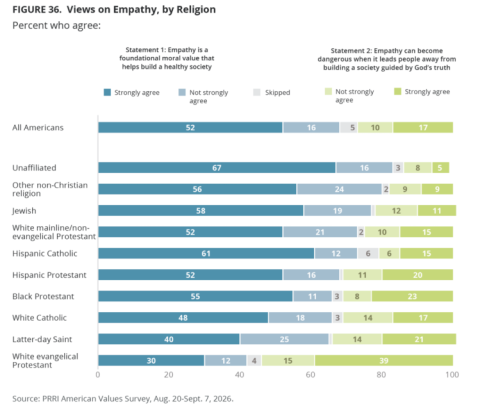
According to a PRRI report released Tuesday, Democrats (84 percent) and Independents (70 percent) are more likely than Republicans (53 percent) to see empathy as a benefit to society. Forty-three percent of Republicans see empathy as a danger if it leads society away from God.
The report, based on a survey of 5,200 US adults, also found that about two-thirds of people see President Trump as a potential threat to democracy, and some of the faith groups that supported the president in the 2024 elections are losing their faith in him.
While people in the US are split over the issue of immigration, with Republicans and White evangelicals supporting the idea of mass deportation of people in the country without legal authorization—a view held by only a quarter of US adults overall—everyone agrees the economy is going in the wrong direction (76 percent).
And almost no one wants to repeal women’s right to vote—a topic that has become popularized by Doug Wilson, a spiritual adviser to Defense Secretary Pete Hegseth.
The issue of empathy made headlines in January 2025, when Episcopal Bishop Mariann Budde spoke during an interfaith prayer service at the Washington Cathedral on Inauguration Day about the need for mercy and empathy. President Trump and Vice President Vance were in the audience for the service.
It has also been a matter of growing public debate, said Robert Jones, founder and president of PRRI.
Jones said researchers have been tracking the public conversation about empathy, which began among evangelicals with a blog post from conservative author Joe Rigney in 2019, and spread to influencers like Allie Beth Stuckey, who wrote the book Toxic Empathy: How Progressives Exploit Christian Compassion, and Canadian professor Gad Saad, author of Suicidal Empathy: Dying to Be Kind. More mainstream evangelical voices, like Albert “Al” Mohler, president of Southern Baptist Theological Seminary, have also expressed concerns about empathy.
“The question is always, is this something that happens on a podcast or just in certain circles,” Jones said. “How widespread is it?”
That led PRRI to ask in this new survey if US adults see empathy as a benefit to society or a threat. Researchers found what Jones called a partisan “empathy gap.”
Religious groups were also split. At least two-thirds of most major religious groups said empathy “is a foundational moral value for a healthy society,” as did 83 percent of those identifying as religiously unaffiliated. White evangelicals were the least likely to name empathy as a foundational social value (42 percent), and more than half of White evangelicals (54 percent) said, “empathy can become dangerous when it leads people away from building a society guided by God’s truth.”
By contrast, White Mainliners (73 percent) and White Catholics (66 percent), both of which, like White evangelicals, have supported Donald Trump in past elections, still see empathy as important.
“It tells you that this language has now become the majority view inside of White evangelical circles,” said Jones. “They really are on an island by themselves on this question.”
Among other findings, PRRI found that the GOP has lost ground with voters who supported Donald Trump in the 2024 election. In 2024, just over half (51 percent) of Hispanic Protestants viewed the president favorably. That has dropped to 31 percent in 2026, according to PRRI.
About half of White mainliners (48 percent) approve of the president, down from 57 percent last year. Half of White Catholics (49 percent) approve of the president, also down from 57 percent in 2025.
When PRRI asked people who voted for Trump in 2024 if their opinion of the president had changed for the better or the worse over the past two years, more than two-thirds (68 percent) said “for the worse.” Among Hispanic Protestants, 70 percent said their opinion of Trump had worsened since 2024.
“If I were either a Republican or a Democratic strategist, the one eye-popping movement here is that Trump favorability among Hispanic Protestants is down 20 points,” said Jones.
Researchers also found that religious adults are divided over the upcoming mid-term elections.
“Among those who are registered to vote and plan to vote, white evangelical Protestants (68%) and white Catholics (51%) are the only religious groups with majorities who would vote for the Republican candidate,” according to the report.
Hispanic Protestants (44 percent) and White Mainliners (43 percent) prefer Republicans to Democrats, but neither party has the support of a majority in those faith traditions, PRRI found.
“By contrast, strong majorities of Black Protestants (76%), the religiously unaffiliated (63%), other non-Christians (56%), Jewish Americans (52%), and Hispanic Catholics (48%) say they would vote for the Democratic candidate over the Republican candidate,” according to the report.
The survey found that immigration remains a dividing line. Since 2013, PRRI has been asking US adults what they think should happen to people who are in the country without legal authorization. Their surveys have given three options—offer a path to citizenship, allow people to become permanent residents but not citizens, or identify and deport them.
Overall, more than half of US adults (59 percent) support a path to citizenship, while a quarter (24 percent) support deporting immigrants in the country illegally.
According to the report, “Around seven in ten Hispanic Catholics (77%), Black Protestants (73%), Hispanic Protestants (70%), and unaffiliated Americans (68%) support allowing undocumented immigrants to become citizens, followed by majorities of white mainline/non-evangelical Protestants (55%), members of other non-Christian religions (55%), white Catholics (54%), and Jewish Americans (54%).”
Jones said in a 2013 interview that more than half (56 percent) of White evangelicals supported a path to citizenship, while about a third (30 percent) said the government should identify and deport those in the country without legal authorization.
Today, evangelicals are split, with about half (48 percent) supporting deportation, while 44 percent support a path to citizenship.
“You can see the traction that the mass deportation agenda has been able to get over thirteen years,” he said.
Among the survey’s most provocative findings: More than half (57 percent) of respondents agreed Donald Trump is “a potentially dangerous dictator whose power should be limited before he destroys American democracy.” But a third agreed Trump is “a strong leader who should be given the power he needs to restore America’s greatness.”
Jones said researchers wanted to use language that is part of the public discussion about President Trump. So, they decided to ask people to choose between two opposing views in society.
“We would never ask the question this way as a straight agree or disagree,” he said.
Researchers also asked a second question that has emerged among conservative evangelical influencers—the idea of repealing the 19th Amendment, which gave women the right to vote.
Idaho pastor Doug Wilson, who founded the Communion of Reformed Evangelical Churches, the denomination to which Hegseth belongs, has promoted that view, saying every household should have only one vote—and that men should make that vote as leader of the household.
Most respondents (87 percent) opposed repealing the 19th Amendment, PRRI found—and that view is consistent across religious groups, Jones said in an interview.
“There’s not much traction,” said Jones. —Religion News Service