Thirty years after the end of the Bosnian War, religious leaders across Bosnia and Herzegovina are calling to change the country’s constitution, which they say entrenches divisions between religious communities and keeps the country locked in the shadow of war.
National elections on October 4 saw a record-low turnout and a resurgence of nationalist leaders—some backed by Trump advisers—in several parts of the country. Many critics believe the outcome and lackluster participation are the result of Bosnia’s political structure, tied to a peace treaty that, while once necessary, has become antiquated.
“I’m not sure that we are in position for any democratic election because we don’t actually have a democratic constitution,” Emir Zlatar, the general secretary of the Council of the Congress of Bosniak Intellectuals, said in an interview at his office in Sarajevo last month. VKBI is a nongovernmental organization that aims to protect the Bosniak ethnic group’s cultural, historical, and national identity.
Zlatar, a Bosniak Muslim, is a part of a coalition of NGOs and leaders from across Bosnia’s cultural tapestry—including Muslims, Catholics, Orthodox Christians, Jews, and others—calling for constitutional change and movement toward a solidified civic national identity. Known informally as the Council of Civil Society Organizations, it argues the current system disenfranchises religious minorities and encourages conflict between larger religious groups.
When the Socialist Federal Republic of Yugoslavia broke up in the early 1990s, it plunged the Balkans into a decade of war. Yugoslavia’s central mountainous republic, what would become Bosnia and Herzegovina, saw the most intense fighting. Its population was broadly divided among Bosniaks, Croats, and Serbs, with none commanding a strong majority.
The three ethnic groups are all South Slavic peoples, with languages, foods, folk arts, and music nearly indistinguishable and their histories deeply intertwined. The largest distinction between them lies along religious lines. At least nominally, a Croat is Catholic, a Bosniak Muslim, and Serb Eastern Orthodox.
“Religious affiliation and national affiliation are the two most important forms of identity in Bosnia and Herzegovina,” said Mile Babić, a Bosnian Franciscan friar and scholar of theology and philosophy in Sarajevo.
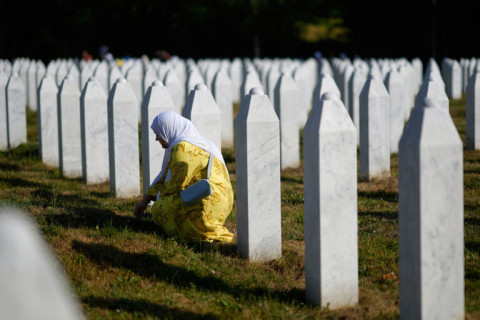
Those divides led to nearly four years of war known for acts of genocide and crimes against humanity such as the Srebrenica massacre and the longest siege of a capital city in modern warfare.
The Dayton Agreement, a United States and European Union brokered treaty, is credited with bringing the war to an end in 1995, establishing a power-sharing system. A portion of it remains in the country’s constitution.
Under it, the country was divided into separate entities, including a Bosniak-Croat federation and a Serb Republic. It also established a tripartite presidency, where leadership of the country is divided between an ethnic Bosniak, a Serb, and a Croat. The same divisions apply to the upper level of Bosnia’s parliament, the House of Peoples, and to key seats at all levels of Bosnia’s government.
That reality blocks an estimated 100,000 Bosnian citizens from running for high office, including Bosnia’s Jewish, Roma, and Albanian minorities, as well as many immigrants and their descendants. Bosnia and Herzegovina has a population of about 3.2 million.
For minorities, the tripartite system doesn’t just block members’ political ambitions but also affects their activities and needs, said Rahela Dzidic, president of the Jewish Community of Sarajevo. Though they once made up one-fifth of Sarajevo’s population, today Bosnia’s Jews number under 1,000.
“We feel that we are discriminated (against) because we are excluded from political participation and political decision making because of our small number,” she said. “And because we are not constituent people, we are in a way discriminated (against) because we are not getting our property back,” she added, referring to efforts to reclaim Jewish property nationalized after World War II.
For the Roma, who number up to 50,000, or just under 2 percent of Bosnia’s total population, lack of representation has put up barriers to recognizing Roma suffering during the Bosnian War and halted education and employment opportunities, said Dervo Sejdić, a leader in Bosnia’s Roma community.
Sejdić and Jakob Finci, a Bosnian Jewish leader, took the political disenfranchisement issue to the European Court of Human Rights. In 2009, the court ruled in their favor, agreeing the system was discriminatory and would need to change if Bosnia wanted to join the EU.
But two decades later, Bosnia has seen no structural change. Now in their 70s and 80s, the two are unsure they ever will.
“If there are some changes (to the constitution), then I hope we will have a chance to work together, to live together and to fight together for the future of this country,” Finci said. “Otherwise, I hardly can see the bright future of the people living on this territory.”
Such a transition would require societal change as well, Finci and Dzidic said. “This idea of multi-ethnic country still is not clear in everybody’s head,” Dzidic said.
Ethnic-nationalist parties tend to support the status quo because it guarantees their power, said Vladimir Andrle, the president of La Benevolencija, the Bosnian Jewish community’s charitable and educational arm, and a member of the coalition advocating for change.
Others, acknowledging the Dayton Agreement’s part in ending the war, are reluctant to make any change that could risk another war.
“Dayton has been the only security, I think, whatever we think about what the Dayton Accord brought,” Dzidic said.
Critics also note that dividing the country and positions of power along ethnic lines entrenches divides. That spreads beyond just the political sphere and into mosques, churches and beyond.
“Each major religious community is closely linked to its respective people,” Babić said. “Consequently . . . nationalist politicians sometimes act like religious leaders, while religious leaders act like nationalist politicians. In this way, religion—whether intentionally or not—becomes an instrument serving nationalist politics.”
Muhamed Jusić, director of the Department of Foreign Affairs and Diaspora at the Riyasat of the Islamic Community in Bosnia and Herzegovina, said this creates a scenario where “religion is becoming more and more politicized”—a trend seen globally, too.
Jusić also said the tripartite system results in fractured foreign affairs.
“Hopefully, people will realize that this division and polarization is not working, and it’s not too late,” Jusić said. “Fortunately, we have people on all sides. Our friends here in the Jewish community, our relations with the Catholic Church, with many in the Orthodox Church—ordinary people, they work together.”
In 2022, the Council of Civil Society Organizations came together and put out a declaration, calling for removing ethnic criterion from government and pursuing policies that will put the country on a path toward EU accession and NATO membership.
“The biggest problem here in Bosnia and Herzegovina is that people are not voting,” Andrle said. “People lost hope that elections can change anything. For 30 years, we are living this life, and we haven’t seen a change in society.”
Andrle was 7 years old when war came to Bosnia in 1991. Jusić was only a few years older, but the memory of it is still a driving force.
“If you know what war is, you will not spare any effort to avoid it again,” Jusić said. “There is nothing holy about war, nothing glorious about war, nothing about atrocities that should be glorified.”
“War is always a failure of all of us as human beings, regardless of the causes,” he added. —Religion News Service