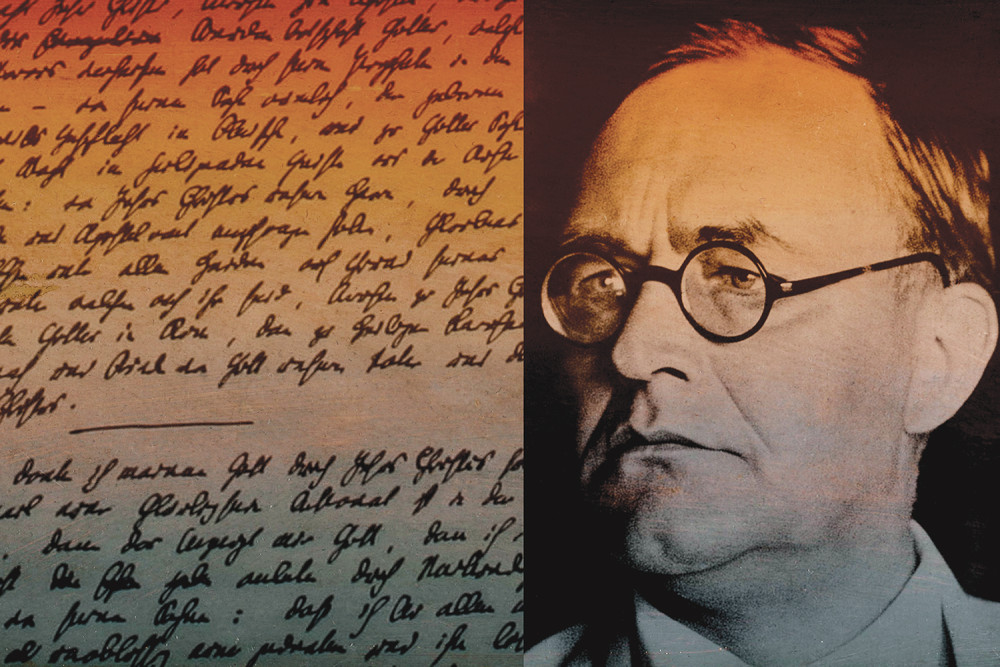
In October 1914, a 28-year-old Swiss Reformed pastor named Karl Barth opened a newspaper and read something that would shatter his faith in the European intelligentsia.
Remembered today as the Manifesto of the Ninety-Three, the document was a fierce defense of Germany’s conduct in the opening weeks of the First World War. It categorically denied both sensationalized and well-documented reports of war crimes, including the so-called Rape of Belgium, in which invading troops killed nearly 6,000 civilians and drove 1.5 million more from their homes; the manifesto insisted that Kaiser Wilhelm II’s armies were fighting as the indispensable guardians of European culture.
Addressed “To the Civilized World!,” the manifesto implored the global public: “Have faith in us! Believe, that we shall carry on this war to the end as a civilized nation, to whom the legacy of a Goethe, a Beethoven, and a Kant is just as sacred as its own hearths and homes.” It was an appeal endorsed by a roster of minds few societies in history could rival. Yet it would soon stand as a permanent monument to how readily brilliance can become the slave of pride, power, and propaganda.
Read our latest issue or browse back issues.
The 93 signatories did not speak with one voice in the decades that followed, as military defeat, a Carthaginian peace, and economic crises helped morph nationalism into National Socialism. Some lent their prestige to the totalitarian state that emerged. Philipp Lenard, the Nobel Prize–winning physicist, denounced Albert Einstein’s relativity as “Jewish physics” and became an ardent scientific propagandist for the Third Reich. Gerhart Hauptmann, a Nobel laureate in literature, signed a loyalty oath to Adolf Hitler, and his name was associated with the regime.
Others were not so pliant and found themselves under the Reich of a terror they had failed to foresee. Walther Hermann Nernst, the Nobel chemist who formulated the third law of thermodynamics, opposed the Nazis and their antisemitism. Two of his daughters married Jewish men and were forced to flee, and he lived to see his academic world systematically destroyed. Paul Ehrlich, the father of modern chemotherapy and another Nobel laureate, died well before Hitler’s rise, yet the regime removed his name from a street name simply because of his Jewish heritage. Max Liebermann, the master Impressionist painter and president of the Prussian Academy of Arts, was stripped of his honors and driven into isolation, while Max Planck, the founder of quantum theory, lived to endure unimaginable tragedy when the Gestapo executed his son, Erwin, for participating in the July 1944 conspiracy against Hitler.
What horrified Barth the most were the names of prominent German theologians. Among the 93 signatories were Wilhelm Herrmann and Adolf von Harnack, the Marburg and Berlin luminaries who had shaped his intellectual formation. In particular, Harnack, a renowned philologist and church historian, had even helped draft the kaiser’s war appeal to the German people. “It was like the Twilight of the Gods,” Barth later recalled, “when I saw the reaction of Harnack, Herrmann . . . and company to the new situation.”
For Barth, the deeper lesson of 1914 was both spiritual and political. He recognized that Kulturprotestantismus, the cultural religion embraced by the German academic establishment, was morally compromised. By conflating the ambitions of the empire with the will of God, his teachers were in fact actively constructing a theology that enthroned German culture as divine.
In response, in the aftermath of the war Barth published The Epistle to the Romans, a work of such radical consequence that Catholic theologian Karl Adam famously compared it to dropping a “bombshell on the playground of the theologians.” The Divine, Barth argued in uncompromising language, is infinitely beyond every culture, political ideology, and nation-state. No military, however virtuous or cultured it imagines itself to be, has the right to claim the words inscribed on military belt buckles: Gott mit uns. God with us.
Decades before the rise of the Third Reich, Barth had identified the fundamental danger of religious nationalism: The moment a country equates its own political destiny with providence, its institutions lose capacity for moral introspection and self-correction. It was therefore not surprising that when Hitler seized power in 1933, the German university system, long steeped in the nationalistic “Spirit of 1914,” largely capitulated. Many professors took the required civil service oath of unconditional allegiance to the führer.
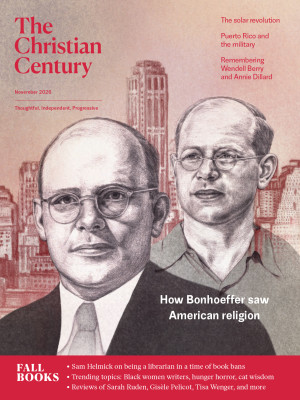
Barth, then teaching theology at the University of Bonn, flatly refused unless he could append a qualification reflecting his beliefs. As a result of his noncompliance, he lost his academic chair. He returned to his native Switzerland, but not before drafting the 1934 Barmen Declaration, the foundational statement of the anti-Nazi Confessing Church. Barmen drew an uncompromising line in the sand, asserting that the church belonged to God—not to the führer, the state, or the blood-and-soil mythology of the nation (see cover story, page 42). Among Barmen’s key signatories was Martin Niemöller, a former U-boat commander who would spend seven years in Sachsenhausen and Dachau before authoring his haunting indictment of moral apathy, “First They Came.”
The temptation to identify national power with divine authority is hardly unique to Wilhelmine Germany. It is a perennial current within American civic life, one that many of our greatest leaders—Roger Williams, George Washington, Thomas Jefferson, John Adams, James Madison, and Abraham Lincoln among others—actively resisted. We should remain especially vigilant when political leaders presume that God exclusively backs one side in a war—and doubly skeptical when those claims are propagated through institutions and by leaders with pervasive global influence. No doubt, Barth would today be greatly concerned by the present atmosphere in Washington, in which politicians and clergy regularly imbue the government’s wars with divine purpose.
Toward the end of his life, Barth received numerous honors from universities such as Oxford, Chicago, St. Andrews, Edinburgh, and Geneva. He even appeared on the cover of Time magazine in 1962. Yet his enduring legacy is not academic acclaim. It is the example of a scholar who, beginning at age 28, looked upon the consensus of his era’s most profound thinkers and most powerful institutions and, echoing another reformer four centuries earlier, answered with a simple refusal: Here I stand.