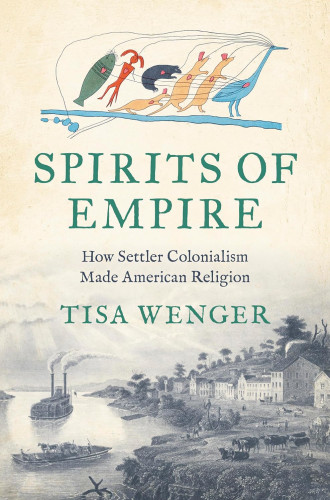
Spirits of Empire
How Settler Colonialism Made American Religion
In the 1880s, interior secretary Henry Moore Teller was a passionate supporter of Native American causes, and he struggled to defend their land rights. However, he strongly supported the draconian Code of Indian Offenses, which prohibited a sweeping range of practices including ceremonials, funeral rites, the work of “medicine men,” and “old heathenish dances.” Teller would have been appalled if anyone had accused him of religious persecution. Indians were welcome to pursue their religion as they wished, to worship the Great Spirit and pray to him, but the government was free to suppress those customs and rituals that manifested Native “savagery.” As everyone in Teller’s culture knew, religion was a well-defined category, and it was inward, cerebral, and ideally textual. Customs and rituals were something totally different. Native peoples, in contrast, had no doubt of the spiritual value of those rituals and dances, although they never felt the need to mark them off from other aspects of life or to identify them as religious.
Such a fundamental clash of worldviews stands at the heart of Tisa Wenger’s massively researched and brilliantly expounded Spirits of Empire. She focuses on the settler colonialist project by which new European migrants not only conquered the lands of North America but resettled them and re-created them in their own image, replacing not just the original peoples but also every aspect of their lands and culture, as well as their place names.
Read our latest issue or browse back issues.
At every stage, religion was at the heart of this overwhelming imperial project. The settlers justified their conquests in religious terms, citing the imperative need to extend godly rule over the continent and to evangelize the Natives. Although the language of manifest destiny dates to the 1840s, the concept is far older. When settlers encountered Native resistance, that too fitted perfectly into the religious framework—as manifestations of satanic anger against the advances of the gospel. As those settlers knew, those Indians had no “religion.”
Although Teller’s concept of religion was quintessentially Protestant in its origins, all Christian denominations accepted Teller’s vision to varying degrees, and it profoundly affected them. Consciously or otherwise, suggests Wenger, each denomination became an agent of empire. That was true of the faiths of the original settlers, but the vision was also internalized by later arrivals and by the new groupings that rose on American soil. She naturally has a great deal to say about Mormons, whose scriptures concern the alleged progenitors of contemporary Native peoples. It took a very long time for Christians to recognize the radically different nature of spirituality in Native contexts and to appreciate how utterly it differed from their own traditions. As Wenger argues, imperialist interactions were by no means incidental to American churches as they developed; rather, they “made American religion.”
Native responses to these religious conquests were varied and often highly creative. While some Native peoples accepted full conversion to the new faiths they were offered, other solutions were possible. As they grasped this unfamiliar concept of a religion, some Native peoples tried to restructure their own beliefs in this unfamiliar mold. Moreover, many who accepted Christianity did so very much on their own terms, selectively appropriating what seemed of use to them. Some of the most powerful passages in Spirits of Empire record the conversations that missionaries had with Native people, in which on occasion we see a genuine and fruitful exchange of enlightening ideas.
Throughout, Wenger’s account draws on numerous case studies that will not be familiar to nonspecialist readers. For instance, we have an informative portrait of the Kickapoo people and their prophet Kenekuk. There are better-known examples as well, though I was surprised to see that the book makes no mention of that faithful Catholic catechist Black Elk.
Even if they rejected the Christian package they were offered, Natives often accepted particular aspects of that faith, many of which adapted well to their own traditions. Critically, that included the role of prophets and visionaries as well as the millenarian ideas that they witnessed in successive Christian Great Awakenings. As nervous White observers realized all too well, Native resistance was at its most determined and dangerous when it was led by a prophet, such as the Shawnee Tenskwatawa, brother of Tecumseh. Arguably, most of America’s Indian Wars were religious wars in all but name, in that protagonists on both sides were motivated by religious ideologies and beliefs that drew on supernatural inspiration.
Although Wenger does not have the space to address these parallels, on every page we find examples of the sort of dialogues, syntheses, and confrontations that have been so frequently studied in the context of new Christianities in Africa and Asia. The book is a major resource for the study of Christian missions and Christianization in general, and by no means only in the North American context.
In light of what we might think of as all this obsessive religiosity, it is startling to read Wenger’s account of a central motif in her argument, namely, secularism. In common parlance, secularism is the antithesis of religion, and specifically of Christianity. For Wenger, however, it represents that worldview in which religion is identified as a separate category and is then set apart, “epistemically and politically, from other aspects of life.” Secularism does not mean the absence of religion or hostility to religion: rather, “it is a project that works to produce and discipline religion as a special kind of thing.” In the American context, we are dealing specifically with what she terms “settler secularism,” which underlies our concepts of freedom of religion and the nation’s vaunted lack of religious establishment. Although secularism and Christianity seem to be at odds, historically “they have worked together as colonial systems of knowledge and power.” Much of Wenger’s book revolves around that secularist interpretation, which will undoubtedly be much debated in future studies of American religion.
Spirits of Empire is both thought-provoking and rewarding. I will be digging into it for a long time to come.