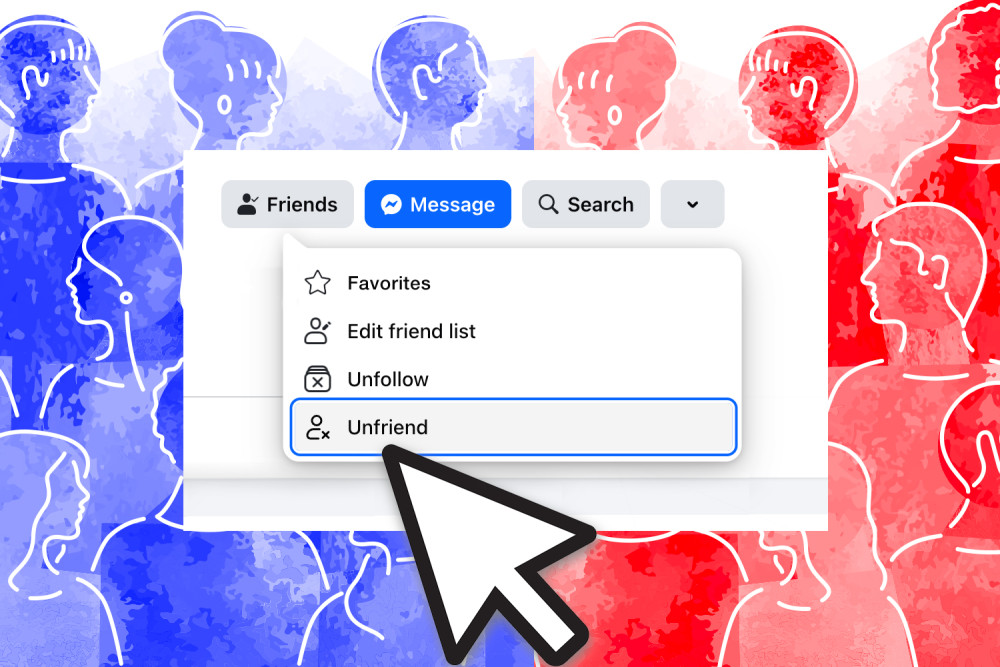
Are we cutting each other off over politics more often than we used to? Data on such a question would be hard to gather, because each term in the question bears wildly different meanings for different people—who is we, what is cutting off, what is politics, when is used to? But social scientists have never met a philosophical quagmire they can’t ignore, so they have skipped such questions and gone and gathered that data. It sounds dramatic.
One team at the University of California–Irvine claims that “37% of Americans reported having had a political breakup,” and that for 96% of these people, the “most impactful breakup” came after 2016. (Personally, I’ll cut you off if you use the word impactful in print.) The Irvine researchers used an opt-in pollster, which might not attract the most motivated responders. But older, more established polling firms, such as Reuters/Ipsos and Harris, have reached similar conclusions, and the same studies suggest that it’s left-leaning people who initiate more of the breakups. So for the sake of argument, let’s treat this as true: We’re dumping our friends and family over politics, especially if we’re liberal or left-leaning, more often than we used to.

Read our latest issue or browse back issues.
At this point in the discussion, commentators generally pause to shake their heads, deplore the trend, and exhort readers to show a little courage and tolerance. Much of the advice they give is condescending or absurd. Eventually, a few columns from now, I will get around to advising and exhorting too, and I will likely fall into this trap, despite my best efforts. But before I go there, I want to ask two questions: Is it weird that breakups are happening over politics? And is there something inherent about liberalism or leftism that makes such breakups seem more likely or more desirable? I think the answer to both questions is no.
Christian commentators in particular have a habit of talking about electoral politics as though it were a strange hobby or preoccupation of certain insufficiently thoughtful people, rather than a sustained negotiation over some of the acutest questions of human life. It is simply not true, as the all-absolving cliché has it, that Republicans and Democrats want the same things but are divided about how to get them. I do not want to deport 20 to 30 million people, nor to imprison them in poorly managed for-profit facilities where they will receive inadequate medical care and spoiled food and work for slave wages, or none, at micro-industries that benefit the president’s cronies. If you do want that—and it was the campaign theme of the party for whom a majority voted in 2024—our lives are pointed in very different directions. I could list many, many examples like this, and they are all things that are, in some sense, on the ballot right now.
Nor do I have much patience, at this point in my life, for the style that some Christian intellectuals on both the right and the left affect: that politics matters but that American electoral politics is too trivial to spend brain cells on. American electoral politics is often trivial. So, in one sense, is cell replication—it happens all the time. Still, if your cells replicate too much, that’s called “cancer,” and you need to make a whole lot of exhausting, quotidian judgments: whether to take the chemo your doctor recommends, how to manage your nausea, who will drive you to the hospital. I’m not saying that everybody needs to issue statements about every issue or event—in fact, I think the compulsion to issue such statements, or demand them of others, ought to be resisted, and I’ll say more about that down the line. But you don’t get to tell other people that a primary is too trivial to matter, either.
It’s also not clear to me that this is a new feature of our politics. Let me amend that statement: the data suggests it is new. I genuinely don’t get why. I hear folks express nostalgia for elections as recent as that of 2012, when it all felt lower-stakes, and I feel like they’re describing conditions on some other planet. One candidate was an incumbent president who routinely committed what in the figurehead of a less powerful state would be universally condemned as war crimes. His opponent smugly told a roomful of his rich friends that nearly half the population of the country he wanted to govern were basically parasites. That strikes me as a fairly serious predicament. To be sure, it’s one you can think your way through: A person who openly believes that his own country’s population is nearly half non-people is certainly not going to show mercy or consideration to the populations of other countries, so you’ll probably conserve more total lives by voting for mercy at home and wickedness abroad over wickedness toward all. I feel fine about the extremely constrained choice I made in 2012, but I don’t miss that election.
Before that, we had the unnecessary and therefore murderous war in Iraq to fight about. Before that, we fought about whether the caretaker of a person dying of AIDS should be shooed from the hospital. (As a child fundamentalist, I was decidedly on the wrong side of that question and will regret it till I myself am expiring in some hospital room from which my wife hopefully won’t have been removed.) We fought about how many Vietnamese children should die for the sake of “US credibility,” about whether the people who bombed a church in Birmingham had legitimate concerns that they were simply expressing the wrong way. And so on, back to the election of 1860, when the main issue on the ballot was whether to let the slave states expand their regime of theft, rape, torture, and murder to new territories. It’s not just hard to ignore such differences, it’s wrong.
Does all of this mean that we’re doomed to a circle of friends and family who agree with us? I have yet to meet the person with whom I agree on every point that matters, and I maintain close relationships with people whose politics I think evil and who feel the same way about mine. So I do not counsel despair. But I think too much of the writing on this subject starts by minimizing its difficulties. I wanted to start by acknowledging them.