Despite reasons for celebration and unity this year—the World Cup or commemorating America’s semiquincentennial—the truth is that our country still feels fractured. These divisions extend beyond political ideologies because they’re fueled by anxiety and institutional distrust. The Bible often becomes a pawn in these debates; each side uses it to justify or legitimize their positions. Americans have long turned to the Bible to explain who we are as a nation. But can the Bible help us overcome our deep divisions?
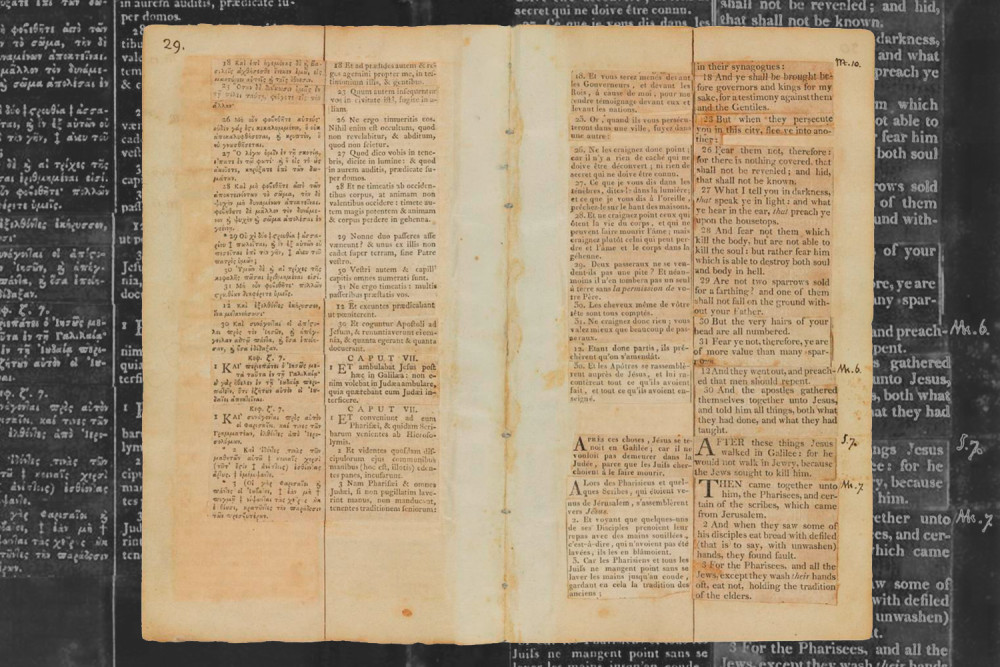
The selective use of the Bible is not new. Thomas Jefferson literally took a razor to his Bible. His The Life and Morals of Jesus of Nazareth is a redacted set of the Gospels that deletes the miracles, resurrection, and other supernatural elements of Jesus’ life. The result is a document that simply collects the ethical and moral teachings of Jesus. Jefferson’s Bible is not only a historical artifact, but it is also proof that various views of Christianity existed in the early republic. It is also a cautionary tale of how truth can be flattened by the weight of time. It raises the question that haunts our republic to this day: Do we allow Scripture to shape our identity, or do we reshape Scripture to fit the nation we imagine ourselves to be?
Some Americans, like Jefferson, continue to create their own “Bibles.” We often choose the passages that support liberty and equality, or prosperity and national destiny, while ignoring texts that challenge our assumptions. As a result, the Bible remains a site of contestation for American identity, a place where we wrestle with—or deceive ourselves about—who we are and who we hope to be. The actions of this nation continue to be contested and defended through competing interpretations of scripture. In the midst of centuries of such Bible disputes, some specific transformative voices arose at critical junctures. They did not simply quote the Bible; they used it to expose gaps between American ideals and American realities. Exploring a few of these figures and how they used the Bible in public speeches during another tumultuous period in our history, the 1850s and ’60s, might provide insight to help us move forward.
Frederick Douglass’s 1852 speech “What, to the Slave, is the Fourth of July?” remains particularly relevant. In the powerful speech we find an example of the Bible serving as a source of conscience. Douglass distinguishes between the Christianity of Christ and the Christianity of slaveholders. He describes a religion “which favors the rich against the poor; which exalts the proud above the humble; which divides mankind into two classes, tyrants and slaves.” Referencing Isaiah 1, Douglass declares: “the popular church, and the popular worship of our land and nation—a religion, a church and a worship which, on the authority of inspired wisdom, we pronounce to be an abomination in the sight of God.” Like the biblical prophets, the abolitionist leader admonishes a nation to remember who we aspire to be, to acknowledge our sin and repent in order to live up to our ideals. Douglass employs scripture to expose national hypocrisy.
One year earlier at a women’s rights convention, itinerant preacher Sojourner Truth delivered a speech often referred to as “Ain’t I a Woman?” The electrifying and extemporized speech argued for human dignity and gender equality by appealing to scripture. As Douglass challenged pro-slavery readings of the Bible, she challenged patriarchal interpretations. She said, “I have heard the Bible and have learned that Eve caused man to sin. Well if woman upset the world, do give her a chance to set it right side up again.” She continues: “And how came Jesus into the world? Through God who created him and woman who bore him. Man, where is your part?” Again, the Bible is used to establish grounds for equality in a nation founded upon this principle. Sojourner Truth not only restores marginalized voices, she also highlights the liberatory nature of the biblical texts.
In his second inaugural address in 1865, Abraham Lincoln’s biblical rhetoric is noteworthy. In it, the president refuses to identify God completely on the side of the North or South. Instead, he suggests that both sides “read the same Bible and pray to the same God”—and yet neither side can claim victory. Quoting Matthew 7, he cautions against judgment and certainty. As the Civil War is drawing to an end, he insists that “the Almighty has His own purposes.” Lincoln’s observation of divine providence contrasts sharply with modern claims that God automatically (and seemingly only) blesses America. Instead, his speech uses the Bible to establish a position of humility in the wake of utter devastation. He does not express certainty about God’s actions or motives, but rather presents a questioning of the country’s own relationship to justice. He does not claim or invoke God’s blessing, but instead leaves room for self-examination. This is a model for what prophetic biblical reading might look like: not necessarily comforting or victorious, but reflective.
Today we still need voices that expose hypocrisy, demand justice, and walk humbly with God. These three historical touchpoints remind us that even when competing visions of our nation seem irreconcilable, there are ways to course correct. These corrections do not come when we only look to scripture to affirm or comfort us; we must be willing to allow it to challenge, even convict, us. Will the Bible offer us the counsel that blesses national self-regard or the one that unsettles, judges, and calls a people toward justice?
The Jefferson Bible typifies the persistent problem of selective reading. We are still editing the Bible and harmonizing it with our own firmly held beliefs. Liberals, conservatives, nationalists, progressives, and a wide gamut of churches all construct their own versions of a Bible, retaining what confirms their commitments and excising what troubles them. It doesn’t have to be this way. Scripture is available as both a standard to judge our nation and a guidepost to help move us forward toward justice and mercy. The choice is ours as to whether we are willing to listen and respond together in love. We can use the Bible as a tool for defending ourselves, or we can allow it to expose our blind spots and unsettle our certainties. Will we simply read the Bible, or will we allow ourselves to be read by the Bible?