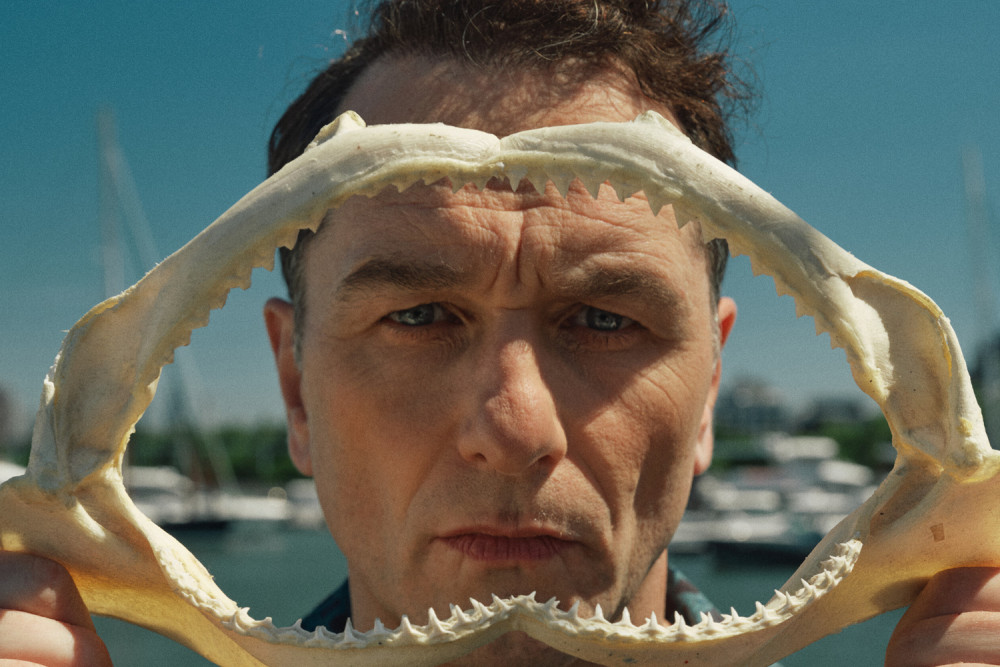
Just over halfway through the first season of Widow’s Bay (created by Katie Dippold, streaming on Apple TV), three unlikely comrades make an appointment with a local drug dealer (Chris Fleming). “Todd O’Connor?” Patricia (Kate O’Flynn) asks curiously. “Hey Patty,” he responds jovially. She smiles at the connection they have made before throwing up her hands: “Oh, my god, you’re a drug dealer.” “No, no, no, please. I’m a shaman,” says Todd. “Todd and I went to school together,” Patricia explains to the others before her boss Tom Loftis (Matthew Rhys) cuts her off so they can get down to business. Tom, Patrica, and local fisherman Wyck (Stephen Root) are seeking information about a hallucinogenic mushroom they found on the desk of the Rev. Bryce (Toby Huss) after he hanged himself in his church office. They think it might be a clue to the curse that is destroying their island.
The scene encapsulates the remarkable mood and tone of the show, weaving together deadpan humor, macabre and bizarre events, unsolved mysteries, supernatural menace, and the endearing but often suffocating rituals and habits of small-town life. The small town in question is a tiny New England island called Widow’s Bay. As in many small towns, most of the residents have roots that stretch back decades, if not centuries. Rumor has it that the locals cannot leave the island without suffering terrible retribution. No wonder you can’t go looking for mushrooms without running into an old classmate.

Read our latest issue or browse back issues.
Most of the locals seem to take this reality in stride, and they are welcoming enough to newcomers. Tom, for instance, was born off island, but he married a local girl, and when she died, he stayed to raise their son. After he is elected mayor in an uncontested election (perhaps a first warning sign that the locals know something he doesn’t), he is sure that if they can just attract more tourists, the tides will turn for the island’s fate. They do, but not in the way he was hoping. As crowds of new visitors arrive for the start of the summer season, a fisherman sails beyond the coastal boundary of the town and loses his mind, ghosts begin to haunt the recently renovated inn, a spectral presence stalks Tom, and the weather turns wonky. This, it turns out, is only the beginning.
The idea that small towns are hiding dangerous secrets under their placid facades grounds a lot of horror stories and supernatural hauntings. Sometimes this is because the small town is imagined as closer to the superstitious and irrational, home to long, dark histories that soak like literal or metaphorical blood into the soil itself (see pretty much everything Stephen King writes). Sometimes it is because there is a goosebumpy pleasure in the shock of contradiction between the image of a small town as quaint and safe and a reality of murderous menace (like the recent very fun reboot of The ’Burbs).
Widow’s Bay knows the delight of both tropes and plays them up with just the right tilt of a knowing nod. For all the jump scares and ghostly happenings, however, the show also knows something about close communities that exceeds the usual small-town horror cliches. It isn’t rational, for example, to want your high school rival to get her comeuppance when you are both being chased by an unkillable killer, as happens to Patricia, but if you have lived in the pressure cooker of small-town gossip your whole life, sometimes scoring points in a decades-old feud is just as important as escaping with your life. The horror tropes eventually give way to this weirder, funnier, and strangely more realistic portrait of small-town life. These choices give the show a humor and pathos that make it some of the best TV I have watched in years.
In one scene, one of the island’s oldest residents, Ruth (K Callan), shows Tom pictures and tells him stories of her life. “My Alfred, I loved him so much. . . . But he got bit by an animal and became that animal,” she says with a sigh. “My daddy built this house, back when they did things right,” she says a few minutes later. “But something got Daddy in the lake.” “Jesus, Ruth, you’ve really been through it,” Tom says with amazement. “One of the benefits of growing up in Widow’s Bay is that we learn to weather the storms,” Ruth says with patient wisdom. Tom cannot accept this. He is terrified that his son will be stuck on an island that quite literally devours its young. “You can’t control the bad things that happen in life,” Ruth insists; all we can control is ourselves.
The scene is both ridiculous and profound. It encapsulates the central drama of the show, which is the question facing any community with a long history: Can things be changed? Should the islanders bear the curse of their history with equanimity, as Ruth does? How far should they go to rid themselves of this evil? How does any community reckon with its history without destroying the traditions that hold it together? Somehow the show manages to ask these questions with a straight face while also discussing lake monsters and shape-shifting animals. “There is a quote I love,” Ruth says as she pulls a cross-stitch down from the wall. “The world is violent and mercurial. It will have its way with you. . . . We live in a perpetually burning building, and what we must save from it all the time is love.”
Whether this is a profound, if intense, version of folksy wisdom or the naive ramblings of an old woman who doesn’t want to face the truth remains to be seen. Season one ends with a truce between our weary heroes and the island, and the reckoning to come is getting personal. Time is not on their side, but I’ll take anything that lets me spend more time in Widow’s Bay.