
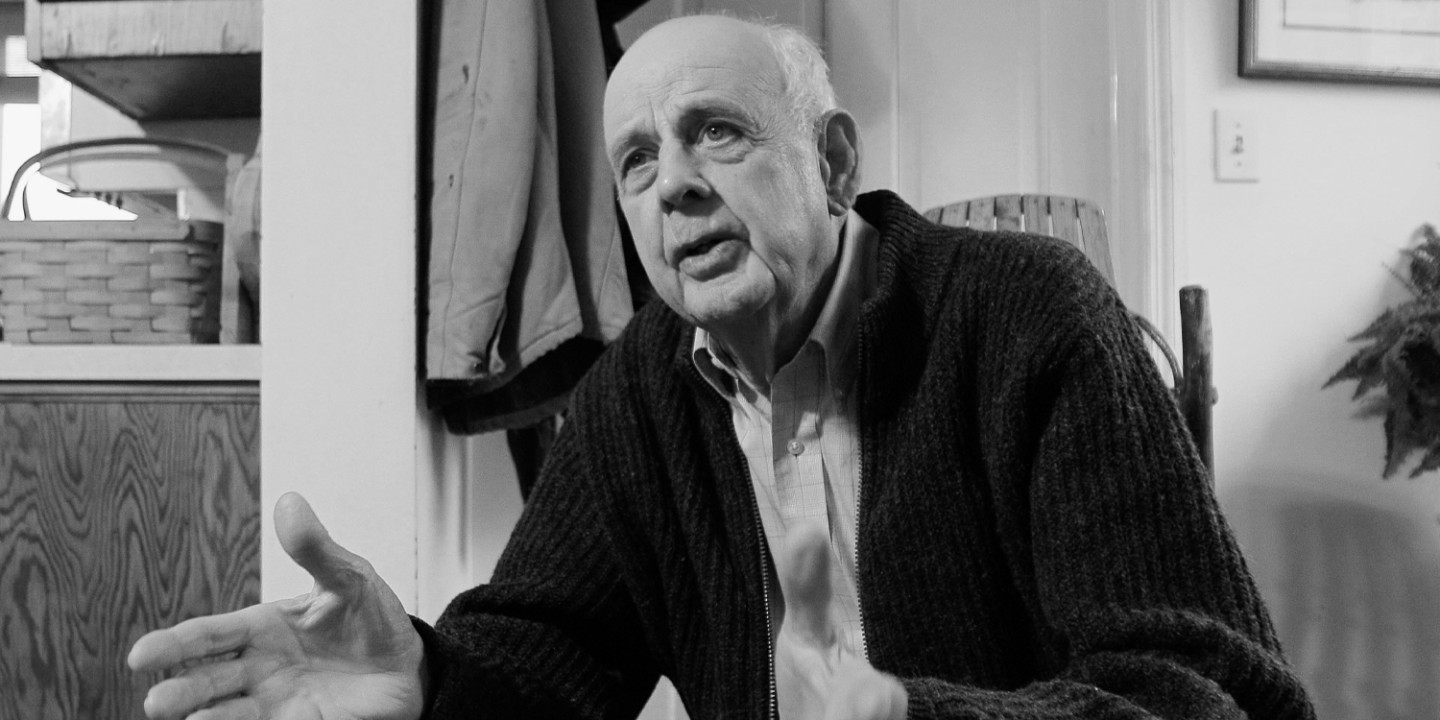
Wendell and I first became friends in the spring of 1998. I had recently moved to Kentucky to teach, and a friend said, “You should pick up some books by Wendell Berry. I think you’d like him.” I had no idea that my life’s work was about to change. My family had raised me in the ways of farming, but it was Wendell, who died today, who convinced me to become an agrarian.
I soon learned that it was Wendell and Tanya’s custom to host visitors Sunday afternoons at their farm in Henry County. I wrote him a letter to ask if I might come out for such a visit. He sent me directions and a hand-drawn map. The drive up took me through rolling hills, woodlots, and meadows, much of it meandering along the Kentucky River. It was beautiful country. Wendell and Tanya’s home sat perched on a hillside, overlooking the river. A bit down the hill were their barns, a storage shed, a huge garden, pasture for their sheep, and Wendell’s “long-legged” writing shack, with its woodstove and its 40-pane window. It was a farm that showed multiple signs of loving attention. I was nervous as I made my way to his porch.
I shouldn’t have been. Wendell welcomed me with a warm hand and his signature big grin. Before I knew it, we were either laughing, as he told tales of his home community, or deep in conversation, as we discussed authors that we thought to be essential for our time. Little did I know that I had just met the most gracious, insightful, and funny person I would ever know. In the phone calls, meals, and family visits that followed, I became convinced that agrarian sympathies and skills are crucial for the healing of our communities and world. Agrarianism has the power to correct and redirect the fundamental philosophical and theological categories by which we live. It has no better teacher than Wendell. Here’s why.
In 1977, Sierra Club Books published Wendell’s The Unsettling of America: Culture and Agriculture. In its opening lines, he notes, “As a people, wherever we have been, we have never really intended to be.” The yearning to be somewhere else—and the belief that by being there both life and we ourselves will be better—has worked like a disease that manifests itself in various forms of negligence, discontent, and destructiveness. Being unable or unwilling to cherish the places and communities we find ourselves in, we have also consigned them to ruin and ourselves to loneliness. As Wendell puts it in his poem “The Morning’s News,” published in Farming: A Handbook (1971),
It is man, the inventor of cold violence,
death as waste, who has made himself lonely
among the creatures, and set himself aside,
so that he cannot work in the sun with hope,
or sit at peace in the shade of any tree.
It is an illusion to think one can cherish a place from a distance or sitting in front of a screen. Such a thought turns cherishing into an abstraction or simply an emotion.
Wendell understood this when, as a promising young writer, he made the (much questioned and sometimes ridiculed) decision to leave the exciting literary scene in New York City for his home of Henry County. As he would later describe it, it was precisely his commitment to embrace a place—a place with a sordid and often violent history—that enabled him to understand what the work of healing and cherishing requires. When asked by people if he meant that everyone needs to return “home,” his answer was clear: You don’t need to return to the location of your birth to cherish a place. But you do need to commit to staying put somewhere, learn its particular history and potential, and then figure out with others how to make this chosen place a healthy, hospitable home worth celebrating. This sort of work takes time, patience, and a lot of practical skill in the arts of homemaking and repair.
The whole of Wendell’s vast oeuvre (more than 50 books), whether in the form of poetry, essay, or fiction, can be read as a sustained, richly developed effort to remind people of their creaturely condition and to describe the practical requirements of a peaceable, even beautiful life with others. Sounds simple enough. The trouble, however, is that few people want to be creatures. They want to be gods who are exempt from the detailed, demanding work of care. They want to be free of the imperfections, neediness, and limits of embodied, entangled life with others and instead take up residence in a disembodied, ethereal heaven somewhere beyond the blue. In the same poem, Wendell recommends a different path:
. . . I think I must put on
a deathlier knowledge, and prepare to die
rather than enter into the design of man’s hate.
I will purge my mind of the airy claims
of church and state. I will serve the earth
and not pretend my life could be better served.
To say that Wendell was the leading agrarian of the last century isn’t quite enough. Though he often acknowledged the insights he learned from his agrarian elders and contemporaries—ranging from Hesiod and the biblical prophets to Wes Jackson and Vandana Shiva—Wendell was unique in his ability to crystalize and communicate an agrarian vision that calls people from all places and walks of life to reconsider life’s fundamental questions. To read him is to encounter a man who speaks plainly, persuasively, and often humorously about matters of life and death, home and community, the point of education and work, the meaning of health, and the prerequisites for a convivial life together. In his hands, agrarianism isn’t simply a teaching for farmers. It is a comprehensive vision and set of responsibilities for a culture that makes the flourishing of people and land together its foremost priority.
Wendell saw agrarianism as a comprehensive set of responsibilities for a culture that prioritizes the flourishing of people and land together.
Wendell is often caricatured as a romantic back-to-the-lander. Nothing could be farther from the truth. To read his work is to have a front-row seat to the pain and the waste and the violence and the racism of this nation’s agricultural past. Wendell did not idealize this history, nor did he recommend that all people take up farming. Most folks do not have the skill, intelligence, or temperament to be good farmers. What he sought, instead, was to educate people so that no matter where they are they will have some appreciation for the ecological, economic, social, philosophical, artistic, and religious elements that together make for resilient, viable farming communities. He understood that the future of agrarianism depends on urbanites having agrarian sympathies that make them better food consumers and more informed citizens. Strong farming communities, just pricing of food and land, a more ecologically attuned health system, support of local economies: these are all central agrarian concerns that citizens can get behind whether they are farmers or not.
At root, Wendell believed the world to be sacred. It is, as he puts it in his poem “The Mad Farmer Manifesto: The First Amendment” (published in 1971 in The Country of Marriage), “a holy vision, had we clarity / to see it—a clarity that men / depend on men to make.” Experience, reading, and the daily rounds of farm work taught Wendell that scripture is trustworthy in its teaching that every creature and every inch of earth is made and approved by God as good and beautiful. God loves the whole world, even those parts we may disapprove of or fail to understand. Had we been present at the first sabbath sunrise, we would have witnessed a creation radiant in its life, filled with “perfect joy and life and light” and marked by a “blessed conviviality,” as Wendell puts it in one of his early sabbath poems. Our vision, however, has become distorted, because we often lack the patience and attention, the devotion and love, that enable its proper perception. Careless work, hubris, and too much haste have had the effect of silencing creation’s song.
Wendell had little patience for churches that teach contempt for bodies and the earth. He was unflinching in his critique of the sort of Christianity that walks hand in hand with merchants and conquerors and that is often all too willing to “join the military-industrial conspiracy to murder Creation” (from Sex, Economy, Freedom, and Community, 1993). What he longed for instead was the formation of communities in which the care and celebration of all its members, human and nonhuman, might occur. In his poem “The Mad Farmer, Flying the Flag of Rough Branch, Secedes From the Union,” published in Entries (1994), Wendell offers this invitation:
Come into the life of the body, the one body
granted to you in all the history of time.
Come into the body’s economy, its daily work,
and its replenishment at mealtimes and at night.
Come into the body’s thanksgiving, when it knows
and acknowledges itself a living soul.
Come into the dance of the community, joined
in a circle, hand in hand, the dance of the eternal
love of women and men for one another
and of neighbors and friends for one another.
Wendell believed this vision to be an invitation to heaven, but not the false heaven of disembodied flight from earth. He may have been thinking about how scripture ends with a vision of God descending to a healed and redeemed creation to live with mortals forever. In this vision, there is no escaping and no annihilation of earth. How could there be, since God has always loved each and every creature? Instead, there is only the unending touching, feeding, befriending, and healing of bodies that Jesus modeled in his ministry. Insofar as Christians have an interest in preparing a welcome home for God and a nurturing place for others, I have no doubt that Wendell will continue to serve as an essential teacher and guide.