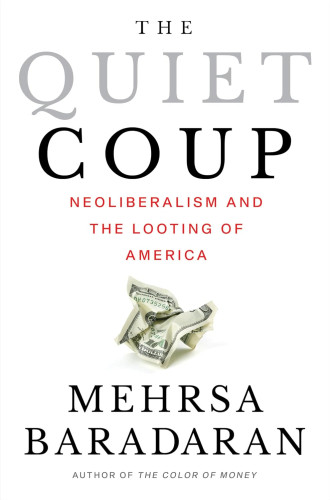
The Quiet Coup
Neoliberalism and the Looting of America
In the growing field of books about the neoliberal economic era in the United States, there are many that focus on neoliberalism as a political and legislative project, pointing to the expansion of free trade agreements, the push to lower taxes and reduce regulation, and the export of this model to developing countries through the so-called Washington Consensus that held sway at the International Monetary Fund and World Bank in the 1980s and 1990s. In these accounts, a symbolic starting point of neoliberalism is the election of Ronald Reagan in 1980.
Mehrsa Baradaran is a law professor, and this gives The Quiet Coup a unique perspective on neoliberalism. For Baradaran, neoliberalism was as much about court decisions and legal ideologies as it was about legislation. In particular, Baradaran argues that what we now call neoliberalism originates in both the wave of independence in former colonies in the 1950s and 1960s and the backlash to the civil rights movement. Neoliberalism, she writes, was not primarily about reacting to Keynesian economics at home “but rather a rhetorical tactic in forestalling a racial reckoning.” Her arguments are sweeping, fascinating, and largely persuasive.

Read our latest issue or browse back issues.
Baradaran illuminates the racial inflection of many ideas of early proponents of neoliberalism, such as Milton Friedman, Alan Greenspan, Lewis Powell, and Friedrich Hayek. Greenspan, for instance, was largely responsible for Richard Nixon’s racially charged approach to the 1968 presidential campaign, even though Greenspan as an economist had no background in social policy. Greenspan argued that the government should not engage in efforts to address the historic injustices that fed racial uprisings during the campaign. To do so would be an unjustifiable intervention in market dynamics that would impoverish the people it sought to help. Baradaran notes wryly that Greenspan’s memo laying out this strategy “contained no numbers, data, or cited studies. What Nixon . . . wanted was not Greenspan’s knowledge or expertise, but his ideology. . . . Greenspan helped the campaign adapt [George] Wallace’s resentful message on race . . . and present it as an embrace of capitalism and liberty.”
This is just one of many detailed historical examples that Baradaran presents in a fluid and readable fashion. Likewise, in a chapter on the decolonial era, she demonstrates how Western companies and countries, concerned about losing access to cheap raw materials in former colonies, fashioned an economic regime whose primary purpose was “to undermine the demands of coalitions of former colonies and disenfranchised minorities for an equal voice in deciding the world’s future.”
The strongest and most original parts of this book come when Baradaran focuses on two legal movements that underpin neoliberalism. The first, textualism, is likely well known to many readers from its influence on the current conservative majority on the Supreme Court. Baradaran demonstrates how conservative billionaires funded the rise of this movement as a tool to strip law of any moral component and to dismiss broader considerations of justice in society.
The second, the law and economics movement, may be less well known. In Baradaran’s telling, however, it is as important as textualism, if not more so. This movement trained judges to focus on the economic implications of their judgments. The result was weaker antitrust efforts, longer criminal sentences, and more rulings against regulatory agencies. Baradaran is particularly strong in demonstrating how both of these movements, while often wrapping themselves in the language of objectivity or science, were in fact ideologically driven. The result of both textualism and law and economics is that “neoliberals stripped the law of its pursuit of justice and equity, subjugating it to the needs of the market.”
Baradaran also addresses the way neoliberalism has degraded Christian witness in the United States. Moving beyond the oft-told story of the alliance between economic conservatives and the religious right, Baradaran uses so-called unconscionability provisions in contract law—rooted in religious prohibitions on usury—to illustrate how neoliberalism warped religious values. Prior to the neoliberal era, judges could and did strike down contracts in which the provisions were deemed unconscionable.” She gives examples of poor, often Black, individuals who were trapped in predatory installment contracts for furniture or appliances, a practice that impoverished racialized minorities and enriched business owners. Thanks to the influence of the law and economics movement—with its insistence on the sanctity of a contract no matter how unjust its terms—on a series of court decisions, unconscionability is now largely unenforceable, and standardized contract terms demand forced arbitration and prevent class action lawsuits, weakening an individual’s power against major corporations.
When the law defers to economics, it is challenging to speak in moral terms about the economic system. Rhetoric of equity, fairness, and justice is replaced by the language of freedom, choice, and contract.
Running throughout Baradaran’s book is the noun from her title: coup. The result of more than a half century of neoliberal law and policy, she argues, is a sense shared by many people across the political spectrum that the legal and political system is stacked against them and simply does not work, that it enriches the powerful and leaves the vast majority struggling to survive. She is clear-eyed about why this is the case. Neoliberalism makes it difficult to talk about value (because the only values that matter are economic, such as price) and robs us of social trust (because each of us is believed to be a rational actor seeking to maximize our own good). The discontent we experience is the result of the corruption of a system that was established not out of a commitment to a common good but instead, as Baradaran argues, “to preserve an unjust world economic order,” one that “fused the interests of segregationists, wealthy heirs, and the corporate tentacles of the dying empires to keep the market rigged in their favor.”
The Quiet Coup amounts to a powerful indictment of the present economic order. It also contains a warning. Baradaran writes, “you can rig a system for only so long before it breaks. And once it does and trust is gone, fascism is not far off.” Baradaran’s book cries out not only for a more just economic system but for a moral discourse that challenges neoliberalism and moves beyond facile solutions. This is a discourse to which religious leaders can and must contribute.