Everyday Apocalypse
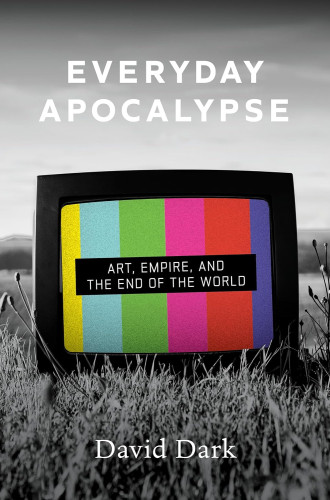
First published in 2002, David Dark’s Everyday Apocalypse has been a formative text for Christians interested in the intersection of theology and popular culture and, in particular, the ways art can focus its lens on power and politics. A new edition from Vanderbilt University Press includes updates meant to speak to our current cultural moment. Dark teaches in incarcerated communities and is a professor of religion and the arts at Belmont University, as well the author of the Substack Dark Matter.
In the opening chapter of Everyday Apocalypse you write about the word apocalypse: “In its root meaning, it’s not about destruction or fortune-telling; it’s about revealing. . . . It’s a call-out as well as a call-in. A both/and, cool and hot but never ever lukewarm kind of thing.” Can you say more about the book’s title and its connection to art?
Read our latest issue or browse back issues.
Each and every day is a revelation made up of revelations, one apocalypse after another, data incoming. It’s more than any of us knows quite what to do with. Art, meanwhile, is integration, documenting all that data as thoroughly, justly, and therefore as beautifully as we can. That can look like me taking a picture of an oddly situated squirrel in a tree or you asking someone a thoughtful question. Or it is anyone anywhere making the most of their creative energy, alone or with others.
This definition—art as the documentation of revelation—speaks to another passage I wanted to ask you about. You write, “Art shows us how to live, how to see ourselves and others and our sweet old world realistically and therefore prophetically and therefore poetically.” Where do you see art being used in this way in our current moment?
I hesitate to speak of art as something that gets used for something else, because I believe integration is the whole thing. Art gives us permission to feel and to say what we feel. When we feel more, we love more and do better by ourselves and others, instead of destroying ourselves and others.
In our current moment, I see South Park and Saturday Night Live delivering the goods. Each week, the art that is their comedic witness is like a release valve offering bursts of candor and fresh air amid the weaponized despair on offer from disinformation mills and the elected officials who promote their content. I also treasure Big Thief and Billie Eilish and Paramore. Genuinely free people behaving freely and without fear are always good news. Slow Horses and Severance and Peacemaker are pretty great. Oh, and Andor. I want everyone to watch Andor. It deepens the Star Wars tradition powerfully.
Everyday Apocalypse has been influential for the ways it praises things some Christians were raised to think of as unholy, including banned books like Octavia Butler’s Parable of the Sower and popular music and television like The Simpsons and Prince. What initially led you to write about this topic, and what made you decide to revisit the book now?
It was, in large part, the catastrophically successful Left Behind series. It’s funny and horrible that so many people who haven’t read John’s Apocalypse imagine they know what it means because they’ve read or been influenced by Jerry Jenkins and LaHaye’s brutal fantasy concerning God, Jesus of Nazareth, and our beautiful world. Politics isn’t always theology, but theology is always politics. And their brand of Christian Zionism is, one might say, official US foreign policy.
Around the time the school where I was once employed assigned Left Behind to high school freshman, I felt compelled to stage a nonviolent counterattack with words. I’d also recently met N. T. Wright, who deepened my conviction that the series is itself a form of antichrist.
Revisiting the book became a needful thing, and I’m grateful Vanderbilt University Press has given me the opportunity to make it a better book.
What do you mean when you say “make it a better book”? What did you add or change and why?
At 55, I am no less enamored by—and, I hope, no less committed to—the good news of Jesus and the prophets than I was in my 20s. But I now see a Christian supremacist tone in the earlier version which I find shameful and even a little bigoted. I hope I’ve successfully cleansed the new version of that mess.
Relatedly, I only recently came to see that Flannery O’Connor was publicly committed to some White supremacist thinking in her lifetime, and I thought it important to address it in the new edition. To love a person—you or me or Flannery—is to love a process. Love doesn’t smooth over abusive behavior. Love confronts it.
Radiohead and the Coens and Beck have each given us new work since 2002, and I was very pleased to include some of it in the new version, alongside consideration of Sinéad O’Connor and Kendrick Lamar as righteous witnesses among us.
The big change, though, is an insight concerning art and empire that I owe at least partially to conversations with my friend Brian Eno, the British artist and activist: Empire is power over; art is power with. That insight shapes and runs like a thread throughout the new edition of the book.
The people who are currently in power in America have made their contempt for the kind of art you are praising clear by, among other things, defunding art through cuts to federal programs, placing demands on curators and public arts organizations about what kinds of themes and artists they promote, and even trying to take Jimmy Kimmel and Stephen Colbert off television. It feels like a scary time to be an artist who confronts empire. Do you have any thoughts for those who might fear speaking up?
I hold close to my heart a word of warning from a Marilynne Robinson article: “Those who control the word ‘American’ control the sense of the possible.” For this reason, I won’t give that word up to anyone. America is a crime scene and a long conversation about what human beings owe each other. Yes, we have had presidents commit war crimes with the help of their enablers, but we also have Aretha Franklin and James Baldwin and Dorothy Day and Daniel Berrigan.
I believe a person guilty of war crimes can also be well intentioned. I say this as someone currently funding all manner of caging, torturing, and killing with my tax dollars—and as someone trying to stop that caging, torturing, and killing. Art is integration. Empire is disintegration. Like governments, media companies, church organizations, and families, I have both art and empire operating in and through me many times a day. But art overcomes and outlasts empire.
We have millions of citizens, living and dead, who have overcome fear with love and self-respect and myriad acts of creative nonviolence. Maybe they’re even most of us. Fear has no future. And God gave no one a spirit of fear, ever.