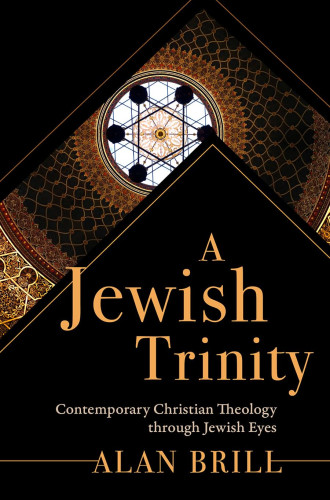
A Jewish Trinity
Contemporary Christian Theology through Jewish Eyes
The late rabbi Jonathan Sacks used to say that Christian theology is too important to leave to the Christians. Several generations of Jewish thinkers have done us Christians the favor of mucking around in our thought and offering corrections. Jules Isaac showed the Catholic Church that its own sources were not nearly as anti-Jewish as it thought, leading the way to the revolution of Vatican II and Nostra aetate. Sacks, Daniel Boyarin, Michael Wyschogrod, Peter Ochs, and others have shown us aspects of Christian faith which Jews can agree with, disagree with more profitably, and even challenge. This sort of ecclesial-synagogal exchange hadn’t happened since the first century, if then.
I’m tempted to say the most remarkable aspect of A Jewish Trinity is how unremarkable it reads to a Christian theologian, but that would do it a disservice. Alan Brill studied comparative mysticism at Fordham and teaches at Seton Hall, so it is not surprising that he is adept with modern Catholic sources like Karl Rahner. What is more surprising is his word of correction to his fellow Jews: Christianity has changed in modernity in ways that Jews should notice. It is not inscrutable—here he scrutinizes it with profit. Brill even encourages further change in us: more Moltmann and Balthasar, less Augustine.
Read our latest issue or browse back issues.
Think how hard each of us is working to understand just our own faith. That a person of a different faith would so competently, even creatively, understand ours in addition to theirs is impressive.

Each of the book’s six chapters treats a theological topic: Trinity, incarnation, original sin, atonement, messiah, and covenant. On each, Brill sees significant and profound overlap with Judaism—but also remaining and even unbridgeable differences. Historians have shown decisively that early Christians were picking up strands of Jewish thought with such core teachings as emanations of the godhead, preexistence of a Logos-like figure, atoning sacrifice, and so on. Christianity grabbed hold of one view or the other and hardened it into doctrine that Jews could not and cannot agree with. But that doesn’t make those ideas non-Jewish or anti-Jewish. Brill joins Boyarin in pleading with his fellow Jews not to denigrate Christian thought as un-Jewish or even pagan.
For example, Christianity came to believe in eternal coexistent divinity for a divine Son and Spirit. Jewish concepts of a divine kavod (glory) or shekinah (indwelling presence) and of a preexistent Torah are not worlds apart from this. Then, Brill often lauds what came to be judged heretical notions of Christianity. For him, Docetism or adoptionism sync with Jewish thought then and now where Nicene Christology does not; Pelagianism could be perfectly Jewish even today, while Augustinian original sin was and remains objectionable. And Brill celebrates several 20th-century developments—Rahner softening original sin to something more existential and less quasi-biological; Moltmann reintroducing the not-yet of Jewish eschatology to correct for excessive Christian triumphalism.
Brill does not grant these points of overlap at no cost. He sees Judaism as a faith not of salvation history but of Torah observance guided by scribes. Here a yawning chasm remains between our faiths. Brill all but pleads for Christians to grant an ongoing significance to Torah as at least starting the repair of the world that Christians are sure is already consummated only in Christ. I am struck by how often his Jewish parallels to Christian teaching are funny: one Nachman of Breslov promises that anyone who comes to his grave and recites ten psalms will not remain in hell; the rebbe himself will pull him out of hell by his earlocks! It is striking how often modern Hasidism bends back toward something that looks to us more Christian (while keeping Jewish humor intact).
I am particularly struck by Brill’s discussion of Moltmann’s trinitarian theology, which redoes trinitarian thought around three “movements” Moltmann describes with the Jewish terms shekinah, tzimtzum (contraction to make space for creation), and tikkun olam (repair of the world). Brill seems charmed but unconvinced: a Jewish trinity would be more monarchian (a high God with lesser emissaries) and less perichoretic (equal persons in relation). Moltmann himself is unsure whether he is simply appropriating Jewish terms. What I find most striking is that nothing happens when Moltmann uses Jewish terms for Christian thought. We Christians might be pleased, for ours is a doctrine-based faith. Jews will likely remain unmoved, given their more practice-based faith. Even on the Christian side, the changes may seem superficial, not as interesting (or possibly objectionable) as Moltmann’s more creative thought on divine passion. I’ve rarely felt the distance between our faiths so
profoundly.
I’m struck that the book seems to vindicate one of our worst ancient habits. The fathers of the church often vilified opponents by claiming their thought was “Judaizing.” Here Brill finds the greatest Jewish resonance with ancient heresies, seemingly agreeing with one after the other. I’d like to think that he’s wrong, that the more Jewish options were the ones taken by orthodox Christian thinkers: no half-god can save us, atonement can only be effected by God in person, God cannot break covenant without being untrue to himself. But then a Christian would say that.
Jewish-Christian conversations seem to have taken a step or two backward in the wake of Israel’s attacks on Gaza in response to the October 7 attacks by Hamas. I hope this book reminds us all that we are siblings, with both more overlap and more contention than any of us tends to grant.