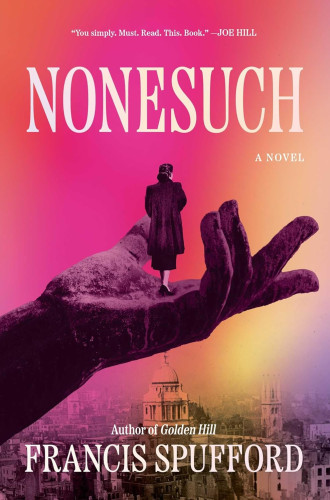
Nonesuch
A Novel
If Winston Churchill had died before World War II began, he wouldn’t have been around to rally the British to fight Hitler, in which case Great Britain might well have stayed out of the war, effectively handing Europe to the Nazis. This counterfactual hypothesis is impossible to prove, but in the magic of Francis Spufford’s novel it may be put to the test. In the early months of the war, as Churchill mobilizes the nation, members of the British Union of Fascists discover a way to travel back in time; they aim to return to September 29, 1939, to assassinate Churchill and redirect the course of history.
Standing in their way is Iris Hawkins, a nervy assistant at a London brokerage firm, who stumbles onto their plan and learns, via angelic beings, about “quantum tunneling” through time. With the proper incantations, uttered at the proper sites in London, a bridge can be constructed to Nonesuch, the place “where all times are present.” Iris is the one person who can block the project and fend off the “magical fascist lunatics.”
Read our latest issue or browse back issues.
Spufford is one of few writers with the ability to pull off such a historical-fantastical adventure story. His novels have always displayed an avid historical interest, and this one is thick with details of wartime London, from food rationing to the fate of the British fascists known as Mosleyites. The novel often reads like a tribute to the cityscape of 1939–1940, which Spufford appears to know by heart, much of it now vanished because of war or urban renewal.
Iris is an engaging hero for this tale—smart, sexy, with resources of courage and generosity. When not grappling with occult forces, she is maneuvering her rise in the financial world and studying the writings of John Maynard Keynes. She shrewdly manages the men who patronize her and gets what she wants while avoiding emotional entanglement. That approach begins to change, however, after her encounter with Geoff Hale, a guileless electrical engineer who both puzzles and attracts her because he wants nothing from her but an honest relationship.
It’s a night with Geoff that brings her into contact with supernatural powers. She spies a figure outside his house who turns out to be a Watcher, or fallen angel, drawn to the house by the occult researches of Geoff’s father. A former clergyman, he has devoted his life to texts from the 1600s, an era when natural science was intertwined with astrology and speculative philosophy (another historical epoch Spufford evokes with assurance). Geoff thinks his father has frittered his life away on this “wooly-minded nonsense” but is forced to revise his view after his own close encounter with an angelic being. The esoteric texts may be silly, but the supernatural forces they invoke are dangerously real.
Neither Iris nor Geoff brings religious belief to their metaphysical adventures, but they show up in church on Christmas Eve 1940. Amid the candlelight and carols, Iris is moved by the hopes for peace shared by those gathered, regardless of status and station and despite the fragility of those hopes. Everyone knows that a bomb could come through the roof at any moment. The story of the child in the manger, around whom angels also hovered, is a reminder of that fragility, but it also evokes the suspicion that a way exists for humans to live without rivalry—that there is “some other thing they all were, or might be, if you could but know it.”
The romance that unfolds between Iris and Geoff is the emotional heart of the book. As bombs fall on London, and British troops are evacuated from Dunkirk, the two haltingly learn to love each other without wanting to possess or control the other. Their education in love is a kind of anti-fascism campaign conducted in the personal sphere.
The angels don’t endorse the practice of time travel, viewing it as another kind of violence, a “violence done to time.” As for Iris, she sees something intrinsically wrong and inhuman in an intervention that ignores the preciousness of human lives in which good and evil, bravery and horror, are incalculably intertwined. But the issue turns out to be more complicated for Iris herself. The land of Nonesuch offers her an opportunity to go back in time and help people she loves—but unraveling that thread of history will rearrange the fabric of her life. Is that what she wants? Is that what she means to choose?
The book’s last line is “To be continued,” promising a sequel. I’ll be watching for it.