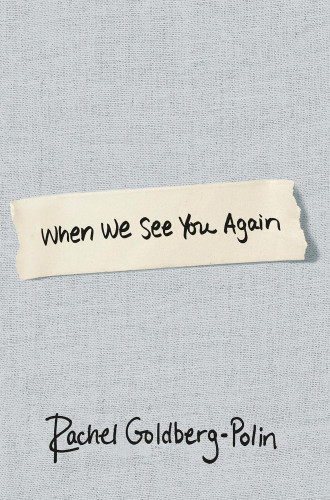
When We See You Again
“Everyone has a crush on their oldest child,” one of my parents’ oldest friends said to me years before I was anywhere near having a child of my own. When We See You Again is a recounting of Rachel Goldberg-Polin’s crush on her oldest child, Hersh, the suffering she endured while he was held captive in the tunnels of Gaza for 332 days, and her family’s devastation at his killing by Hamas on August 31, 2024. Hersh was kidnapped from a music festival he was attending with his best friend, Aner Shapira. Shapira was killed that day throwing grenades back at the Hamas fighters, which saved the lives of Hersh and many others. The day that Shapira’s family finished the 11 months of reciting kaddish for him was the day of Hersh’s funeral; as Hersh’s father noted, one year wasn’t enough to say kaddish for the two of them.
But we should start where Goldberg-Polin does, with her love for her only son: his raspy voice, the way he always carried her bag when they walked together, that his “nostrils were shaped like small kidney beans” and his “eyes were cookies,” that he “had a quiet presence and way of being without taking up room or air.” On Friday nights when she would give him the blessing of parents to children (Num. 6:24–26), “he bent toward me and put his face downward to receive my words and love.” He wrote a text to his parents before the last Yom Kippur of his life that said he was sorry for anything wrong he’d done and thanked them “for being good supportive parents.” Readers are glad to know that mother and son expressed their feelings, and yet the depth of their love makes reading about the loss all the more painful.
Read our latest issue or browse back issues.
This memoir shows in real time how one person copes with intense grief, an anguish so deep that Goldberg-Polin’s body morphs in its wake: She never gets another period after Hersh’s kidnapping, she gets shorter, and her hair visibly grays. But the book also witnesses the faith that enables her to get up and say the traditional Jewish morning prayers each day. Her favorite prayer is, “God has great faith in me.” She explains, “I always liked the idea that God believes in us. Right after that prayer, every single day, I would say out loud my mantra, ‘HOPE IS MANDATORY. Go.’ Then I would fling back the blanket, and thrust myself into another day of torture.”
But there is more. Goldberg-Polin writes not only about what gives her strength but also about what has helped Jews cope with loss and hate for centuries. An educator, Goldberg-Polin has taught at a Jewish day school in California, an adult education program in Virginia, and the Pardes Institute in Jerusalem, where her family has lived since 2008. She has the ability, as her husband writes in the afterword, to clarify complex concepts.
And to learn about the faith of Hersh himself. Like most children, Hersh did not want to be a carbon copy of his parents or to observe religion exactly as they did. He spent his last Yom Kippur in the Jerusalem Forest with his two best friends, “dressed in white, with a prayer book, meditation books, a camping mat, and a sleeping bag” to practice hitbodedut, a Jewish meditative method of “saturating oneself in aloneness.” He was reading the Dalai Lama’s The Art of Happiness and had absorbed Holocaust survivor Viktor Frankl’s Man’s Search for Meaning. Hersh was looking forward to a long-planned trip to India after finishing his army service in December 2023; instead, he spent that time malnourished in a tunnel in Gaza.
Hersh’s faith and philosophy sustained him and others in the tunnels with him, as Goldberg-Polin and her husband learn from Or Levy, a hostage who was released after 491 days. Levy tells them that Hersh persuaded their captors to give him a book to read, Leigh Bardugo’s Shadow and Bone, and that Hersh told the group about Frankl’s statement, “He who has a WHY can bear any how.” Levy also shared that Hersh heard his mother being interviewed on the radio and knew that his parents were doing all they could to save him. Goldberg-Polin writes, “at that moment, in that sterile and eerily quiet hospital room, 168 days after Hersh was killed, via Or, Hersh was sending us comfort.” She felt “a fleeting moment of gentle consolation that came and went.”
At the Holocaust museum in Jerusalem, Goldberg-Polin notes, a quote on the wall reads, “A Jew killed for no other reason but being a Jew is called holy.” Hersh teaching the other hostages about Frankl brought comfort to his grieving parents: “We knew that Hersh, after all he had been through, was somehow able to remember wisdom that had helped another Jew, from another time in history, to endure and survive another chapter of the unimaginable.” She later found a copy of Frankl’s book at a friend’s house, an edition that includes an introduction by the late rabbi Harold Kushner, author of When Bad Things Happen to Good People, about his son Aaron’s struggle with progeria and death at age 14. In his introduction, Kushner notes that Frankl’s book is “less a Holocaust memoir, per se, than an explanation of the sources of strength one needs to survive any genre of suffering.” When she read these words, Goldberg-Polin says, “I realized this book and its lessons were a gift from Hersh.” She adds, “Now I use the book Hersh used to help himself and others—to help myself make meaning out of the colossal anguish and hardship of life without him.”
Goldberg-Polin’s faith, like her grief, has morphed and shape-shifted, but it is ever present. She believes, paraphrasing Talmud Sukkah 53a, that “a person’s feet will always take them where they are supposed to be.” She believes that her son was meant to live exactly 23 years and 332 days. She wants to live in a “city of hope,” and she is aware that she will meet her son again—not in this world but in the world to come, olam ha’ba. Even readers who don’t share all of her certainties can share her joy at anticipating her reunion with her son, his chance to “cleave toward me and hug me into your chest and I’ll bury myself in your smell of Hershness.” Like the rest of the book, this clear and evocative prose conveys a beauty that reaches beyond this world.