Rumor has it that back in 2014, Mark Zuckerberg began work on Ko’olau Ranch, a sprawling 2,300-acre compound on the Hawaiian island of Kauai. When completed, it would be kitted out with a shelter, complete with its own energy and food supplies (though the carpenters and electricians working on the site were banned from talking about it by nondisclosure agreements). A six-foot wall blocked the project from view on a nearby road.
This is not your run-of-the-mill home improvement project.
When asked if he was building a doomsday bunker, the Facebook mogul answered with a definitive no. The property’s 5,000-square-foot underground space, he said, is “just like a little shelter, it’s like a basement.” But then there’s also Zuckerberg’s decision to buy 11 properties in the same neighborhood of Palo Alto, California, which together make up a 7,000-square-foot underground space beneath.
Read our latest issue or browse back issues.
Basement or bunker—some have called it a billionaire bat cave—there is speculation around Zuckerberg and other tech leaders, some of whom have also been buying large plots of land with underground spaces, perfect for conversion into multimillion-dollar luxury bunkers. Meanwhile, Reid Hoffman, cofounder of LinkedIn, has claimed that about half of the super-wealthy own properties intended as “apocalypse insurance,” with New Zealand as a popular destination for such homes.
One of the most enduring figures of pop culture is the sandal-shod figure carrying a huge sign with the bracing warning, “The end is near.” A cross between John the Baptizer and the Peanuts character Pigpen, the figure was the stuff of comic strips and comedy routine walk-ons; he usually inspired laughter.
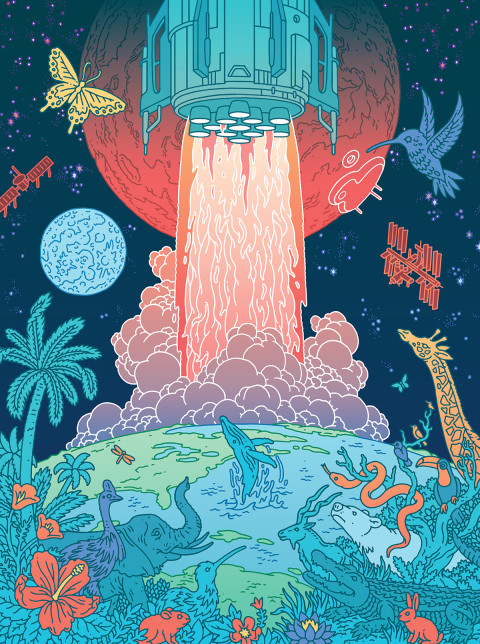
That sloppy prophet has been supplanted by Elon Musk, the richest person to ever walk the Earth and the founder of, among other companies, SpaceX. Discerning what he (and his fellow latter-day seers) understands as the impending extinction of humans, he has become the leading advocate for the colonization of Mars (and eventually other planets). As climate change, global conflicts, pandemics, and the growing presence and power of AI assail this planet, it is time to prepare, Musk argues, to leave it behind. Whereas past existential risk was largely posed by natural hazards, the bulk of future risk will be anthropogenic—that is, arising from human activity.
Musk’s plan is to establish a self-sustaining, large-scale settlement and a directly democratic, self-governing colony. The colonization of Mars will allow humanity to become multiplanetary, thereby ensuring the long-term survival of the human race if it becomes extinct on Earth. This plan has received both praise and criticism, with the latter voices questioning its feasibility, how it would be accomplished, and whether Mars can support human life.
Musk and those who share his views contend that Earth and its human inhabitants (nothing is mentioned about other life forms, it should be noted) are on the precipice of an apocalypse, but his colonization plan raises larger questions as to whether such a cosmic event is escapable and who would or should have the power to decide who gets out of this earthly life alive, and according to what criteria.
“There has been a strand of religious apocalyptic thought,” writes Church of England priest Edward Cardale in the April 17, 2025, issue of Church Times,
that believes that, if the End is coming, then it will be by God’s will, and we cannot resist it. This belief, however, is less evident in the 21st century. Instead, we have a kind of resignation, or false optimism, which is heightening the risk of a humanly caused apocalyptic breakdown in the later part of this century.
This “false optimism” has been fed by annual summits and gatherings—with their lofty declarations and pledges to address ever-encroaching environmental degradations and their “targets” for 2030, 2035, 2050, and beyond—that offer the hope that we can get through the disaster that is clearly bearing down on the planet.
Cardale also wonders about the apocalyptic dimension of the gospel, with its call to repentance in fear and trembling. Where is the humility that might restrain the Muskan impulse to simply flee Earth? If some manage to escape the apocalypse and survive, what of those who do not stock up and prepare? What about the rest of the created order? (Granted, there is a long-standing belief that the New York City cockroach could survive a nuclear conflict.) Colonization of Mars and other planets as a means to escape a dying Earth and to ensure the survival of only human beings is a human-centric belief that disregards other life forms, which smacks of human arrogance. Will there be a SpaceX ark to transport nonhumans to colonize the planets?
Perhaps the larger question before us is this: What will it mean, ethically, theologically, practically, and pastorally, to repudiate the idea that our own survival is the most important thing to worry about? Ethically, it will entail making different choices of how to live on this one planet within the created order; theologically, it will mean living in accordance with the teachings of the scriptures, not in a spirit of literal absolutism but in loving respect and humility; practically, we will need to abandon the belief that our own survival may not be feasible or just when it compromises the survival of others; and pastorally, it means that the church will need to preach and teach more clearly about how to understand the apocalyptic dimension of the gospel.
In the book of Genesis, God tells Adam that God has provided everything for his sustenance (1:29). Earth was made for all of us, humans and nonhumans, and it was made to provide what we need to live and thrive. So far, that cannot be claimed about any other planet. If we now seek to escape Earth, it is only because we, not God, have made it uninhabitable. And in Revelation’s apocalyptic conclusion, John reveals his extraordinary vision of “a new heaven and a new earth” (Rev. 21:1), which will emerge after the consummation of all things. There is no mention of escape, nor of survival on another planet.
If we need to be convinced that the 21st century bears the marks of an environmental apocalypse, we need only go down the list of recent extreme weather events. As Cardale argues, even if our era does not bring about the apocalypse, it looks and even feels apocalyptic, in the sense that we are witnessing an end to our formerly stable and predictable climate, an unspooling of what was once benign and nonthreatening.
We can’t escape Earth by booking a one-way ticket to Mars. But we can escape this narcissism-fueled escapism—by building a more mature response, grounded in faith, to countenance whatever is approaching. We can accept that God might be calling us into a future not to survive it but to accept it, without succumbing to the resignation and fatalism that Cardale cautions against. That future will require a profound faith in the God who brings new life out of death.
********************
Pamela Lewis chats with the Century's community engagement editor Jon Mathieu about different responses to the apocalypse—and what Revelation might say about plans to colonize Mars.