
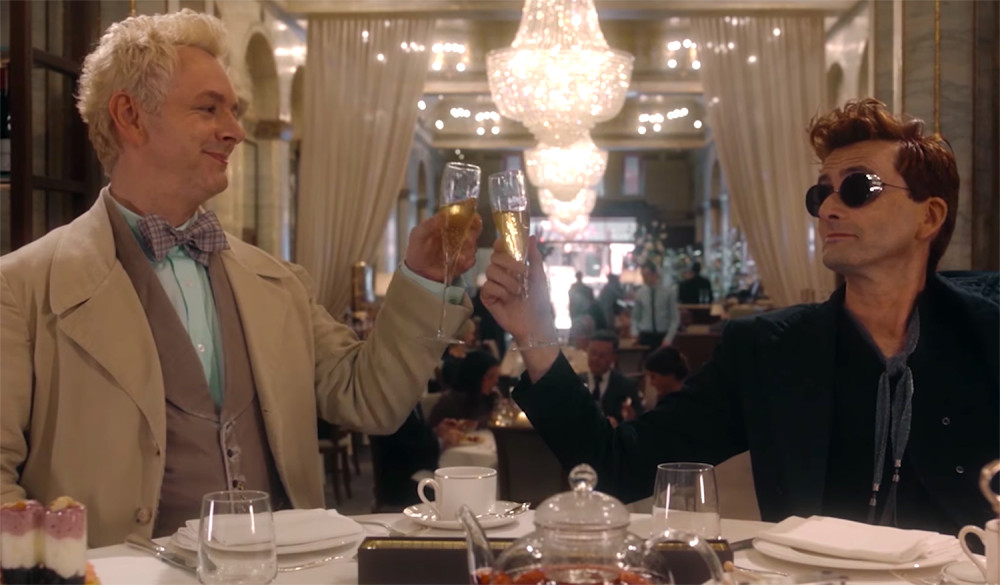
The final chapter of Good Omens dropped last month. Based on a novel of the same name by Terry Pratchett and Neil Gaiman, the series focuses on the unlikely friendship between a demon, Crowley (David Tennant), and an angel, Aziraphale (Michael Sheen), and their uncommon affinity for human beings.
It is striking just how much richness the series finale packed into one 90-minute episode. It wasn’t supposed to be this way. Good Omens was supposed to have a proper season three with six episodes, but well-documented allegations of sexual assault by Neil Gaiman led to the abbreviated ending. This strikes me as the right decision, given the seriousness of the accusations. It also makes me wonder whether we should or even can apply the same judgment to the show’s source material—scripture.
The final episode features a botched rollout of the second coming. While the original intent is for Jesus to come to earth to usher in a reign of peace, everything seems to go wrong. That’s bad for heaven but plenty of fun for the viewer, as we get to watch Jesus, played by Bilal Hasna, come back to earth to try out his parables on a generally unreceptive audience.
What if you got to ask God one question at the end of all things? For the demon Crowley, that question is, “Why make people and then punish them for behaving like people? Humans are gonna human.” Good Omens has always had a soft spot for the people trapped in between the divine super-bureaucracies of heaven and hell. Indeed, the show exhibits very little patience for this divine ordering and instead focuses on the injustices that God seems content to paper over. Season two’s most striking storyline took us back to the time of Job, with our angel and demon duo teaming up to defy God’s orders in order to protect Job’s children. This story seems to circle back to the very beginning of Crowley’s “fall” thousands of years ago, which he contends was punishment for just asking questions. He is a demon, though. Not the most reliable narrator.
The show has always forced us to confront either the absence or imperfection of God, who exists at such a remove that it would be nearly impossible to make contact. That’s what angels like Aziraphale are for. God is aloof, just like in Job. That’s no different in the final season, where it seems that God (played by a Black woman, Tanya Moodie) has created human beings largely as playthings. The apocalypse happens because God gets bored—a sharp contrast to Crowley and Aziraphale’s love of human beings.
I won’t spoil it, but Crowley and Aziraphale sacrifice a lot in order to give human beings a decent shot at living in “the real world” where “Free Will [is] a real thing.” If anything it is their infatuation with humans that seems most in keeping with my own understanding of the character of God. God is not bored with us; God seems to be recklessly in love with us, if the grand redemption narrative of scripture is accurate. God just can’t quit us.
And perhaps it is precisely that love that causes God to be at more of a remove than we would like sometimes. The Kabbalistic notion of tzimtzum articulates that in order for there to be creation, God had to withdraw; otherwise all of the space in the universe would have been taken up by God. Because God loves us and gives us free will, God doesn’t intervene and lets us make our own meaning.
I was genuinely moved by the show’s ending, but I felt uneasy enjoying something that is corrupted by its association with the author. It seems right that it would be curtailed, if not outright cancelled.
We tend to approach scripture very differently. Psalms ascribed to David form a core part of our worship experience, with many of them sung in various communities as an important part of liturgy. Scripture records acts by David that are shocking not only by today’s standards but also by biblical ones. He goes so far as to kill a commander in his army in order to steal the man’s wife.
If we can’t separate the art from the artist, can we separate the authors of sacred scripture from scripture itself? Watching a show that is so preoccupied both with the questions of scripture and bound up with the genius and alleged crimes of its creator makes me see these questions anew. David’s Psalms are beautiful. Does it matter that, traditionally, they are thought to have been written by a murderer and rapist? It has to matter, just as we admit that reading scripture for many women has to be inherently traumatic.
The Good Omens season finale is worthy of theological interest because it asks the sort of questions that Christians ought to be asking. Would we recognize Jesus if he came to us? What kind of God do we believe in, and is God bored with us yet? What do we do when beauty and moral failure are bound up together with the same project?
The show doesn’t give us a systematic theology, but it does show us a world in which Jesus is still recognizable, human beings are worth saving, and impactful stories are entangled with problematic tellers. In that way, it’s closer to scripture than we might think. Both point us towards something beautiful while refusing to link beauty and perfection. Both can help us to ask better questions and enlarge our moral imaginations.