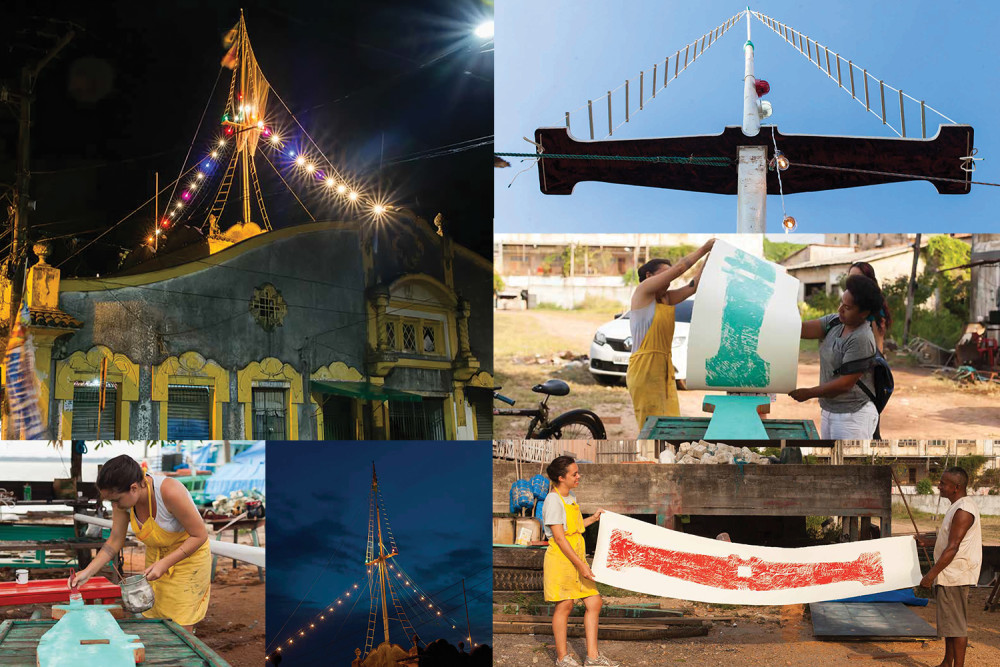
Elaine Arruda is a Brazilian visual artist whose work emerges from the riverine landscapes of Belém, in the Amazon, where water orients life, memory, and territories. A printmaker by training, Arruda has long been drawn to the dense visual languages of ports: the crossing lines of masts, flags, ropes, lights, colors, and boats. In Mastarel, her collaboration with naval carpenter Mestre João Aires, those lines leave paper and expand into markets, streets, and waterways. This work marks an intervention in the city as a vessel that carries ancestral knowledge across water, wood, bodies, histories, and public life.
The project takes its name from the mastaréu, a wooden adornment above a boat’s mast. At the center of the work is Porto do Sal, a complex of ports along Guajará Bay that have long connected Belém to islands and river channels inhabited by Indigenous and Afro-descendant communities. Around the Mercado do Sal, urban and riverine ways of life converge, carrying traditional knowledge into the city’s colonial center.
Yet this coexistence is fragile. Belém’s waterfront has been undergoing gentrification, to which Mastarel responds by placing a mast on the roof of the market, a neglected building from the 1930s. Arruda describes it to me as a portal: Passing through it, one discovers Beco da Malvina and a riverine community in the middle of the city—socially and geographically hidden from those who move through official Belém.