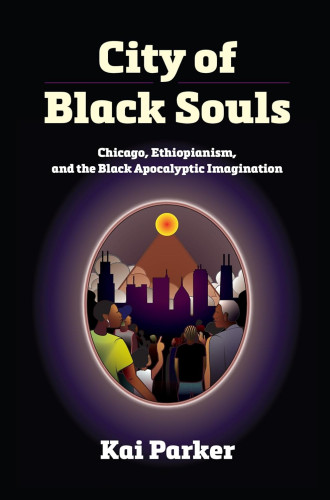
City of Black Souls
Chicago, Ethiopianism, and the Black Apocalyptic Imagination
City of Black Souls is a superb study of an intoxicating era of American religious history and specifically of Black spirituality. It focuses on the impact of the transformational year of 1896, when the Christian kingdom of Ethiopia won an astounding victory against the invading colonialist forces of Italy, and this at a time when European imperial advances seemed unstoppable. The Battle of Adwa echoed across Africa, spawning multiple “Ethiopian” churches that survive to this day. Delighted Black Americans likewise saw the event in cosmic and often apocalyptic terms, believing that they were living through that prophetic movement when, in the words of Psalm 68, “Ethiopia shall soon stretch out her hands unto God.” Kai Parker uses the alternative “suddenly” for “soon,” which neatly captures the sense of immediacy following news of Adwa.
Over the coming century, the consequences were immense, driving new pan-African initiatives and resonating through many aspects of culture, including music and the visual arts. The movement found a natural capital in Chicago. “Between the dusk of Reconstruction and the riotous aftermath of World War I,” Parker writes, “Chicago became an Afrodiasporic hub of Ethiopianism—of Black aspirations for religious and political autonomy oriented by biblical invocations of ‘Ethiopia.’”
Read our latest issue or browse back issues.
Vastly augmenting this impact was the near despair that Black Americans faced at the turn of the 20th century. Reconstruction had failed in 1877, and through the mid-1890s, Black people were struggling desperately to preserve their civil and political rights. In the very weeks that the news of Adwa was arriving in the United States, the Supreme Court was debating the case of Plessy v. Ferguson, which would consecrate legal segregation for two generations to come. The appalling rise in lynchings provides an effective index of White supremacist efforts to restore the old order. By far the bloodiest period in the history of lynching was the years between 1891 and 1895, which accounted for almost 1,000 known incidents. Adding to the cumulative horror, many of those killings were accompanied by hideous torture and mutilation. Meanwhile, the spread of the convict leasing system de facto restored Black forced labor across much of the South.
As a “New South” boomed, its ideologies were grounded in unchallengeable Whiteness. Nationally, in the same years, White elites wholeheartedly adapted explicitly racial ideologies to justify their global expansion, and the use of “Anglo-Saxon” and “Nordic” terminology became standard. What place could Black Americans possibly have in this emerging world order? In a famous study published in 1954, The Negro in American Life and Thought, Rayford W. Logan traced this history. Logan’s subtitle is The Nadir, 1877–1901, and that notion of a lowest point is hard to avoid.
Yet even at that nadir, Black activists and creative leaders were demonstrating extraordinary energy, using as bases the well-established free communities of northern cities such as Chicago and New York. Ida B. Wells undertook her heroic exposés of lynching, and such cultural figures as Paul Laurence Dunbar and Charles W. Chesnutt were already becoming celebrated in White circles, both in the United States and Europe. Dunbar’s fame in Europe coincided with a surging interest in Black musical forms, including spirituals and ragtime. Such visibility prefigured the far better known worlds of the Harlem Renaissance a quarter century later.
Already before Adwa, some enlightened souls were looking to Africa for hope. If White Americans could turn to the imagined medieval past of the Anglo-Saxons, their Black counterparts were just as entitled to turn to idealized Africa. Dunbar’s famous “Ode to Ethiopia,” which became a kind of Black national anthem, dates from 1893. Pan-Africanism, moreover, was already shading into the kind of Afrocentrism that would become so controversial in the 1990s. As early as 1882–1883, George Washington Williams published the monumental (and very widely read) History of the Negro Race in America, with extensive coverage of all the then existing states and kingdoms of Black Africa, naturally including Ethiopia. Williams, like many successors, found Black African roots for Egyptian civilization, and for all the other great traditions that sprang from it, including all the achievements of classical Greece and Rome.
But if all the building blocks of Ethiopianism were clearly in place before Adwa, the movement grew suddenly after that galvanizing shock. Parker traces its influence through a dazzling range of thinkers, including some I was surprised to see. To my shame, I had not usually thought of Wells in this context, but Parker brings out her central role very clearly.
Parker also makes clear the apocalyptic strain of the movement, which heralded the “sudden” rise of Ethiopia and, by implication, the imminent ruin and damnation of the White world order. Ethiopia was not only a predominantly Christian society but was also arguably the world’s oldest Christian state, with a church that preserved very ancient traditions. Its Orthodox roots also meant that it could be viewed differently from its Catholic and Protestant counterparts, with their historical legacies of injustice. Ethiopianism was a Black and African movement, but it was also uncompromisingly Christian, which allowed that country to occupy pride of place in any newly rethought apocalyptic agenda. Parker traces that apocalyptic strand though the 20th century, culminating neatly in Chicago pastor Jeremiah Wright’s prayer that “God damn America.” Such an uncompromising statement was very bad news indeed for Wright’s congregant Barack Obama, who at that moment in 2003 was already contemplating a future presidential run and had no need of such potentially toxic words.
The book is very good on the role of foreign missions in developing and promulgating the movement, both in Africa and North America, and Parker shows the remarkable interest that Black Americans took in the larger diaspora. In 1915, for instance, concern for African and Caribbean affairs fueled an impressive Chicago-based political movement to prevent a new federal statute that would prohibit all African or Black immigration.
Transnational concerns reached their height in the mid-1930s, when Mussolini’s Italy launched a brutal invasion of Ethiopia that was explicitly intended to reverse the shame of Adwa. Even by the standards of the era, the resulting war was horrific, with massive use of poison gas against the mainly Christian Ethiopian civilians and repeated massacres of civilians, including monks and clergy. The struggle had major ramifications for American cities, where the substantial Italian populations were usually delighted to see the restoration of national honor, and pro-Fascist sympathies were commonplace. But when Italian Americans demonstrated publicly in support of Mussolini’s campaigns, they found themselves opposed by equally passionate Black residents, who urged the defense of the last independent Black African state, and who saw the conflict almost literally as a crusade against global injustice.
Parker’s chapter on these controversies, which highlights the role of Black Protestants, bears the title “Send Bullets, Not Bibles.” His lead character is John C. Robinson, the Black pilot from Chicago who led Ethiopian efforts to defeat the vastly superior Italian air force. Robinson was a member of Pilgrim Baptist Church, “the foremost Ethiopianist church in Chicago and perhaps the US.”
Parker eloquently unfolds a narrative of political and religious ideas, but in my view, he is at his absolute best in his account of the cultural manifestations, in music and the visual arts. I stress this because even very good historians often find it hard to detach themselves from the textual worlds they encounter in the archives, where Thinker X issues a stinging (and amply documented) retort to Journalist Y. In reality, people form their impressions of a religious movement from any number of nonwritten sources, and any attempt to write a history of Black American religion while omitting music would produce only a very lean pamphlet.
At every point of his narrative, Parker is keenly aware of the very diverse musical dimensions, and his account of related themes in gospel music is exemplary. Thomas A. Dorsey, who served as music director at Pilgrim Baptist and is sometimes described as the creator of modern gospel, is a critical figure in Parker’s story. But his account spans a much longer era, and a truly revealing chapter, “From Plantation Melodies to Yoruba Gospel: Ethiopianism, Music, and Decolonization,” extends the story. I learned much from Parker’s account of the amazing Dungill family, who performed from the 1930s through the 1960s, and who included progressively more distinctively African music in their repertoire, including Yoruba-language gospel songs.
I was also delighted to see Parker’s insightful coverage of Ethiopianist strands of the visual arts. In an analysis of William Edouard Scott’s painting The Flight into Egypt, which uses biblical analogies to understand the Great Migration out of the segregationist South, Parker places the work in a surprising (to me) Ethiopianist context. The artist drew not only on apocryphal accounts but on traditions distinct to the Ethiopian and Coptic churches, which he applied to strictly contemporary American affairs. Throughout the book, Parker draws usefully on such nontextual evidence.
Parker travels far in his range of reference, and his cast of characters and organizations is impressive. While acknowledging this, I would also offer a criticism in terms of his framing of Ethiopianism, which was by no means the only attempt in this era to take Black Americans back to a real or imagined African antiquity. For Black and White people alike, the late 19th century was an age of wide-ranging religious discovery and unrestrained syncretism. While the Ethiopian dream allowed believers to remain within a broadly Christian framework, other rising sects went much farther in pushing the boundaries of religious innovation. One was the family of Black Hebrew movements, which portrayed the ancient peoples of the Bible as African and Black, so that modern-day Black people were their literal and direct heirs. Such groups first emerged in the 1880s, and the pioneering Church of God and Saints of Christ was founded in 1896, the same year as Adwa. The idea of seeking noble religious roots for Black Americans, whether in Africa or the Middle East, was very much in the air.
The other surprising omission in City of Black Souls is Parker’s sparse treatment of the heterodox Black versions of Islam, of which the Nation of Islam became the most famous. The pioneer was the Moorish Science Temple of Noble Drew Ali, founded in Newark in 1913, which moved its base to Chicago in 1925. The temple appeared at the flood tide of Ethiopianism, and at many points it echoed the core ideas of that creed. The main point of difference was its notion that modern-day Black Americans should rediscover their supposed roots not in Ethiopian northeast Africa, but rather in the “Moorish” northwest of that continent. Typically for an age that was so open to the esoteric and mystical, the temple offered as its scripture a Holy Koran that was in fact an “Aquarian” pseudo-gospel channeled by a mystically minded White preacher.
The Nation of Islam, which appeared in the later 1920s, exemplified anti-White apocalyptic rhetoric with a raw fury equal to any of the movements we read about in City of Black Souls. We need not strive too hard to argue for any linkages between the Ethiopianists and the “Moors,” the Nation, or the Black Hebrew Israelites, but such examples would have neatly illustrated the many overlapping worlds of speculation and religious inquiry that were so freely available in these effervescent years.
My main criticism of Parker’s book, therefore, is that it is not longer. He has chosen an incredibly rich subject, and his treatment is eye-opening. The book is a fine achievement.