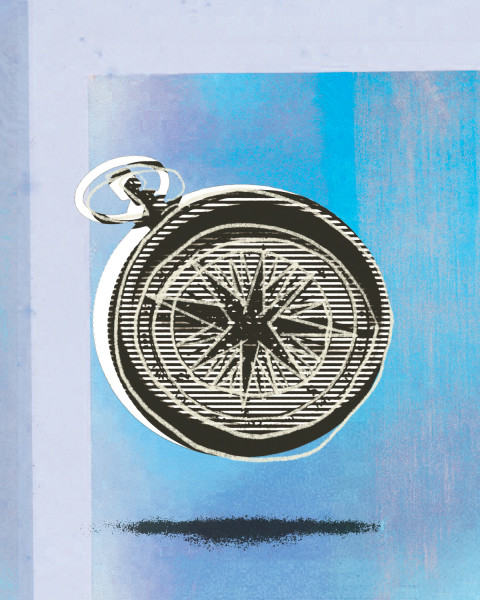
Grace Lee Boggs’s question “What time is it on the clock of the world?” is one of those profound questions you hear once and don’t easily forget. Recently, I’ve been helped by other questions too: What is happening? Why is this happening? Where am I?
Four answers to that last question have helped me ground my spiritual journey: wilderness, community, empire, and creation. The wilderness bears witness to the precarity and resilience of life even under harsh, unfavorable conditions. My community of faith has changed quite a bit over the years, yet vital friendships remain key lifelines. The muck of empire and its complicated relations of power shapes my every day, whether I’m conscious of its tentacles or not. And no matter how stuck I get, the marvel and mystery of creation holds me and everything I know.
Read our latest issue or browse back issues.
It so happens that the four gospels open in these very settings. Mark opens with a voice crying out in the wilderness. Matthew opens with a long list of names depicting the community of saints. Luke opens with numerous references to the empire of his day. John opens with a vision of the cosmos and all things created through the Word.
There is something striking about this dynamic range. The gospels’ attention to place and time and their collective breadth deepen my appreciation for the wisdom of scripture. Last year, I wrote a column about the multivocality of the gospel endings (“The four gospels and their very different endings,” April 2025). That the differences between the gospels might themselves be a source of spiritual insight is deeply compelling to me. I find myself leaning in to hear what they are trying to tell me about my life in this wide and wild world.
Wilderness. Left to my own devices, I experience the wilderness as a sad, desolate place. My worst fears, my most self-absorbed thoughts can overtake me if I’m not careful. But reading Mark, I wonder what possesses John the Baptist to choose the wilderness. And why is there a river there? It dawns on me that the wilderness is not a place bereft of life or vegetation or water: It may lack abundance, but it is not completely absent or empty. There is plenty of life in the wilderness for those who have eyes to see. Apparently, it can even be a place to which people flock, where lines form and crowds gather to hear a strange prophet uttering surprising words.
Mark changes my view of the wilderness from a place devoid of life to a place that highlights the resilience of life. The scarcity of the wilderness calls forth the most tenacious expressions of life.
Community. When I think of the community of faith in my life, I tend to focus on the people right in front of me. My field of vision becomes very small. I see an intimate circle of friends, trustworthy confidants, people who challenge and inspire me.
In contrast, the community of faith in Matthew’s opening stretches millennia. He deftly takes us back many generations, chronicling a past filled with twists and turns. The names of intimate strangers remind us we are not alone, that many, so many, have gone before us. The inclusion of women like Tamar, Rahab, Ruth, and Bathsheba reminds us of heroic outsiders who reshaped redemptive history and of the men who would have been lost without their help. Matthew’s genealogy tells me it has always been important to de-center one’s perspective, as hard and unnatural as that may be.
Empire. A cult of empire is alive and well today, and a comprehensive world-and-life view that leaves little room for dissent or doubt is pervasive in religion and politics. Grave infractions against human dignity are seen as necessary collateral damage. Obedience to doctrine and policy we may not feel comfortable with is celebrated as virtuous faith and a way of overcoming total depravity and the noetic effects of sin. The license such a system gives to a few rulers in the name of faith is astounding.
The Roman Empire looms large in Luke’s story of Jesus, set in the time of Herod’s rule over Judea. Herod’s superior, Caesar, issues a decree, and everyone in the empire must start traveling toward their hometowns. The empire asserts spiritual, economic, and political power, and everyone must fall in line. In such a time and place, Mary’s revolutionary Magnificat asserts, early in the gospel, a preferential option for the poor and oppressed.
That the gospel of Luke begins with counter-imperial agitation, railing against Caesar, is central to its good news. In the face of the empire, Luke’s opening invites me to sing and rail against the Caesars of our world.
Creation. Our everyday contexts feel humdrum, exacerbated by pixelated screens and windowless rooms. Ordinary time and the world of the flesh can feel less than glorious. It doesn’t help that the New Testament often refers to the flesh as fallen and sinful. And yet, the splendor of creation beckons us to open the door and step outside.
The motion of crossing a threshold and stepping outside can help us understand the opening of John. Everything was made through the Word, a world without end, touched and beloved by God. Eugene Peterson’s paraphrase depicts how far the ordinary marvel of the incarnation reaches: “The Word became flesh and blood, and moved into the neighborhood.” In Christ, God’s very self steps into creation.
To return to the original question: Where am I? The gospel openings teach me where I am: in the wilderness, within community, under empire, and amid creation. They teach me, too, that God makes a way through the wilderness, gathers us into community, calls us to resist empire, and sets our brief lives within a creation vast with mystery.