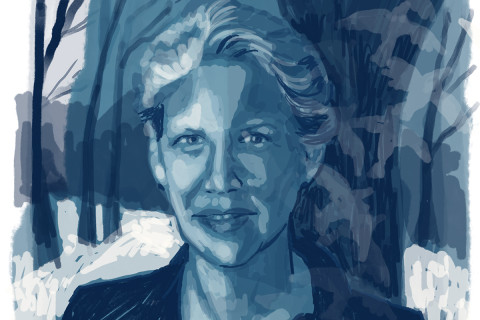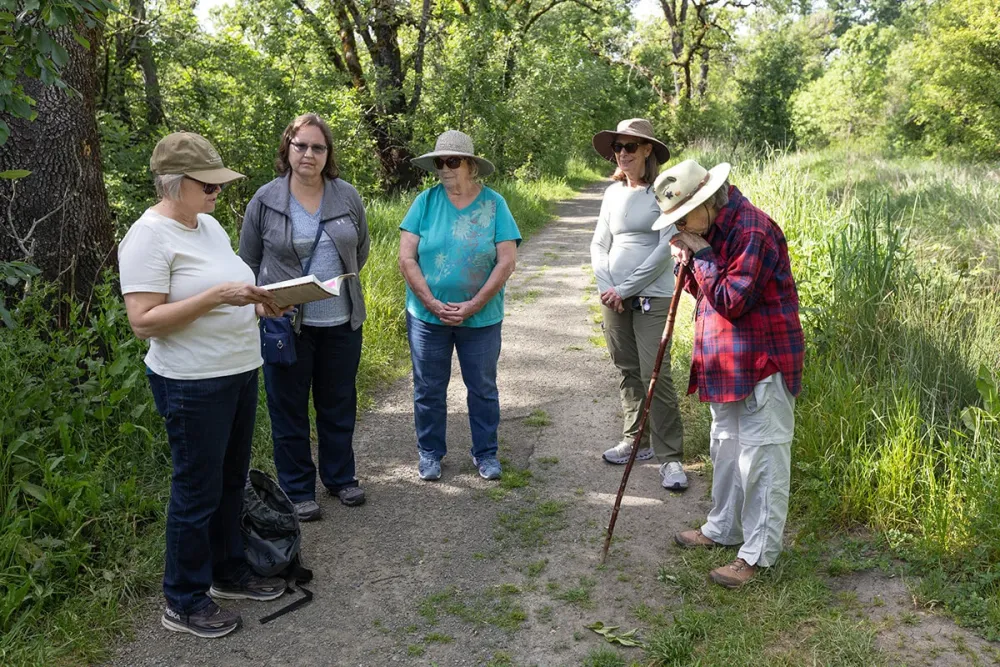
Standing alongside a creek amid California Live Oaks where Pomo, Wappo and Miwok tribes once gathered food, healed, and loved, Laurie Bayen is preaching the gospel. The gospel of respect for creation. The gospel of unity among cultures. The gospel of paying attention.
“I think one of the formative scriptures for me is the passage of the Sermon on the Mount about not storing up treasures on Earth,” she said. “It continuously calls me to account. Jesus is saying the most important things are right in front of you.”
Bayen pastors a small congregation at nearby Windsor Community United Methodist Church in Sonoma County, but on this day in mid-April, she is an outdoor, historical and spiritual guide for those participating in a Sacred Ground field trip to Laguna de Santa Rosa. The area is about an hour’s drive north of San Francisco.
Laguna de Santa Rosa is one of 84 sites featured on the Sacred Ground mobile site that Bayen launched three years ago and is housed on the free OtoCast app. Though nearly all the Sacred Ground sites are in Northern California, additional ones are being developed in other parts of the state and in Nevada, Oregon, and Canada.
Bayen’s dream is to offer the Sacred Ground program across the United States. Each site includes an info page, photos, a short narration, and instructions on getting there. There is often a call to action for users.
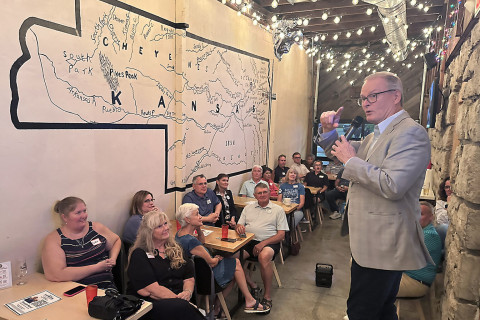
Besides opening users’ eyes to God’s bounty in nature, Sacred Ground focuses on Indigenous histories and continuing violence against peoples and lands in 2026. At a stop at Bita-Kom-Tara (Flat Rock Park), for instance, Bayen talks about efforts to fight commercial development near the confluence of Santa Rosa Creek and Brush Creek and to restore the park name to its Indigenous roots.
Bayen said she had been thinking about the idea for Sacred Ground for a while, and more than three years ago, the roots began forming. She took a two-month renewal leave, sailing parts of the Washington state coast with her husband, Albert, and simultaneously reading a book about North American Indigenous history.
“I worshipped at one place in Canada, and I went to a couple of parks there. I noticed there was more land acknowledgement stuff going on there,” she said. “Reading that book, and going to all those beautiful places, it all kind of coalesced. I had a sense that the decline of the church is perhaps a result of all the horror that has been wrought on the earth in God’s name.”
Bayen was also undergoing discernment to help identify her strengths and interests. She joined the UMC’s Creation Justice Movement and went on a camping trip to the coast near her home.
On the dramatic cliffs of Bodega Head, she recalled a “mystical experience.”
“I was enjoying the waves and thinking about those who had been there, including those who had parts of efforts to save it from a nuclear power plant. I thought, ‘there should be an app for this.’”
In the 1960s, Pacific Gas and Light planned to build a nuclear power plant in Bodega Bay, but plans were scrapped because of its proximity to the San Andreas faultline. On the Sacred Ground app, Bayen narrates what visitors see at this remote northern California coastal town.
“Geologically speaking, you are actually not in North America at all, but on an island, which is temporarily merged with the North American plate,” the narration goes. “This is a prime viewing spot for migrating California gray whales, but there are breathtaking views no matter what the weather or season.”
Sacred Ground has received three grants from the Los Rios district of the UMC’s California-Nevada Conference. Money from a Peace with Justice grant has been earmarked for the costs of translating a portion of the app into Spanish.
The district allows Bayen to spend about a quarter of her time on Sacred Ground and the remainder on leading Windsor. As Sacred Ground has grown, its activities and focus have blended into the rhythms at Windsor. Several members are regulars on field trips. They help research new sites, and the leadership board considers Sacred Ground in decision-making.
Sacred Ground was never intended just to be for United Methodists. Bayen hopes to open anyone’s eyes to the wonder of nature.
“The chair of the district union suggested (the grant proposal) would be stronger not only if I pitched it as a way for people outside the church to connect to the holy and nature, but also that I have a component where people who are in the church get outside. We need people to build a community and get outside, post-COVID,” she said.
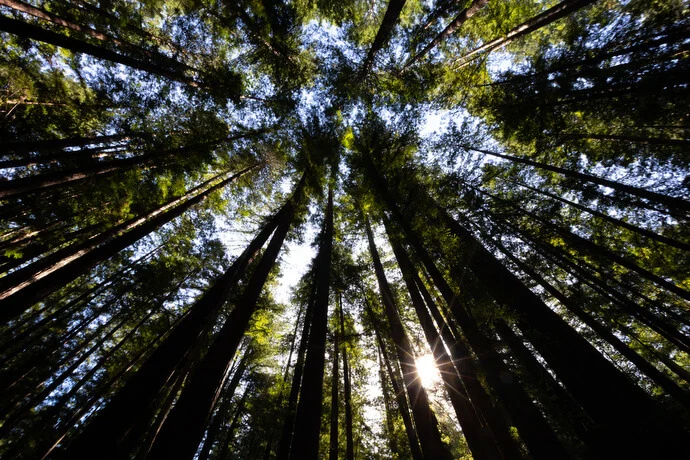
Sunlight filters through old-growth redwoods, some as tall as 300 feet, at Armstrong Redwoods State Natural Reserve near Guerneville, California. (Photo by Mike DuBose)
Because some participants use canes or cope with other age-related challenges, most of the locations have sections that are accessible—and when they are not, the app’s info tab makes a note. The app also makes it clear when dogs are welcome.
Bayen also has connections with multiple Indigenous groups to ensure the app is accurate and culturally sensitive.
The most visited site on the Sacred Ground app is Armstrong Redwoods State Natural Reserve, just a few miles from the coast. In the 1850s, redwoods were at risk because of logging, and nearly all of them had been cut down. Today, they are protected treasures throughout the region.
Volunteer Joan Bacci escorts a Sacred Ground group along well-trod paths at Armstrong, explaining redwood roots (not deep, but wide), how the trees thrive on fog, and spotting unique animals, such as banana slugs. The largest tree, called Colonel Armstrong, is 308 feet high at last count and approximately 1,400 years old.
Bacci describes recent California wildfires and how close they came to making deeper scars into the forest than the fallen trees and branches clearly visible with black wood.
“I just think it’s amazing how redwoods can heal themselves,” she said, pointing to a redwood still growing tall after a 1920s fire.
Healing is a big part of Sacred Ground. Bayen’s favorite site is Bodega Head, a peninsula four miles wide and about 20 miles west of Santa Rosa. It’s a site for marine research and a big spot for whale watching. Herons and seagulls dot the wildflower-covered cliff faces.
Bodega Bay represents the Sacred Ground beginnings, and the end, Baylen said. You can go no farther than the cliff’s edge.
“The relentlessness of the waves reminds me of the everlastingness of God. Time keeps going on. God’s grace and goodness keep going on, despite everything,” Bayen said as she recounts her inspiration for this ministry.
“I feel small at a place like this in a sense of how things continue long after we are gone. We come with our anxious thoughts and good plans, and we regain our perspective that we are just little, that God is great.” — UM News