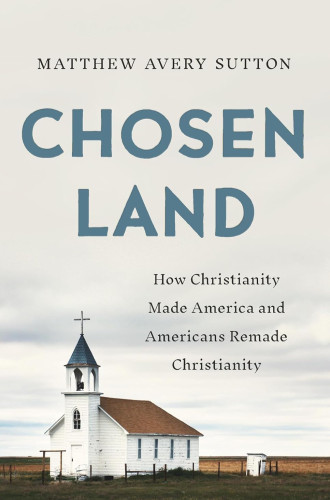
Chosen Land
How Christianity Made America and Americans Remade Christianity
In Chosen Land, Matthew Avery Sutton weaves together 500 years of American history to examine how the Christian faith, in its myriad forms, has played an integral role in the American story. He aims to show how the United States, with its immense diversity of religious expression and lack of a state church, has developed a culture of fervent religious activism that distinguishes it from other Western nations.
Sutton, who is a historian at Washington State University, has written several other books on American Christianity, particularly on contemporary evangelicalism. He achieved some notoriety in 2024 when he wrote an article for the Journal of the American Academy of Religion that critiqued some of the most prominent scholars of American evangelical history, including Mark Noll and Randall Balmer. Sutton argued that they are wrong to cast post-WWII evangelicals as the heirs to 18th- and 19th-century American Protestantism, and in the introduction to Chosen Land, he says refuting that historiography is one of the goals of the book. He shows how the evangelical label was chosen in the 1940s to replace “fundamentalist,” and how prior to the 20th century, “evangelical” could be used to describe almost any Protestant belief system.

Read our latest issue or browse back issues.
Plenty of the figures in Chosen Land fill any standard textbook of American religious history, such as Jonathan Edwards, Frederick Douglass, and Aimee Semple McPherson. But Sutton also introduces new elements to the mix. Perhaps unsurprisingly for someone from Southern California, he includes a fairly lengthy section on Spanish colonization. He also tries to show how the religious landscape of early America was far from homogenous, and even among Protestants, there was significant infighting about what correct belief looked like. America may once have been more of a Christian nation than it is today, but it has never been one in the same way a country with a state church is.
A common thread running through Sutton’s postcolonial chapters is analysis of how people wrestled with the Constitution’s Establishment Clause and Free Exercise Clause (“Congress shall make no law respecting an establishment of religion, or prohibiting the free exercise thereof”) to determine what it meant for society. Should enslaved people be allowed to worship freely? Should there be Protestant education in the public schools? What about religions that have religious practices the mainstream finds objectionable, such as Mormon polygamy?
One thing is clear: There was no point in US history when religion was separate from politics. But neither was there an era when everyone lived like an idealized 1950s Protestant Christian nuclear family—not even in the actual 1950s, when, Sutton notes, a mother (successfully) sued for the right of public schools to set aside time for religious instruction. He shows how even while the hegemonic Protestant institutions have always tried to enforce conformity, there have also always been dissenters.
I found myself frustrated at times. Sutton fails to account for the depth and longevity of Protestant anti-Catholicism, including the beliefs that the pope is the Antichrist and that Catholics will always be loyal primarily to Rome. He refers to aspects of this phenomenon throughout the book, and he details the emergence of the notoriously anti-Catholic Know-Nothing Party in the 1850s. Yet he doesn’t explain the larger story of how anti-Catholicism, which predates colonization, came to undergird the development of Protestant thought in the United States.
This makes for an incomplete, sometimes oversimplified narrative. For example, Sutton claims that Thomas Jefferson tried to downplay religious controversies and included nothing in the Declaration of Independence about the rights of religious minorities. What Sutton fails to mention is the Declaration’s complaint about Canada’s abolishment of “the free system of English Laws” and establishment of “an Arbitrary government”—which is taken nearly verbatim from a section of the Declaration and Resolves of the First Continental Congress that decries Quebec’s Catholic establishment, reflecting the Protestant fear of forced conversions. Sutton also neglects to mention the riots and anti-Catholic violence that arose in the 1840s when Catholic leaders strove to secure public funding for parochial schools due to the normalization of Protestant practices in the public schools.
While Catholicism sometimes feels like an afterthought in Sutton’s narrative, he frequently mentions small Protestant offshoots that arose over the years. However, he doesn’t always name the influence these sects had on US society. For instance, although he devotes a few pages to the story of Mary Baker Eddy founding Christian Science, he writes nothing about the group’s long, contentious relationship with religious exemptions and health care.
In a book that starts with Christopher Columbus and ends with Donald Trump, an author will need to prioritize some things over others. But I was often confused by what Sutton chose to prioritize. He devotes several paragraphs to the Spanish attack on the Acoma in 1598 but does not mention the Japanese internment or the Korean War. His sections covering more recent history feel disjointed, with child sexual abuse in the Catholic church being followed by the Branch Davidians.
Still, Chosen Land will be useful for a broad audience: It is easy to read, and it covers a broad swath of American history. Even those who are familiar with the arc of US Christianity will learn something new. While Sutton could have spent more time developing the book’s post-WWII section, the chapters on the 19th and early 20th centuries provide useful context for how Christianity and the new republic shaped each other. Whether or not America really was chosen by God is left for the reader to decide.