
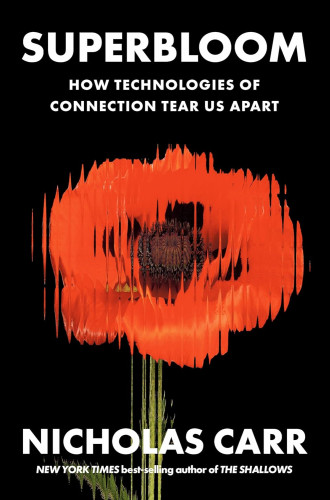
Superbloom
How Technologies of Connection Tear Us Apart
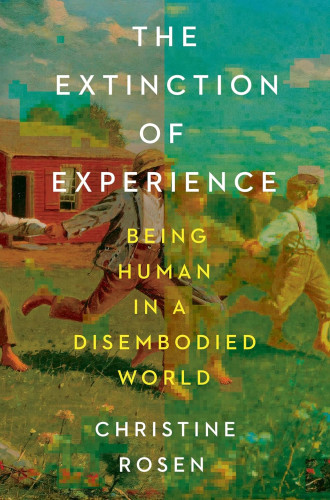
The Extinction of Experience
Being Human in a Disembodied World

The Sirens’ Call
How Attention Became the World’s Most Endangered Resource
“What may emerge as the most important insight of the twenty-first century is that man was not designed to live at the speed of light,” writes Marshall McLuhan, a devout Roman Catholic and one of the seminal thinkers on the impact of electronic media upon culture. Writing in the 1960s and ’70s, well before the advent of social media, he lamented the church’s failure to grasp the theological significance of electronic communication. As McLuhan puts it, “electricity has made angels of us all. . . . not angels in the sense of being good or having wings, but freed from flesh, capable of instant transportation anywhere.” This “discarnate life,” as he calls it, is seductive. It poses an enormous threat to humanity, yet is overlooked by theologians. The only hope he sees is “through the transformation of mankind by the sacraments of the Church, and the development of the awareness of self through community.”
Where theologians have often feared to tread, many journalists, philosophers, and sociologists have dared to go. Three recent books join a growing body of work that laments the trend toward defaulting to technologically mediated communication over in-person interactions. These critiques share a common thread which echoes the concerns McLuhan anticipated: the waning of sense and sensibilities intrinsic to face-to-face communication. What is at stake, according to these authors, is nothing less than our humanity.
Read our latest issue or browse back issues.
Journalist Nicholas Carr is known for his books on how the internet is withering our capacities for concentration, contemplation, and reading. The title of his latest volume, Superbloom, refers to the annual blooming of a poppy field in Walker Canyon, just south of Los Angeles. He uses this natural event as a metaphor for modern communication:

We live today in a perpetual superbloom—not of flowers but of messages. Our phones have turned us into human transceivers, nodes on a communication network of unprecedented scope and speed. Whatever else we may be doing, we are always receiving and emitting signals, many of which we’re conscious of (words, images, sounds) and others of which we’re not (data on our location, behavior, mood).
Prior to the digital age, Carr observes, our way of communicating—in terms of pace, content, and form—reflected how we actually talk with one another. At first, for example, email “felt like an updated version of the mail system, with speedier delivery and no need for postage.” Our emails reflected a length, formality, and narrative quality of letter writing. In time, however, the content was stripped down: “The curt style of the engineer and the mathematician became everyone’s style.” Now, email feels too cumbersome; texting punctuated with emojis is the preferred mechanism. Whereas we used to impose a human way of communicating on technology, technology has now succeeded in imposing its form on us. The manifold consequence of this turnabout and our embrace of it is the central concern of his book.
Among the three authors discussed in this review, Carr is the only one to focus on the emerging reality of AI systems that generate content. He identifies three stages in the evolution of electronic media: the transportation of messages, the selection and feeding of content, and, finally, the generation of content. At the third stage, “the algorithmic feedback loop will complete its circuit instantaneously, freed of the friction inherent in the human work of creation just as it was earlier freed of the friction inherent in the human work of transportation and sorting.” With generative AI, Carr believes, “the technological takeover of media is complete.”
For Carr, technology’s implicit promise of transcending the limitations, inconveniences, and frictions of our embodied existence is misleading:
Any attempt to transcend reality, intellectually, artistically, or spiritually, has to begin from within reality, bounded by constraints of time and space. You can only get beyond the material by going through the material, by suffering and surmounting its frictions. And that becomes harder and harder to accomplish or even imagine the more that life is mediated by mechanisms of communication.
How thoroughly we will embrace the evolution of mechanized communication and the “bot-besotted world” it makes possible depends less on the technology itself and “more on our own attitudes and desires.”
Christine Rosen is a senior fellow at the American Enterprise Institute who writes for Commentary and The New Atlantis. Her latest book, The Extinction of Experience, echoes many of Carr’s concerns about the consequences of our acquiescence to a way of life constrained by technology. The experience that Rosen claims is at risk of extinction is “a way of life rooted in our bodies . . . an experience mediated by our humanity rather than technology.” This loss, she contends, is having a dehumanizing effect on us and our world. We are becoming conditioned to a way of being that is intolerant of delay, preoccupied with capturing experience rather than living it, and opting for breadth over depth in our relationships.
Rosen calls for nothing less than a “new humanism” that places “human beings and human experiences at its center.” The contingencies, the frictions, “the awkwardness of face-to-face conversations and the quirks of our physical bodies, are precisely the ‘ill-fitting pieces of experience’ that, taken together, make us human,” she writes, quoting sociologist Richard Sennett.
She contrasts the experiences of standing before the commanding presence of an artist’s canvas and sitting before a computer screen. The canvas communicates depth and permanence, calls for a disposition of humility and receptivity, and invites contemplation. The screen is constantly changing, preys on our attention, and invites consumption.
Both Rosen and Carr believe our sense of place is waning. It is not incidental that we speak of cyberspace rather than cyberplace. The internet is a timeless dimension without horizons or permanence. Physical spaces only become places when they acquire enduring significance for us—when they are infused with meaning and emotion, as when a house becomes a home. Both writers seem to suggest that we need places in order to find a sense of place in the world—places that orient us and provide essential referents for our identities.
In The Sirens’ Call, political commentator Chris Hayes asks us to pay specific attention to those who are paying so dearly for our attention. In his view, what is at stake is not just the loss of attention but the loss of our humanity. His controlling metaphor is from an episode in Homer’s Odyssey in which Odysseus has himself strapped to the mast of his ship so he can hear but not succumb to the seductive Sirens’ song. Hayes believes the “sirens that are fighting for control of our very being are the devices and corporations and malevolent actors trying to trap us.”
Early on, he draws on William James’s distinction between three forms of attention: voluntary, involuntary, and social. Social media and the “attention merchants” of our day successfully exploit our vulnerability to involuntary attention: “Attention can be extracted from us at the purely sensory level, before our conscious will even gets to weigh in. In fact, this is how a siren functions.” No less targeted by these merchants is our yearning for social attention—our yearning to be seen, recognized, and known. Our exercise of voluntary attention is under assault in what Hayes believes is “a war of all against all for our attention,” making us prone to the surrender of our response-ability.
The merchants’ preferred resolution to the age-old problem of getting and keeping our attention is what Hayes calls “the slot machine model.” The constant, rapid, repeated grabbing of our attention puts us on an “attentional treadmill.” These relentless, ever-changing stimuli condition us for shorter and shorter attention spans. The content that grabs our attention has a “low cognition load.” What amuses and entertains us entails less friction. In a world increasingly patterned by online communication, a politics that traffics in spectacle and entertainment has a lot of traction.
Consequently, our experience of democracy feels less like the practice of a deliberative process and meaningful compromise and more like an attention-grabbing cacophony of breaking news, leaving us feeling bewildered, overwhelmed, and disempowered. We can’t keep from turning our heads only to find ourselves stalled in a high-speed traffic jam. Hayes makes the case that the prophet for our era is not George Orwell, who warned of information deprivation—that the truth will be hidden from us by the powers that be. Rather, it is Aldous Huxley, who warned of information overload—that the truth will be drowned out.
When it comes to the question of how we should live, none of these authors is a technological determinist. Each affirms the possibility of resistance. As Carr puts it:
It’s important to be honest about our own complicity. We’re not being manipulated to act in opposition to our desires. We’re not hostages with Stockholm Syndrome. We’re being given what we want, in quantities so generous we can’t resist gorging ourselves. The manipulation is secondary to and dependent upon the pleasure.
The difficulty lies in the fact that we have become so adapted to efficiency, immediacy, and availability that we find inefficiency and delay intolerable. It’s too late, he confesses, “to change the system.” But “maybe it’s not too late to change ourselves.”
Carr seems skeptical of our capacity to resist the frictionless efficiency that technology makes so readily available. While he does not map out for us what such resistance might look like, his concluding sentences point us in a promising direction:
Maybe salvation, if that’s not too strong a word, lies in personal, willful acts of excommunication—the taking up of positions, first as individuals and then, perhaps, together, not outside of society but at society’s margin, not beyond the reach of the informational flow but beyond the reach of its liquefying force.
Hayes also encourages intentional response, asserting that we are not just objects of attention but also agents. He recommends dusting off our vinyl records; opting for print versions of newspapers, journals, and books; frequenting and multiplying natural food stores and farmers’ markets. He even suggests the possibility of legislation that would cap how many hours of screen time we could spend in a single day.
It strikes me that strapping ourselves to the mast of such good intentions (or legislation, for that matter) seems woefully inadequate to the task of resisting the seductive power of technology.
As for Rosen, she concludes that the time for simply moderating our use of technology has past: “A decade ago, a book about how technology is changing us would offer solutions for a more balanced relationship with our devices, such as take a digital Sabbath, avoid multitasking, and put those phones away at the dinner table! These are no longer enough.” Imagining what resistance to technology’s captivating power might look like, she points to the Amish and how they have learned to curate “a robust skepticism” concerning technology. After acknowledging that this might be a bridge too far, she lists things the rest of us need to do: delay giving our children smartphones, hold tech companies accountable, pressure schools to ban or restrict cell phone use, engage in more face-to-face interactions, and so on.
All of which feels much like the advice she finds inadequate to the task. After over 200 pages of arguments for the dehumanizing effect of our use of technology and its overwhelming appeal, Rosen’s advice feels tepid and inconsequential.
While all three authors sense the importance of collective action and experience, none of them fleshes that out in any substantive way. What provides the Amish with the power to resist technology in their daily lives is that they have a shared, articulate sense for what matters most, for what it means to live a good life. Absent that shared sensibility and clarity, resisting technology’s gravitational pull seems unlikely. Our resistance will remain episodic at best as long as our notions of what constitutes a good life remain ambiguous, inarticulate, and unspecified—and the material setting of our lives continues to make technological devices readily available and conducive to their use.
Albert Borgmann, a philosopher of technology, wrote extensively about the need to marginalize technology not by rejecting it but by placing what he called focal things and practices at the center of our daily lives. A focal thing is something that has a commanding presence, engages both body and mind, and situates us in time and space. Compare the iPad to a guitar: one is a technological device, the other is a focal thing. To take up a guitar engages us physically and mentally, requires discipline, and incorporates us into a community of musicians. The iPad is readily available, easily accessible, requires no effort, and disconnects us from our immediate surroundings. (I recently observed my three-year-old granddaughter, a highly social, playful, engaging toddler. When placed in front of her iPad, she became transfixed and antisocial, unwilling to turn away for extended periods until it was turned off.) For households to become contexts for focal things and practices, Borgmann argues, they require a larger context of communal celebration where focal things are visible and focal practices are nurtured.
One of the few places in our culture where communal celebration occurs on a regular basis is the church. Where else are individuals and families so regularly drawn out of their homes and into a community? To be sure, congregational life is not immune to conforming its life to the very dynamics lamented by Carr, Rosen, and Hayes. When it does, it ceases to be a place where the sacramentality of life is encountered. Instead, tragically, it becomes a conveyor of the commodifying, frictionless, discarnate life: worship becomes entertainment and congregants participate as consumers seeking gratification more than grace.
Years ago, while interviewing Borgmann for the CENTURY (see “Prime time,” August 23, 2003), I concluded by asking him what he would say to congregational pastors in a culture that is becoming so tightly patterned and constrained by technology. He replied:
I would suggest that there are two things they need to do. One is to be more confident of the good things that they’re doing and make it clear to people who are gathered for worship what an extraordinary thing this is and how such gatherings are suffused with grace. I think pastors often give themselves far too little credit for what they preside over and what they stand for.
And then out of that joy and confidence must come the desire to make focal things prevail in the culture at large. You won’t make them prevail if you don’t understand what you’re up against. But if those two things come together—an intelligent understanding of the pattern of contemporary society and confidence in God’s grace—then we can hope that the kingdom of God will come a few steps closer.
That, no doubt, is advice with which McLuhan would heartily concur.