“You really are a true believer, aren’t you?” Years back, this is what a close friend said to me after hearing me preach for the first time. She meant that I was all in on my faith, that my trust in the biblical accounts of Jesus Christ was unequivocal. She heard no trace of cunning or clever hedging in my words, none of that fudged use of metaphor and simile that sometimes marks the preaching of those who, like me, have been shaped by progressive theologies. I had not offered the kind of account of the resurrection or of Jesus’ miracles that explains them away in order to aid their reception among those of a skeptical or sophisticated mind.
My friend was right. Wherever I have traveled theologically, whatever metaphors I have developed, no matter what scientific and critical influences I have absorbed, I have always come back to a firm place of faith and trust that what the gospels say actually happened. Crucially, that the resurrection happened, and that every extraordinary, world-bending, and reformulating truth of the gospels flows from that. At a deep level, I continue to hold this position.

Read our latest issue or browse back issues.
But then I think about the ascension. Even shortly after my conversion in the 1990s, when my faith was at its fiercest and wild with trust, I had what can only be described as a blockage about the ascension. Trust in the virgin birth? Check. Trust in Jesus’ miracles and teachings? Check. In his death and resurrection? Check.
But in the ascension? Meh. Sometimes nada.
I have often wondered why. Part of it is that I find the ascension story ripe with absurdity and low comedy. I do not say that lightly. Theologically, as an event in the arc of salvation, it is hugely significant. Intellectually, I grasp how the ascension signals Christ letting go of earthly presence so that he can be available to all in the Spirit. And I am moved by the notion that in the ascension, Christ takes the fullness of humanity, takes you and me, into heaven.
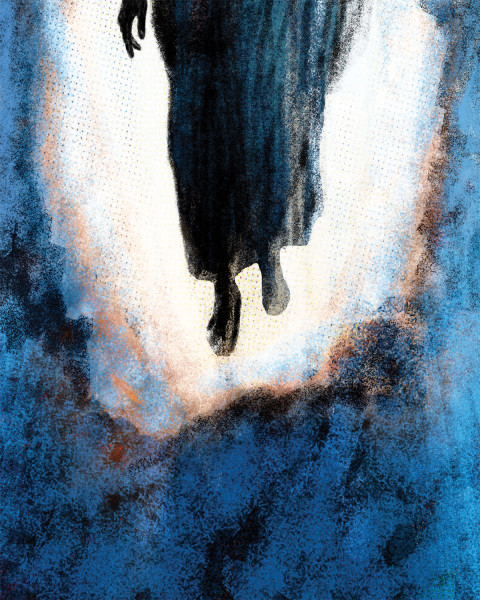
Nonetheless, I struggle to let go of a childishly comedic picture of it. One where, having delivered his farewell oration, Jesus takes off like a little human rocket, flies up, and disappears into the clouds. I get hung up on the speed: Does he go slow and dignified or sudden and fast? Both seem silly to me. I imagine a little bit of shock on his face at lift-off; somehow, I picture him and the disciples waving to each other as he departs.
I say all this shamefacedly. There is, at some level, a failure of my imagination. Pop culture and scientific sense have colonized my faith. I end up reading the ascension through the lens of Marvel superheroes, Super Jesus imbued with the power to fly. Add the modern scientific insight that heaven is not directly above us in the vault of the skies, and the ascension can leave me cold.
What is to be done? Well, maybe this is an occasion for metaphor and simile. Poetry helps, not least because it permits a play of space and time that cracks open my troubled imagination and keeps the flatness of facts—important though they are—from destroying vision. Which brings me to John Donne’s extraordinary sonnet “Ascension.” He sets its truth in the context of the poet’s response to the ultimate fulfilment of God’s story:
Salute the last, and everlasting day,
Joy at the uprising of this Sun, and Son,
Ye whose true tears, or tribulation
Have purely wash’d, or burnt your drossy clay.
What I love here is how Donne breaks open an unexpected vision of ascension in one word: He calls it an “uprising.” This word has an older, literal sense: literally rising up toward heaven. But of course it also means a revolt, a revolution against what is and has always been.
Suddenly I find myself in fresh imaginative space. The ascension becomes a disturbance of the status quo—more than that, a work of resistance and revolution to the “dross” of failing humanity. If Donne affirms a literal aspect to ascension when he later says, “Behold, the Highest, parting hence away, / Lightens the dark clouds, which He treads upon,” this matters only insofar as it represents a revolution in being human.
It is in the ninth line of the sonnet—the volta or turn, where fresh ideas are introduced—that Donne blows open the ascension’s possibilities: “O strong Ram, which hast batter’d heaven for me!” In this line’s wake comes a list of images associated with Christ, but it is that picture of Jesus battering heaven that startles and energizes me. Here is a Christ who will break down the walls of God’s realm to permit the likes of Donne, of you, and of me to enter in. In Donne’s version of the ascension, we find no 16th-century variation on a floaty Jesus going up to heaven. Rather, he gives us an untamable savior crashing in on heaven’s stronghold and taking us with him.
I am not sure if I will ever quite be instinctively ravished by the ascension as I am by the outrageous, embodied wonder of the resurrection. But Donne gives me hope. His words counter my childish and even blasphemous musings about Christ’s ascension. He stirs and reforms my heart with his extraordinary lines.
He closes the sonnet with words of wonder at Christ’s graciousness: “And if Thy Holy Spirit my Muse did raise, / Deign at my hands this crown of prayer and praise.” When I consider Donne’s picture of ascension as a holy uprising, a breaking into the bulwark of heaven from which broken humanity has been excluded, I too feel wonder and praise.