Books

Seeing Christ’s image in Orthodox women

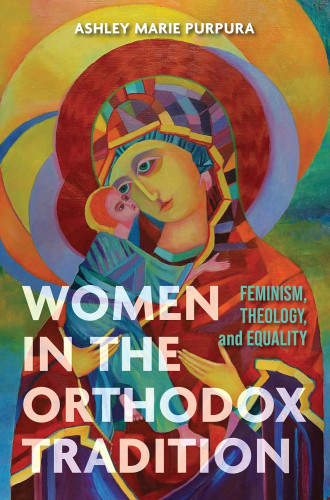
Ashley Marie Purpura explores the Eastern church’s androcentrism—and finds resources to counter it from within the tradition.

Women in the Orthodox Tradition is a bold and novel effort. As theologian Carrie Frederick Frost notes in her endorsement, it is “the first book-length attempt to bring feminist theory and theology into conversation with women in the Orthodox Church. That alone makes it invaluable.”

It’s also risky. The small but growing number of Orthodox converts often come to the faith for tradition, and some of them take to the internet to assert that they don’t want Orthodoxy to end up like the Episcopal Church. There’s also been accompanying growth in social media callouts for scholars who might take on such subjects.

Written by religion scholar Ashley Marie Purpura, the book’s thesis could be succinctly illustrated by the icon of St. Juliana of Lazarevo, which at its center depicts a larger-than-life image of the 16th-century Russian noblewoman. In keeping with one strand of iconographic convention, the monumental central image is surrounded by a series of smaller vignettes of the key moments of St. Juliana’s life. There is St. Juliana nursing the sick; St. Juliana doing needlework while seated before an icon of Mary, the Theotokos; St. Juliana gathering a group of small children to herself; and more.


As Purpura develops her thesis, she carefully examines and peels away the layers in Orthodox tradition regarding women’s roles and agency, which ultimately range far beyond the kinds of left-right cultural bifurcations that are familiar to Christians in the United States.

Sacred tradition, in the Orthodox faith, extends beyond scripture or theology. The concept encompasses the ongoing embodiment of the faith in all its modalities: the teachings of the Desert Fathers and Mothers, devotional practices, apparitions of the Theotokos, hymnography, and more. For example, in Orthodoxy, icons like St. Juliana are not regarded as mere depictions but rather are venerated as instances of living theology, making real their authentic spiritual presences. That is a lot of epistemological freight to navigate.

That’s also why this book seems to operate on two tracks that are joined somewhat uneasily. On one track, Purpura advances a systematic thesis about the thoroughgoing patriarchal nature of the church and how Orthodox women are captive to androcentric perspectives within it. Perhaps related to Frost’s comment about the unprecedented nature of the book, Purpura cycles through references to the key players of feminist criticism, asking forbearance along the way from her readers for whom this is well-trod ground.

In the book’s successive chapters, Purpura establishes the baseline an­­drocentrism of the faith: its construction on scriptures, liturgy, and the “gaze” through which are viewed its female saints; how this androcentrism negatively affects women within the church; how the church’s monastically focused ascetical values can serve to spiritualize forms of subordination; and what might be ways to foreground the reality of women’s spiritual equality—which, she makes clear, Orthodoxy already claims to be the case. Finally, she examines what she views as some ways that this inequality might be remediated—via resources that are already within the Orthodox tradition and not superimposed from the outside.

The other through line in Purpura’s argument relates to the sui generis nature of Orthodoxy in comparison to the Western Christian traditions that draw on expanding juridical notions of rights and freedom. From the beginning, Purpura grants that there is not much of a movement for the ordination of women as priests, although there are small but growing discussions about what the restitution of a female diaco­nate could provide for women pastorally.

Her approach is somewhat unexpectedly gracious and deferential toward those who might disagree with her. It is a shame, therefore, that this book might be dismissed out of hand as heresy by the online community of Orthodox converts who don’t read it, because she plumbs the sources of Orthodox tradition to provide recommendations for how the church can be less androcentric.

And as she has promised, these resources truly are already there in the sacred tradition: “If Orthodox want to maintain that patriarchy as an iconic and non-gender-specific type of spiritual hierarchy that is not associated with the oppressive control of women, as the term is used in secular feminist discourse, then the hierarchical structure of the church should function kenotically—selflessly on behalf of the other,” Purpura writes.

The final chapters of Women in the Orthodox Tradition point to the distinctly Orthodox concepts of kenosis (or self-emptying), an apophatic (or negative) approach to theology, and the hesychastic (or mystical) tradition of monasticism as approaches that ensure that women are recognized fully as image bearers of Christ.

Read this book for its examination of striking saints—such as the 20th-­century Maria of Paris, a twice-­divorced chain smoker who spirited Jewish children out of the city during the Holocaust, and Marinos, who presented as male to live in a monastery and accepted the consequences when accused of fathering an illegitimate child—and for how Purpura explores the ways their examples vivify an embodied Orthodox spirituality that is nonetheless fully within the tradition.

I would aver that, in the conciliar nature of the church, this more fully enfleshed understanding of equality is already in practice, shaping the church the way that water carves through stone. 

Caroline Langston

Caroline Langston is a writer from Yazoo City, Mississippi, who now lives outside Washington, DC. She is a convert to the Eastern Orthodox Church.

All articles »