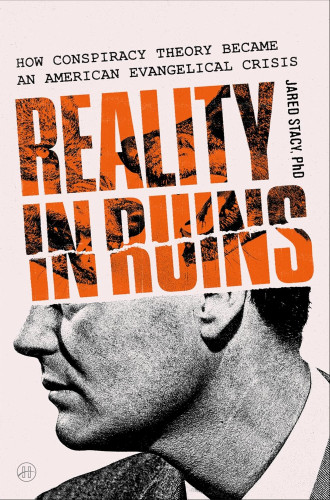
Reality in Ruins
How Conspiracy Theory Became an American Evangelical Crisis
A question often raised in the dawning months of 2026 is how and why we can watch the same event and yet come away with radically different—often antithetical—conclusions. This winter, we watched video evidence of Renee Good and Alex Pretti’s fatal encounters with ICE. Since 2023, we have seen the destruction of Gaza. Five years ago we watched insurrectionists storm the US Capitol. Since the first cameras were installed on cellphones, we’ve been able to see the police brutality inflicted on Black folk. Yet we remain polarized in our interpretation of these events and the conclusions we ought to draw from them. More specifically, Christians seem to be irreparably at odds with one another as to what a faithful understanding of and response to these events should be. How is this so?
In Reality in Ruins, theologian Jared Stacy argues that conspiracy theory and evangelical Christianity in America run together. This evangelical buy-in didn’t begin in the past decade; it is a pattern going back more than 200 years. This is why Stacy argues that evangelicals have inherited a disoriented Christianity. Not only is the evangelical tradition prone to embracing conspiracy theories, but it also actively peddles them for power and profit.

Read our latest issue or browse back issues.
In making this argument, Stacy’s focus is more specific than conspiracism writ large. His task engages a specific manifestation of conspiracism found in Christian communities, churches, and institutions. Crucial to this focus is the role of stories—both the ones told about America and the ones evangelicals tell about themselves. In this way, conspiracism is not merely about truth propositions but involves a greater encompassing narrative that provides the proper conditions for the conspiracy to be regarded as truth. Conspiracism is, for example, not simply the belief that the 1969 Apollo 11 moonlanding didn’t happen; it’s a story about cold war tensions, NASA’s development, and the American government’s willingness to deceive its own people.
Drawing together history, theology, ethics, cultural commentary, and personal reflection, Reality in Ruins follows a three-part structure. The opening chapters name the current state of evangelical conspiracism by introducing new language with terms like disreality and holy paranoia and totality (a turn on “reality”), which become the foundation for Stacy’s argument.
Disreality, Stacy explains, is something experienced viscerally. It is the “the collision of competing realities” that confronts us at every turn. It is not satisfied with mere division. Its task is to “wrench apart our shared reality” into ruins. Disreality is accompanied by a “renaissance of paranoia”—more specifically, a holy paranoia: the means through which disreality accomplishes its task specifically in Christian contexts by creating a Jesus “at odds with himself.” Holy paranoia offers a Jesus “so committed to American might that America's enemies are his enemies.” Last, both disreality and holy paranoia bolster a totality: a claim that this specific Christian imagination is the single, true reality, simply the way things are.
The second part of the book offers a historical survey of conspiracism—of holy paranoia’s prevalance—in the evangelical tradition that extends back to the first Puritans who settled on the East Coast. From these early roots, Stacy’s historical account follows through the American South and White anxiety, the Reconstruction era and the emergence of revivalists like D. L. Moody, the threat of high criticism and modernism present in events like the 1929 Scopes Monkey Trial, and the formation of evangelical apocalypticism, which would come to define cold war Christianity and popular fiction like the Left Behind series. These historical vignettes support a larger point that conspiracy theories “emerge from the anxieties and identities that are latent in the American experiment”—concerns about maintaining the institution of slavery, hostility toward the other, and fear of communist infiltration. In telling these histories, Stacy emphasizes that we cannot overlook the specific ways that evangelicals receive these shared anxieties within a specific context and existing narrative about America and couple them with language of apocalypse, individualism, morality, and freedom.
The remaining chapters offer a constructive argument for the recovery of “good suspicion.” Having laid out a scholarly and accessible explanation for how evangelical conspiracism works, this third section emphasizes Stacy’s experience as a pastor and Christian who has journeyed through these communities. As he acknowledges early in the book, evangelicals are often spoken of as an object (“they”), but for Stacy, evangelicals were once a “we.” Stacy’s own story is intertwined with this movement, and he offers an impassioned and compelling invitation to a better story.
In this pastoral turn, Stacy keys in on the importance of words and language. The way out of disreality, he argues, certainly includes fact-checking, but more importantly it involves “a renewed attention to the power and weight of words.” The “good suspicion” Stacy advocates for is a confidence, courage, and conviction to get behind what is presented at face value and practice the work of both learning and unlearning. It asks questions like, Why do I want this to be true? (or, Why do I need this to be false?), What would I need to unlearn if this isn’t true? and, Who do I need to encounter? These practices of “dissident discipleship” throw sand in the machine of American conspiracism and constitute a way of being that pursues God’s reality—which is to say, reality—over totality by telling a better story, a story of renewal.
Throughout the book, Stacy’s emphasis on the integral role storytelling plays in conspiracism is illuminating and holds incredible explanatory power. While he is not the first to make this point, his ability to connect this thesis to American evangelicalism is wonderfully insightful. As Stacy writes, evangelical totality cultivated through holy paranoia provides an enclosed narrative—an experience of “unity and certainty afforded by a single, shared perspective.” When this perspective is baptized as “biblical” and your people are “right,” then you can never be wrong. Stacy’s concise way of naming these phenomena provides language to describe what so many feel yet struggle to articulate. That in itself is a great gift of this book.
Further, in a cultural moment when such logics are often quickly dismissed, Stacy refuses to demonize or trash his conspiracy theory–believing friends and neighbors. Instead, he argues that we must realize how, “at the heart of it, we are dealing not just with different fact claims, but also different stories. That makes all the difference.” In return, Stacy’s constructive project does not treat his neighbor as someone to fix or conspiracism as a disease that demands clinical intervention. Instead, he calls his reader to recognize how conspiracy theorists have embraced an “act of storytelling that attempts to express the inexpressible, to channel fear into certainty, to narrate the complex by rendering it simple.” How do we push against such forces? We need to offer a better story.
Stacy has done what few books do well: provide substantive, meaningful, and accessible language to describe the world around us. Since finishing Reality in Ruins, I’ve noticed that Stacy’s language and imagery have stuck with me. In my own thinking about the current state of our country, it has become a useful shorthand to name a deeply rooted crisis of faith in a Christianity that attempts to fuse the story of Christianity with American greatness. I’m starting to hear the deeper stories that must be true for conspiracism to flourish. I would not be surprised if, in the months and years to come, Stacy’s terms become commonplace in how we talk about American evangelicalism, conspiracism, and Christian nationalism.