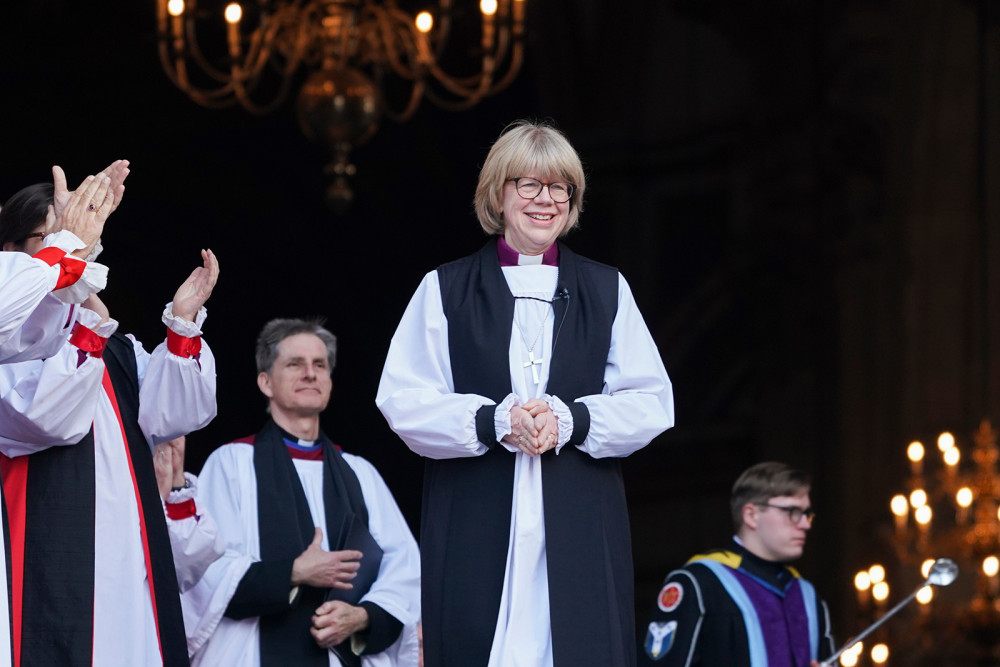
When Sarah Mullally is installed as the 106th archbishop of Canterbury on Wednesday, it is her gender that will likely be the most remarked upon part of her ascent to “first among equals” among Anglican bishops.
However, Mullally’s sometimes twisting journey to Canterbury may never have been completed if it hadn’t been for an Anglican organization called Leading Women. Little known but highly influential in British women’s incremental rise in church leadership, the group mentored women who had the potential to be bishops.
After the first women were ordained priests in 1994, the Church of England’s general synod agreed in 2006 that women should join the episcopate: This decision was ratified two years later. But there was a feeling among women clergy that leadership roles would remain out of reach unless they prepared for the responsibilities that entailed, from pastoral relationships with the laity and the clergy to managing historic buildings to coping with budgets.

June Osborne, then dean of Salisbury; Lucy Winkett, precentor at St. Paul’s Cathedral; Keith Lamdin, principal of Sarum College, Salisbury; and Jane Shaw, dean of divinity at New College, Oxford, launched Leading Women as a yearlong mentoring program in 2010. Besides the practical questions, there were conversations about ambition conflict and Christ-like leadership, as well as advice from women already serving as bishops in the United States and elsewhere in the Anglican Communion.
The founders recognized that in addition to developing women’s confidence, the program needed to help them deal with the prevalent attitudes of men in the church at the time.
Christina Rees, who had been involved in campaigning for women’s ministry in the Church of England for many years, recalled that: “What people don’t understand is the impact of hundreds of years of patriarchy and male entitlement and micro-aggressions. They can make women feel that there is something wrong with them, contributing to imposter syndrome.”
Shaw, now a professor of the history of religion at Oxford University, recalled, “We wanted to help women develop skills, so we had sessions on leadership, including the theology of leadership, but also dealing with money and managing change. We also wanted women to understand what their gifts were, and what transferable skills they might have from previous work experience.”
Somebody who undoubtedly had transferable skills was Mullally, who joined Leading Women’s second cohort in 2012. By then, she was one of a team in Sutton, in London’s outer suburbs, leading three parishes.
Two months after the Leading Women course, a vacancy arose for a canon treasurer at Salisbury Cathedral. Osborne encouraged Mullally to apply. It was her first step into church leadership, followed shortly by her appointment as bishop of Crediton in 2015, which led to the highly prestigious see of London.
Shaw said that mentoring women went beyond teaching leadership skills. Many needed help understanding what their roles might be.
“It was also a question of vocation, about discernment of their vocation, and giving them the space to do that.”
All this work was going on as many in the church opposed their vocations. Many still do not recognize women bishops or even women priests. “Flying bishops” are still supplied to parishes to ordain priests when the congregation does not want a woman to do so.
Upon Mullally’s appointment as archbishop of Canterbury, the conservative Global Anglican Future Conference, known as GAFCON, said in a statement: “Though there are some who will welcome the decision to appoint Bishop Mullally as the first female archbishop of Canterbury, the majority of the Anglican Communion still believes that the Bible requires a male-only episcopacy. Therefore, her appointment will make it impossible for the archbishop of Canterbury to serve as a focus of unity within the Communion.”
Mullally has acknowledged more than once how hard it is to be a woman leader. In February 2025, she addressed the general synod of the Church of England about appointments to senior roles, saying, “I would love to trust people to do the right thing, but the truth is that women continue to be underrepresented,” adding, “I would love to encourage women, which I do all the time, but there continues to be institutional barriers, we continue to experience micro-aggressions,” before breaking down in tears.
After retaining her composure, she was given a standing ovation, mostly from women. Eight months later, in October 2025, she was appointed to the top job at Canterbury.
The BBC plans to broadcast the installation service live and in full on Wednesday.—Religion News Service