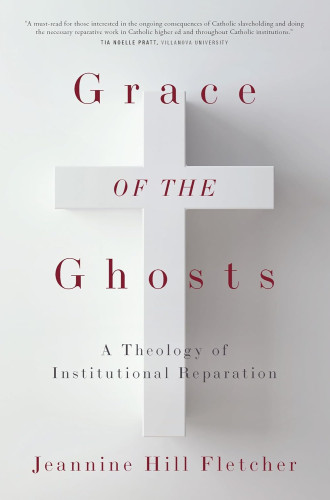
Grace of The Ghosts
A Theology of Institutional Reparation
Jeannine Hill Fletcher’s Grace of The Ghosts is an unflinching, multifaceted, and engrossing work that can be read as a Catholic sequel to her 2017 survey, The Sin of White Supremacy: Christianity, Racism, and Religious Diversity in America. There she explored how “Whiteness and Christianness have been twin pillars of the dominant religio-racial project” of settling and administering American society.
Here the professor of theology at Fordham University uses the metaphor of the ghost to consider the grim history of the Catholic Church in America. An enthusiastic partner in the project of nation-building, the church amassed its institutional wealth and prestige by rendering invisible the crassly ideological and material foundations on which it arose: the dehumanization and exploitation of African, Indigenous, Hispanic, and Asian peoples. These are the book’s eponymous ghosts, whose uncredited grace undergirds the prosperity and power of the contemporary church.
Read our latest issue or browse back issues.
As the largest corporate slaveholder in America, the Catholic Church derived its generative wealth from the desecration and sale of African bodies; its role in the abolitionist cause was nil. Roger B. Taney, the Catholic chief justice of the antebellum US Supreme Court, was an avatar of Catholicism’s embedded White supremacy. As author of the infamous Dred Scott v. Sandford opinion (1857), the Maryland-born jurist marshalled the high court’s imprimatur to exile all people of African descent, whether slave or free, from the nation’s polity, declaring them stateless and possessing “no rights which the white man was bound to respect.” Taney denied the very humanity of bonded Africans by reducing them to mere “articles of merchandise.” He further distinguished Africans from America’s Indigenous people, who he classed in an amorphous category of “pupilage” from which they have yet to be fully liberated. Taney’s opinion greenlit the seizure and despoiling of Indigenous children and their culture in Catholic-run schools of “civilization.”

As White settlers moved west, the Catholic church bolstered the chauvinistic project of othering Mexican, Filipino, and Chinese people while bringing them under its Eurocentric authority. For example, the first bishop of Los Angeles replaced the practices of Hispanic Catholics—which he found objectionable—with the ritual and discipline of the American church.
Hill Fletcher’s aims are several. Acknowledging the continuing reverberations of America’s traumatic history, she constructs a confessional narrative inspired by Maria Yellow Horse Brave Heart’s theology of reparation. Accordingly, Hill Fletcher grounds her work in rigorous archival excavation to catalog across time and space the cruelty and violence waged as the Catholic hierarchy encountered and subsumed non-White people during the long march of Manifest Destiny.
In bringing to light the suppressed history of Catholicism’s ecclesial brutality, Hill Fletcher succeeds brilliantly; her anguish as a devout Catholic is palpable. Without qualification, she frankly characterizes Catholic schools, churches, and universities as “storehouses for the illicit benefits of the sins of White supremacy” while asking how the church can make meaningful restitution after its centuries-long promulgation of a “system of evil” under the aegis of God’s will.
Hill Fletcher views archival excavation as an imperative first step toward the writing of a new Catholic history that foregrounds the many subject peoples whose land, labor, and lives were effectively stolen in the name of Christ and who bequeathed to the church its material “inheritance of injustice.”
Despite the archive’s fragmentary nature, Hill Fletcher demonstrates that reclamation of Catholicism’s ancestral ghosts—a multitude of “absent-presences”—is possible. Through their inclusion in a vastly larger narrative, the history of American Catholicism can be more readily understood as one of agonistic struggle that begs still for redress. Through confronting the many failings of the church, Hill Fletcher writes, “we break open the space to become transformative locations in the future.”
This is sacred and penitent labor. Accordingly, Hill Fletcher calls on White Catholics to investigate the origins of their respective congregations and educational institutions “to see the ghosts that reside within.” By rescuing the stories of Catholics of color from the oblivion of archival erasure, White Catholics can ritually affirm these ecclesial siblings as beloved communicants in their rich if injured multicultural faith. Subsequently, a coherent course of repair can be devised.
To that end, Grace of the Ghosts includes a thoughtful, in-depth guide by which White Catholics can uncover their respective oppressive histories and craft a tailored response. It is through such interrogation and reflection that an enlightened church of “otherwise possibilities” might emerge.
Hill Fletcher closes her narrative with a poignant recounting of how Filipino and Mexican American farm workers in Delano, California, launched the nationwide table grape strike in 1965, which birthed the United Farm Workers Union. In their fraught fight for dignity, agricultural workers infused their struggle with what Hill Fletcher calls “the symbolic and spiritual capital” of their shared Catholicism, transforming their secular demand for humane working conditions and a living wage into a Christ-centered quest for justice.
Under the banner of the dark-skinned Virgin of Guadalupe, farm workers organized the famous Lenten march of 1966 as a pilgrimage replete with Stations of the Cross. This arduous 250-mile trek from Delano to the capitol in Sacramento served not only to highlight their oppression, but also as a mass contemplative practice by which contrite workers confronted the ill will they harbored toward the callousness of their local clergy and landowner-employers, many of whom were Catholic. The strike galvanized Catholics across America, including US Senator Robert F. Kennedy, Dorothy Day, and progressive clergy and laypeople, flowering into a nationwide, multi-religious crusade that earned the endorsement of Martin Luther King Jr.
Concluding, Hill Fletcher invites Catholics to see in the UFW struggle “the otherwise possibility of a truly multiracial and multireligious Catholic tradition willing to stand against the principalities and powers of White supremacy.” As our nation descends into revanchism and authoritarian chaos, its survival depends on all Christians of conscience answering this call.