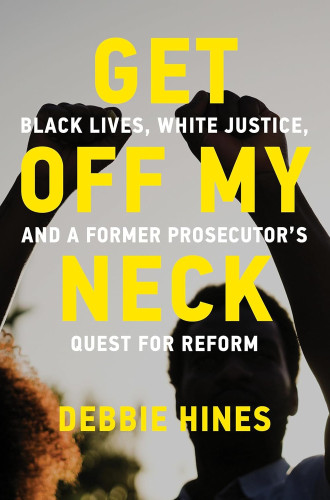
Get Off My Neck
Black Lives, White Justice, and a Former Prosecutor’s Quest for Reform
According to a 2018 projection by the Sentencing Project, a criminal justice reform advocacy organization, one out of every three Black boys born in 2001 will be imprisoned at some point during his lifetime, compared to one out of every 17 White boys. Debbie Hines lays out this startling and dispiriting fact at the outset of Get Off My Neck.
The reality of that vast disparity in criminal justice outcomes stands in stark contrast to the vision of an American dream that provides equal opportunity to all. Resolving this disparity, according to Hines, requires focused reform at the state and local levels because state and local prosecutors’ offices are responsible for tens of millions of criminal cases annually, compared to about 80,000 at the federal level.

Read our latest issue or browse back issues.
It’s a persuasive thesis, and Hines’s book is at its strongest when it’s tying together the compounding effect that systemic racism has at each stage of the criminal justice process—from policing to prosecution to bail to plea or trial practices to sentencing and probation—and how each of these result in disparate real-world consequences to Black people and their families. In the first half of the book, Hines lays out each step of the process, including a chapter on how the criminal justice system disproportionately affects Black youth. Hines gives the statistics and policy analysis life by using examples from her career as a prosecutor in Baltimore and, later, as a criminal defense attorney. Her on-the-ground experiences provide some personal and poignant examples of the system at work, including the daily challenges faced by individuals, however well-meaning, who work within that system.
At times, however, Hines overstates her case, and a stronger editorial hand would have helped to tighten her argument. For example, Hines claims that “at no point does anybody in the justice system consider the impact of these proceedings on Black lives,” a sweeping generalization undermined in her own book by her discussion of how progressive prosecutors are beginning to do just that. More concerningly, Hines states that “the illness of racism” is “encoded in the DNA of the United States” and is “pass[ed] down from one generation to the next.” This comes awfully close to language used in a more literal sense by eugenicists and other debunked theories of scientific racism. By using a genetic metaphor to explain the country’s racism—rather than identifying it, say, as a “social contract” (following Charles Mills) or as “original sin” (to use the metaphor that Jim Wallis popularized in 2016)—Hines undermines her own argument that the country’s systems are redeemable.
Indeed, notwithstanding this metaphor, Hines shows what redemption looks like. She devotes nearly half of her book to solutions: both specific policy proposals and overarching approaches to advocacy, including the role and responsibility of White allies and the importance of developing alliances. Hines’s chapter on the responsibility of White allies to maintain both persistence in committing to the long haul and an openness to receiving criticism as an opportunity to grow is a fruitful message that extends well beyond the criminal justice system. In particular, she highlights the need for White allies to advocate for antiracist policies with other White people, using the recall of progressive prosecutor Chesa Boudin in San Francisco as a cautionary tale for what happens when White allies “fail to engage other white people in the cause of prosecutorial reforms.”
Central to Hines’s message is that reform requires commitment. That’s hard work at any time, but especially now. Hines’s book is very much rooted in community: neighborhoods, advocacy groups, cities, and legislatures—that is, broadly speaking, the “public square.” But a central challenge of our time is to sustain our attention amid the distractions of our hyper-present algorithmic online world. I would have liked to see Hines address the unique challenges of sustaining reform in such a destabilized and constantly evolving atmosphere.
Finally, while Hines’s book focuses on the role of states and localities, she does show the role of federal oversight to rein in violations of constitutional rights. One of the early examples in Hines’s book was the investigation and report by the Obama administration’s Department of Justice into the pervasive civil rights abuses of Baltimore police and prosecutors. The publication of Hines’s book in 2024 predated Donald Trump’s return to the White House, making it understandable that the first Trump administration merited little substantive discussion in the book.
But the book’s paperback release in September 2025 without any new material was a missed opportunity for Hines to address the second Trump administration, both on specific policy changes and on broader challenges to advocacy. In May 2025, the Department of Justice Civil Rights Division closed its investigations into several police departments and retracted the division’s earlier findings (issued during the Biden administration) that police departments in Phoenix, Oklahoma City, Memphis, and Trenton, among others, systematically violated residents’ constitutional rights. More broadly, it was a missed opportunity for Hines to underscore the importance of sustaining reform even during dark times.