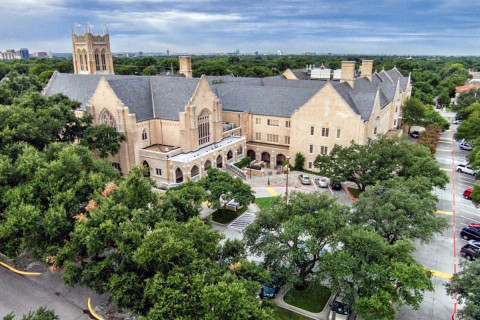

On January 18, protesters burst into Cities Church in St. Paul, Minnesota, in the middle of the Sunday service. The scene was chaotic, with protesters and church members screaming at each other over the pews. The service was shut down, and the congregants went home without finishing it. Cities Church was protested because one of the pastors, David Easterwood, appears to be an ICE field director. (I say “appears to be” because despite Easterwood speaking at a press conference under that title in October, DHS has not confirmed his position and has framed any claim that he’s a member of ICE as “doxxing”—the latest in the agency’s growing culture of secrecy.) Just days before, ICE agent Jonathan Ross shot and killed Renee Good, a deadly escalation in the brutal occupation of Minnesota, and the protesters chanted her name in the sanctuary.
The videos of the protest are disturbing. It’s distressing to watch a church service descend into neighbors screaming at each other. It is distressing, too, that a church could be led by someone who also leads ICE patrols.
ICE has always been an instrument of racist state violence, but it is nearly impossible to exaggerate how much more dangerous it has become over the last year. Trump’s failure to seize control of the state after his 2020 election loss was due in large part to his not having the military’s leadership on his side. But since taking office last January, Trump has turned ICE into his own private army. ICE’s new annual budget of $37.5 billion is greater than every other federal law enforcement agency put together. If ICE were its own military, it would be the 15th best-funded in the world. Over the remainder of Trump’s term, $45 billion is budgeted for new detention facilities, giving ICE almost as much detention capacity as the entire federal prison system. Over 12,000 new agents were hired over the last year, drawn in by DHS’s white nationalist memes and a $50,000 signing bonus.

Read our latest issue or browse back issues.
ICE agents wear masks as they beat and abduct people off the street; their identities are kept secret; the Vice President declared in the wake of Good’s killing that they have “absolute immunity”; and they appear to have stopped providing medical care to their detainees, resulting in at least six deaths so far this month. ICE has transformed into a massive paramilitary force that is personally loyal to Trump, fueled by fantasies of racially cleansing the homeland through violence against immigrants and their allies, and authorized to brutalize and even to kill with impunity. That a pastor of a church can also be a secret leader (however poorly kept that secret) in such an organization is a sign of a profound crisis in American Christianity, one that we must confront rather than avoid.
Confronting the crisis in American Christianity means sitting with the unsettling thought that the gospel might be heard in a church not from the pastor standing in the pulpit and preaching from the Bible, not in the regular administration of word and sacrament, but instead in the shouting of an angry crowd bringing a church service to a screeching halt. Faithful Christian practice, in other words, might be found in what looks like its exact opposite—in the rejection and even active disruption of Christian practice.
The idea that Christianity might end up in such a crisis that one can be faithful to it only by rejecting it was explored in painful depth by Dietrich Bonhoeffer. I’ve returned to Bonhoeffer again and again over this last year. Not because we are living through “the same thing” that he lived through, and not because he was particularly clear-sighted, but because he, more than any other theologian, was honest about how cloudy his sight was. He’s a theologian for moments like this, when the fog descends and we cannot see our way forward, when seemingly simple questions of right and wrong dissolve into paradox.
Near the end of his life, Bonhoeffer contrasted what he called “pious godlessness” and “promising godlessness.” Pious godlessness comes “dressed in religious-Christian finery.” It appears to stand up for Christianity against its detractors, but it does so by evacuating Christianity of Christ’s message: Change your ways, for the kingdom of God is at hand.
Promising godlessness, on the other hand, appears at first as an attack on Christianity. It “expresses itself in antireligious and antichurch terms,” Bonhoeffer wrote. But this opposition to religion and the church “is the protest against pious godlessness insofar as that has spoiled the churches.” By opposing a Christianity that has itself become godless, promising godlessness “preserves in a sure though negative way the heritage of a genuine faith in God and of a genuine church.” Quoting Martin Luther, Bonhoeffer wrote that sometimes “God would rather hear the curses of the godless than the hallelujahs of the pious.”
Notably, for Bonhoeffer, those were the two options. Godliness was off the table. He felt himself in a situation in which Christianity as it existed had utterly discredited itself by its complicity with genocide and idolatrous nationalism. One could paradoxically only remain faithful to Christ in the “sure though negative way” of turning away from Christianity. This was a paradox he wrestled with throughout the last decade of his life, that perhaps one could only remain faithful to a tradition by betraying it.
Christianity in America has perhaps not yet sunk so low, but it is sinking quickly. Our churches are being spoiled by racism and nationalism dressed up in Christian finery. White Christian nationalism is an ugly and servile pattern of thought that is utterly antithetical to the gospel. It takes Christ’s message and inverts it—stay in your ways, for the kingdoms of the world are at hand. The heritage of a genuine church is preserved wherever this anti-gospel message is rejected, even if that rejection takes an antireligious and antichurch form. Strange as it might seem, the disruption of a church service and the silencing of a pastor preaching the gospel might be the only way left for us to hear the gospel.
We can lament the fissures dividing our country, but the fact is, they already run through our churches. Our task is to make those fissures visible—to widen them even—so that the demand to change our ways might be heard.
It’s time for a church struggle of our own.
This article was edited February 3 to correct numbers related to ICE’s budget.