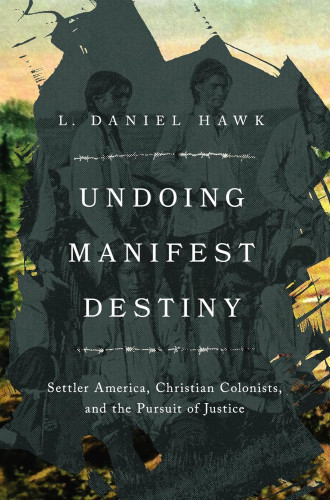
Undoing Manifest Destiny
Settler America, Christian Colonists, and the Pursuit of Justice
Last October, the Trump administration sought to reclaim and revitalize Columbus Day by situating Christopher Columbus as a virtuous man of faith rather than a person whose legacy is tied to programmatic mass genocide in the West. This effort reimagined settler violence as good and holy through the promotion of a falsified memory. In his new book, biblical scholar Daniel Hawk encourages readers to unmask the structures that uphold such settler narratives and to seek ways to engage in decolonial efforts at the local level. Undoing Manifest Destiny is a compelling and accessible model for Christians who seek to work toward decolonizing the settler mindsets they’ve inherited.
This work for Hawk is not detached or nebulous. Each chapter begins with an examination of the history of Ohio. In this way, Hawk creates a dialogue between the localized history of his area and the larger narrative of North American coloniality—and emphasizes the importance of interrogating one’s own community of origin. Hawk uses Ohio history as an inroad to engage mythologies of “the savages in the west,” the use of Indian caricatures as sports franchise mascots, and Christian participation in the programmatic dehumanization and forced assimilation of an entire people. Ohio, as Hawk explains, is not unique; it is merely a snapshot of the banality of settler participation and complicity that can be found in the communities of nearly any reader.
Hawk’s keen awareness of his social location and his audience informs his historical reconstruction and keeps his intentions clear. He is writing to and for “settlers,” which for him acts as a “shorthand for White Christian settlers, that is, for European colonists and their descendants”—
a group to which he belongs. Hawk’s work tasks readers to interrogate the narratives they have grown up with, the stories they tell themselves, and the memories their communities have collectively chosen. He appeals to what he describes as an “obligation to dismantle the sinful structure that our Christian forebears established and that persists to the present day.” Toward this end, he marches through histories that have often gone untold or have been actively suppressed. Each chapter concludes with thoughtful discussion prompts, making this an excellent text for the church or classroom.