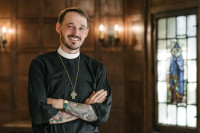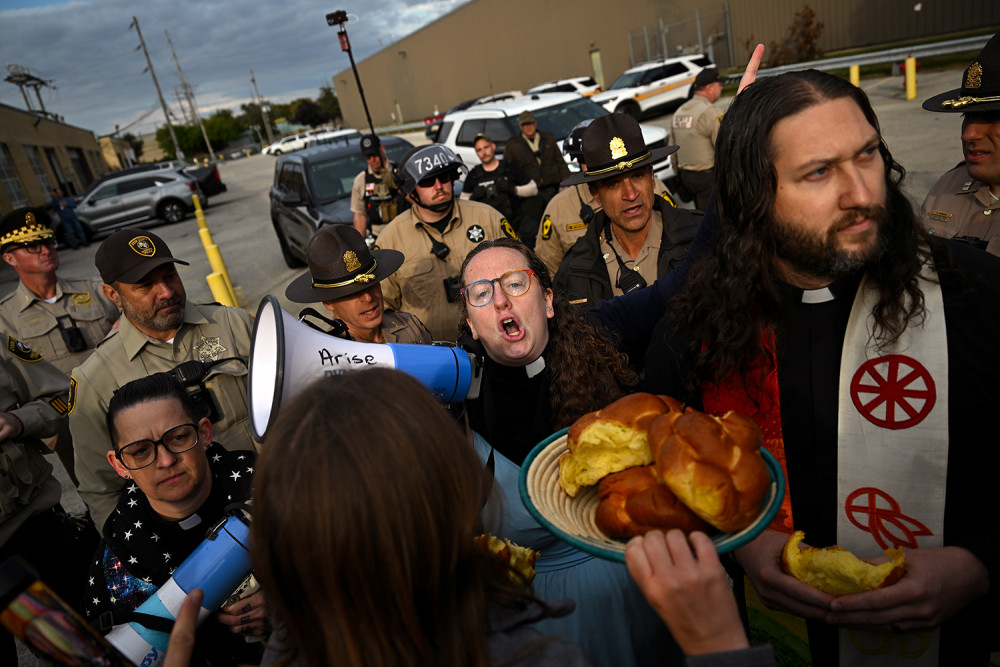
When I went down to the Immigration and Customs Enforcement processing center in Broadview, Illinois, to protest the actions of federal agents in Chicago, I did not expect a warm welcome. But nor did I expect to be assaulted by ICE agents, who grabbed my neck and left bruises all over my body after pushing me with truncheons. One zealous officer even grabbed my chest and twisted hard. I was wearing my clerical collar, and another agent said something that has stuck with me ever since: “Jesus said to follow the law.”
In the middle of a conflict like the one our country finds itself in, it is rare to encounter such a robust theological touchstone. Here was a profound statement about the role of Christians in the world. Christians ought to follow the law—even if that law results in dehumanization, even if it goes against God’s laws of mercy, love, and truth. In an age of rising Christian nationalism, this federal officer made a strong statement about whether God or country ought to come first.

Read our latest issue or browse back issues.
First-century people had similar questions and difficulties when it came to parsing the dividing lines of their loyalties. That’s how I read the exchange in Matthew 22:15–22. It begins with someone asking Jesus a very practical question: “Is it lawful to pay taxes to Caesar or not?” For people living under imperial occupation and with a history of tax resistance, this was a pressing consideration. Jesus offers the answer, “Give therefore to Caesar the things that are Caesar’s and to God the things that are God’s.”
In every sermon I’ve ever heard on this text, Jesus’ response has been treated as a sort of demarcation between worldly and spiritual authority. Even in the early church, this was the prevailing understanding. Take, for instance, Tertullian’s interpretation:
The image of Caesar, which is on the coin, to Caesar, and the image of God, which is on man, to God; so as to render to Caesar indeed money, to God yourself. Otherwise, what will be God’s, if all things are Caesar’s?
Tertullian’s final question seems most striking here. We live in a time when the state is asking an awful lot of us, from acquiescence to norm-breaking to the establishment of a secret police force that does not have to reveal faces or badge numbers. Even making fun of the president seems to be off limits. The question that must be asked is Tertullian’s: What becomes of us if we offer everything to Caesar?
I’ve always seen Jesus’ answer less as instruction and more as an invitation to a question. Just what is God’s, and what is Caesar’s? This is perhaps the most important framework that scripture has given us to reckon with our present times. Every Christian must take up and ponder this question, especially in a time when Caesar is demanding more and more and our prevailing political landscape is tilting toward authoritarianism and dehumanization.
In my youth group’s morning Bible study, the entire group of 12- to 15-year-old boys told me they are being served ICE recruitment ads by YouTube. These ads promise rich rewards—a $50,000 sign-up bonus chief amongst them. They also often contain Bible verses, including this one from Isaiah: “Here am I; send me” (6:8). This is perhaps the most pernicious example I have ever seen of the mingling of state, God, and money. ICE recruitment videos sell a reality in which you can serve all three at the same time. In fact, they conflate the three: to be an ICE agent is to serve a monstrous amalgam of the greatest powers in our lives. Jesus had something to say about that as well: “You can only serve one master” (Matt. 6:24).
Christians have reckoned for millennia with the question of when the state can command our obedience. Paul says to “submit to the authorities” (Rom. 13:1), but this submission did not include abiding by laws that he found immoral. Time and again, we find Paul and first-century Christians in prison for preaching the gospel. I’m a Baptist, and my tradition has taken that example to heart. By the start of the American Revolution, half of all Baptist preachers had spent time in jail for preaching without a license.
While plenty of Christians have argued that we are not bound by laws that restrict the practice of our religion, resisting lawful authority in other matters has been more complex. Martin Luther King Jr. famously had to deal with White moderate critics who argued that his tactics were misguided. In his “Letter from Birmingham Jail,” King offers a prescient statement:
There are two types of laws: There are just laws and there are unjust laws. I would be the first to advocate obeying just laws. One has not only a legal but a moral responsibility to obey just laws. Conversely, one has a moral responsibility to disobey unjust laws.
We find ourselves in a time of unjust laws. The dehumanizing tactics I saw used against protesters at Broadview mirror the disregard for human life and for God’s image that ICE has enacted as part of its plan to terrorize communities. As I write this, at least 22 people have been killed in ICE custody this year; more will surely die before it is published.
The Trump administration has branded protesters as rioters even as it has insisted that its campaign of terror is aimed only at violent criminals. This, of course, is untrue. The protesters I’ve seen have been peaceful, but that hasn’t protected them from violence at the hands of the federal government. This administration has deported countless individuals with no criminal background whatsoever.
It’s worth remembering that Jesus’ death was imposed by the Roman government, using a cross—the empire’s typical punishment for sedition and criminality. The gospels indicate that he was crucified alongside two criminals. Would we say that the Roman Empire’s judgment is correct today? Surely not. Christians have developed a theological imagination that can see beyond the labels the state uses, the kinds of labels often used against undocumented immigrants and protesters.
It’s important for church leaders to not only speak out about this but also put our bodies between ICE and the people they seek to harm. If we don’t, we risk becoming what King called an “irrelevant social club.” That said, not everyone has the privilege or the desire to physically stop ICE vans filled with people slated for detention. Some Christians are especially vulnerable right now, and others won’t feel that such direct action is for them. But there is something for everyone to do at this moment.
One of the most poignant forms of resistance I’ve witnessed came on a Saturday evening at Broadview, when Catholic clergy assembled and asked to be allowed to offer communion to those imprisoned there. They were callously turned away, in violation of laws that guarantee the incarcerated access to spiritual care. God’s body was turned away from Broadview by federal agents, but God’s presence was there in the form of clergy and laypeople who demanded recognition of the fundamental humanity of those held there.
If there is anything that I am sure Christ would condemn, it is the reduction of the church to a quiet, acquiescing presence that does not speak out strongly to condemn such actions. “Jesus said to follow the law,” but when the law is unjust, Christians must resist. Otherwise, the church will fail the test of our times.