When I was in elementary school, I loved to sing in our little choir. I remember trying my best to sing out, to listen for my part, to remember which round our little group was supposed to come in on. I was not very good, although my mother said I had a beautiful voice.
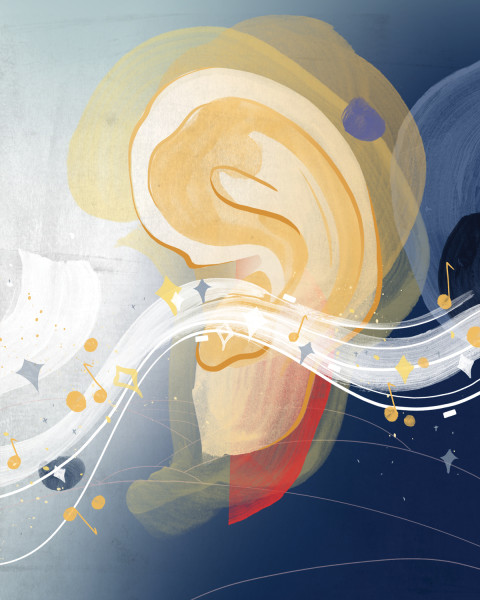
When I was eight, I had my first ear surgery to remove a cyst. By the time I was nine it had grown back, so the bones that reverberated sound were removed—and I was left mostly deaf in my left ear. I remember closing my right ear with my hand and listening to the world through my hammerless ear, processing the strange feeling that everything sounded so far away, like I was listening to the world underwater. To this day if you ask me where the blare of an ambulance siren is coming from I will spin and spin and still point in the opposite way.
Read our latest issue or browse back issues.
All this meant my choir career was cut tragically short. I tried my best. But with only one ear I could never quite catch the note I was supposed to sing. I couldn’t quite hear my neighbors, and after a few awkward, out-of-tune sounds and my classmates looking strangely at me, I learned to mouth the words or whisper-sing.
I rarely sing these days, even in worship. I maybe hum or sing just enough to feel the tremble in my chest, but never loud enough to betray what I am not hearing.
As someone with partial hearing, I grew accustomed over time to both a greater sensitivity to certain sounds and, at the same time, a deep distrust of my own sense of where a sound is coming from. The upside was that if there was an annoying sound at night, like a barking dog or a crying child, I could simply roll over, sink my good ear into the pillow, and let the world go away.
To someone like me who can remember a time without the cycles of social media commentary or the daily, unrelenting, blatant deception and violence of those who have been elected to govern, today’s world feels a bit disorienting. It’s as if I am that nine-year-old boy stepping onto the risers and finding that the sounds are off—I can’t find myself or figure out where my voice fits in. As much as I would like to whisper-sing or simply not show up at all, I can’t leave the riser. But to stay and listen, to face the violence day after day, feels like a terrible choice between denial and constant rage.
We are entering Advent, a time marked by the discipline of waiting. I am sometimes tempted to see waiting as a seasonal exercise: waiting for a birth, for some relief, for an election that could, somehow, draw us out of this cycle of violence. But when I think of those childhood choir days, I am reminded that waiting is not always an exercise in delayed gratification or the culmination of hope and patience. Sometimes, waiting is silence and attentiveness.
I wait for the first verse. I come in on the chorus. Silence, counting, attending to the lyrics, the voices next to me, waiting for the moment when I add my voice. All this is a bit more complicated when your hearing is twisted, when you can’t quite hear your neighbors, when you can’t trust what you hear or translate it into what you should be voicing. So along with silence and counting comes doubt, a little uncertainty, maybe even the anticipation of embarrassment—of singing the wrong thing, of thinking you are in tune while the twisted faces of those around you let you know that you’re not.
I wonder if Advent waiting is something like this: an attentiveness to the people to our left and right, listening to the melody wash over us, anticipating our turn, again and again. Alone, our voice won’t dash evil upon rocks or bring down the walls, but here we are, on the chorus, and all we can do is offer our voice to the many until it’s time to be silent again. And perhaps we all have a little partial hearing, which doesn’t mean we don’t sing, but we do know we are going to need some help to get the note right. There are a lot of tones I can’t hear, but in most songs there are at least a few sections where I can match what I hear to what I sing, and I sing those with everything I have, maybe whisper a few notes, and then rest when it’s others’ turn to shout.
Maybe in this Advent season waiting isn’t hoping for the end of this terror but attending to the moment when God asks us to join our voice and our life—in all their limitations—to create a little beauty. The kingdom of God might be something like this song, this chorale, with some of us waiting and resting and then being ready when our part comes, pressing out with our whole selves. Together we begin to see the kingdom of God pressing against the evil in the world, creating a space where all of us, in all our imperfection and particularities, have a place.